New Democracy maintains a steady lead in the new Interview poll for politic.gr, published today, Monday (March 23, 2026). Meanwhile, small changes are observed in the lower percentages, while the “gray” landscape among undecided voters remains intense.
New Democracy appears strengthened in March compared to February (from 26.4% to 28.7%), according to the Interview poll, widening its lead over second-place PASOK, which also records an upward trend compared to the previous measurement (from 12% to 13.9%).
New Democracy’s strengthening could be linked to international instability, as the escalation in the Middle East appears to enhance rallying around the government and the choice of “security”. Similarly, PASOK’s rise seems to be attributed to the recent intra-party process, which functioned as a unifying factor for its base.
Voting intention in the Interview poll

Course of Freedom drops from third to fifth place with 4%. In third place is KKE (5.2%) and in fourth is Greek Solution (5%). SYRIZA is at 3.6%, MeRA25 at 3.5%, and Voice of Reason at 3.4%. The Democrats recorded at 2.4% and New Left at 1.3% remain outside parliamentary representation.
The percentages of undecided voters (17.4%) and those declaring another party (10.4%) are particularly significant, as they collectively exceed 27% of the electorate. Overall, more than one quarter of the electorate remains electorally fluid, keeping open the possibility of realignments.
Electoral result estimation

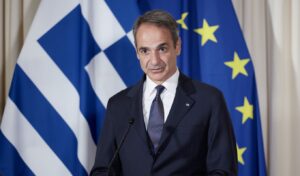
When asked which political leader citizens trust most for governing the country, Kyriakos Mitsotakis records a lead with 32.7%, maintaining a clear distance from other political leaders.
Kyriakos Mitsotakis gathers 32.7% on the question “which political leader do you trust most for governing the country”

Particularly significant is the fact that the answer “none” gathers 31.6%, a percentage almost equivalent to that of the prime minister, reflecting the intense skepticism of a large part of society. In second place among political leaders is Nikos Androulakis with 13.4%, while the others record clearly lower percentages.
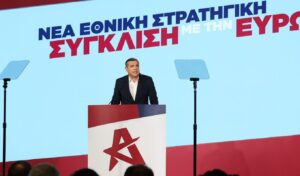
What citizens think about the emerging parties of Tsipras and Karystianou
The electorate appears hesitant toward potential political ventures by Alexis Tsipras and Maria Karystianou.

In Maria Karystianou’s case, the majority of citizens (75%) state they would not choose such a party, with positive intention percentages at 24%.
The picture is similar for Alexis Tsipras, as negative percentages prevail (75.6%), while positive intention stands at 24.1%.
65% have been affected by the war
The war appears to have now entered Greeks’ daily lives, as 65% declare they have been affected, versus 34% who answer negatively. Indeed, 75% state they have observed price increases in daily consumer products, such as food and supermarket items, versus 21% who answer negatively.
More than half (54%) declare they have limited their car trips, while 46% answer they have not changed their behavior.
Changes in citizens’ daily lives are reflected in specific sectors, with the greatest reduction recorded in car use (16.6%). This is followed by expenses related to heating (14.9%) and entertainment (12.8%).
Similar trends are recorded in electricity consumption (11.9%), as well as clothing and footwear purchases (11.8%), and travel (11.8%). Even food purchases (8%) are affected, highlighting the pressure households face even for basic needs.
In the same context, the majority of citizens appear to support market interventions, as 70% declare they agree with imposing price caps on food and fuel announced by the government, versus 21% who disagree.
“Defensive action” – Greece’s involvement in the war
Greeks’ stance is clear on the issue of intercepting Iranian missiles by the Greek Patriot system, with 78% considering it purely defensive action. Conversely, 22% believe this action involves the country in the war.
Meanwhile, 52% of citizens evaluate the government’s stance on the war issue positively (“positively” or “rather positively”), versus 44% who evaluate it negatively.
No clear majority emerges in citizens’ stance toward using small modular nuclear reactors (SMRs), as positive and negative responses both gather 43%. 14% declare themselves undecided.
It’s worth noting, however, that in previous measurements negative attitudes were higher, which may be related to the nature of these specific reactors, as they are smaller and theoretically more controlled units.