The Greek Navy is conducting an exercise using drones and unmanned systems and platforms. The exercise is already underway, with the first phase completed in harbor from March 9-13, followed by the at-sea phase from March 16-20. This marks the Greek Navy’s first coordinated effort to evaluate, under realistic operational conditions, unmanned systems developed by Greek companies, both in the air and at sea.
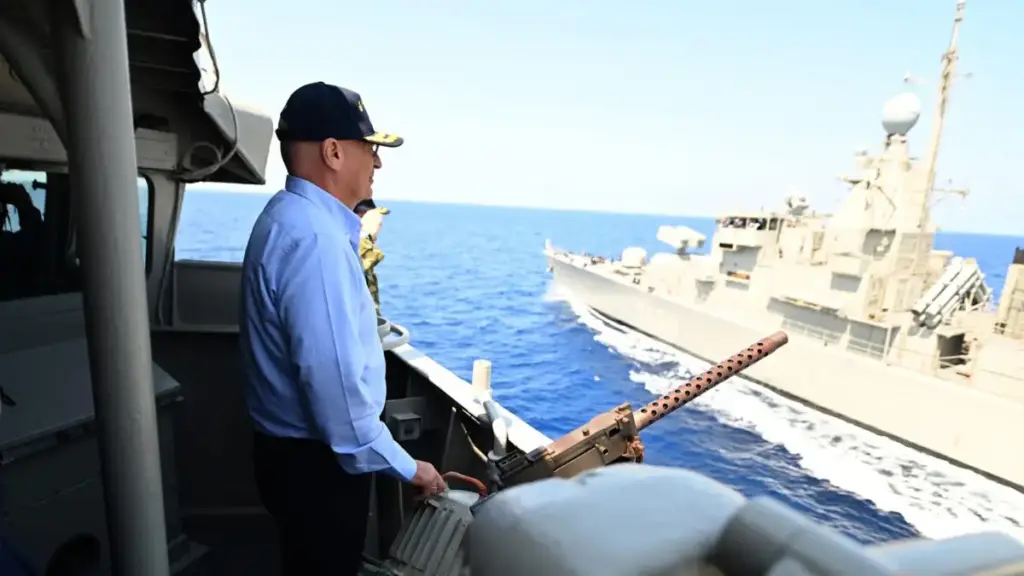
Defense Minister Nikos Dendias is expected to observe the exercise, codenamed “UVEX 1/26,” on Wednesday at 09:30 from the frigate “Elli” in the Gulf of Megara. Through this process, the Greek Navy aims to identify technological solutions that can be immediately integrated into its operational doctrine, while strengthening cooperation with the domestic defense industry in a rapidly evolving sector.
The exercise focuses primarily on maritime surveillance and control missions, as well as naval operation scenarios where drones play an increasingly decisive role. In this context, capabilities are being tested such as maritime surveillance and reconnaissance, with unmanned aircraft collecting imagery and data transmitted to ships and operations centers. Special emphasis is placed on detecting small or fast targets, as well as asymmetric threats that are difficult to detect with conventional means.
Greek Navy: The exercise and the new era of maritime drones
Simultaneously, a significant part of the exercise concerns network-centric operations, namely the connection of drones with ships, sensors and command systems, which constitutes a fundamental pillar of modern naval doctrine.
Special emphasis is placed on cooperation between aerial drones and unmanned surface vessels (USVs), which can undertake surveillance missions, electronic warfare, sensor transport as well as strike operations.
The development of maritime drones signals a new era for naval warfare, as USVs offer capabilities such as port facility protection, intelligence gathering and offensive action execution.
The experience from the war in Ukraine is indicative, where naval drones proved their effectiveness even against large warships, significantly influencing modern military concepts — including Greek planning.
For the Greek Navy, integrating unmanned systems is not simply a technological evolution, but an operational necessity. The unique environment of the Aegean Sea, with its large number of islands, limited maritime spaces and increased surveillance needs, makes drones a valuable tool.
With lower operating costs, continuous surveillance capability and flexibility in mass deployment, unmanned platforms are expected to play a decisive role in future operations.