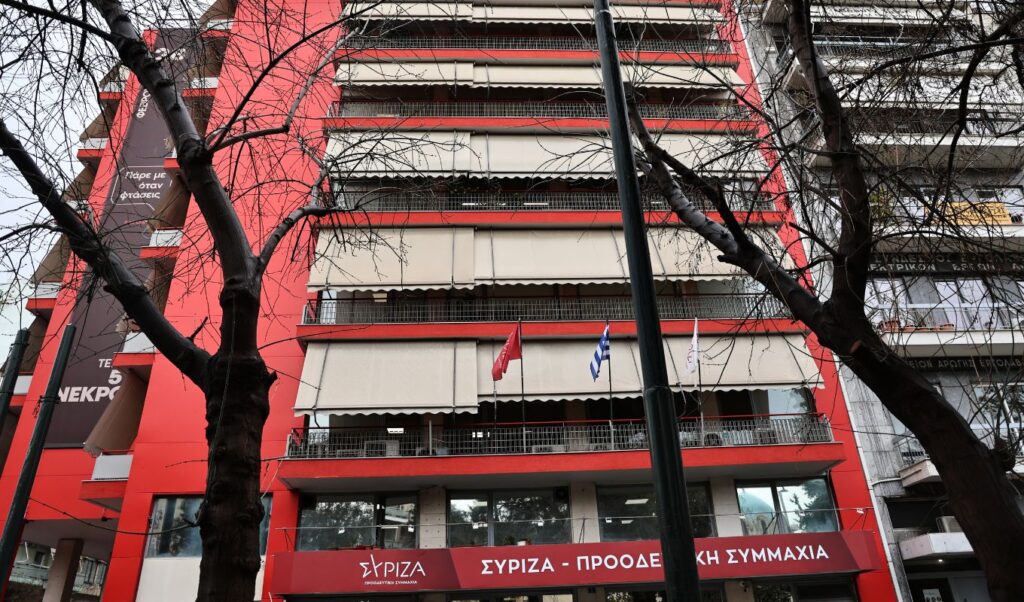
Two clear lines for their party’s approach to the upcoming elections are expected to clash this coming Saturday at the Central Committee meeting of SYRIZA among Koumoundourou officials.
One line, advocating for cooperation with other progressive parties, is expressed by Socrates Famellos and members of the presidential team, while the internal opposition, which includes Pavlos Polakis, Nikos Pappas, and Tryfonas Alexiadis, believes that after a reasonable two-month period waiting for reactions from other parties, SYRIZA should decide on an independent electoral campaign.
SYRIZA’s press spokesperson, Kostas Zachariadis, appeared twice in the last twenty-four hours to clarify the party’s line, saying that “SYRIZA-PS’s goal is not an independent campaign, but a large alliance in the progressive space, in order to achieve policy change.”
SYRIZA secretary Stergios Kalpakis also moved along the same line, taking things even further. “When we talk about unity of progressive forces, we’re talking about an equation with very specific factors,” the Koumoundourou official noted. “SYRIZA-PS, New Left, PASOK, and Alexis Tsipras. It doesn’t concern KKE, MeRA25, Course of Freedom, or generally forces with which there are strategic disagreements. From this equation, PASOK seems to be distancing itself, insisting on an independent course. Let’s see what they decide at their congress too; however, they’re making a historic mistake. Much more so when cooperation of progressive forces – in all polls – is the scenario that gathers the most chances to beat New Democracy. Therefore, the burden of responsibility for a progressive solution falls on the remaining factors; in simple terms, on the space of the former unified SYRIZA-PS. But there too, more steps need to be taken. Alexis Tsipras’s role is very important and his moves attract great interest. However, for this effort to have positive results, both unity is needed, because fragmentation removes forces, and reconstitution.”
At the same time, through a text by Tryfonas Alexiadis, which was shared with Central Committee members, the minority shows how, in their opinion, SYRIZA should move if PASOK doesn’t respond to Socrates Famellos’s proposal. The text contains no reference to Alexis Tsipras personally, despite the fact that a previous Political Secretariat decision specifically mentions the former prime minister. Instead, the proposals mentioned in the relevant text concern those who want and can cooperate with SYRIZA, thus leaving implications about the former prime minister, who initially appeared particularly negative about cooperating with SYRIZA officials.
Among other things, the text provides a specific timeline. An invitation to all progressive forces for creating an (initially) electoral alliance. The invitation must be clear and with a time horizon (maximum two months).
Electoral alliance manifesto: Necessary discussions should take place to reach a common statement-manifesto, which will reflect the intention for electoral alignment of progressive forces that desire and work toward this direction.
The message from Tsipras’s close associate, Thanasis Karteros – The question “if the former PM should hurry”
Meanwhile, in an article in Efimerida ton Syntakton, Alexis Tsipras’s close associate, Thanasis Karteros, wonders “if Alexis Tsipras should hurry.”
The question is probably rhetorical, since those at Amalias know very well that the largest percentage of officials coming from SYRIZA, who expect to join Alexis Tsipras’s new political entity, fear that by stubbornly staying in Ithaca, Alexis Tsipras risks losing momentum. They even believe he should have a daily presence, criticizing the prime minister on all current affairs issues.
In his article, Thanasis Karteros, after referring to the opposition’s dead ends and problems, notes that “the proposal for progressive opposition cooperation hovers, more as a survival move than as a realistic alternative solution choice. Even if one overlooks that it’s rejected with disgust by those it’s addressed to, one wonders how much it could offer a way out. How, by what magic way, can partners in a regime of introversion and bankruptcy form a ‘consortium’ of positive political balance sheet. To convince not only that they want to, but also that they can, within the difficult objective situation, stand realistically, credibly and in terms of electoral victory against Mitsotakis’s established and arrogant regime.”
He continues, addressing in reality the main opposition party and those who see Alexis Tsipras as the only solution but don’t dare make the next move: “So what? What possibility exists to defeat Mitsotakis’s arrogance? To neutralize any chance for another black four-year term, born from the black hole of the absence of an opponent? Reality speaks to whoever listens and doesn’t live in fairy tales with dragons about 2015. To whoever follows the effort for reconstitution of the progressive camp, which gains ground daily – at the base, but also at the top. With Tsipras’s signature – and whatever objections, observations, reservations one may have, no other signature appears on the horizon. Should those who have understood – already quite a few – therefore hurry to start changing the data? Should Tsipras hurry too?”