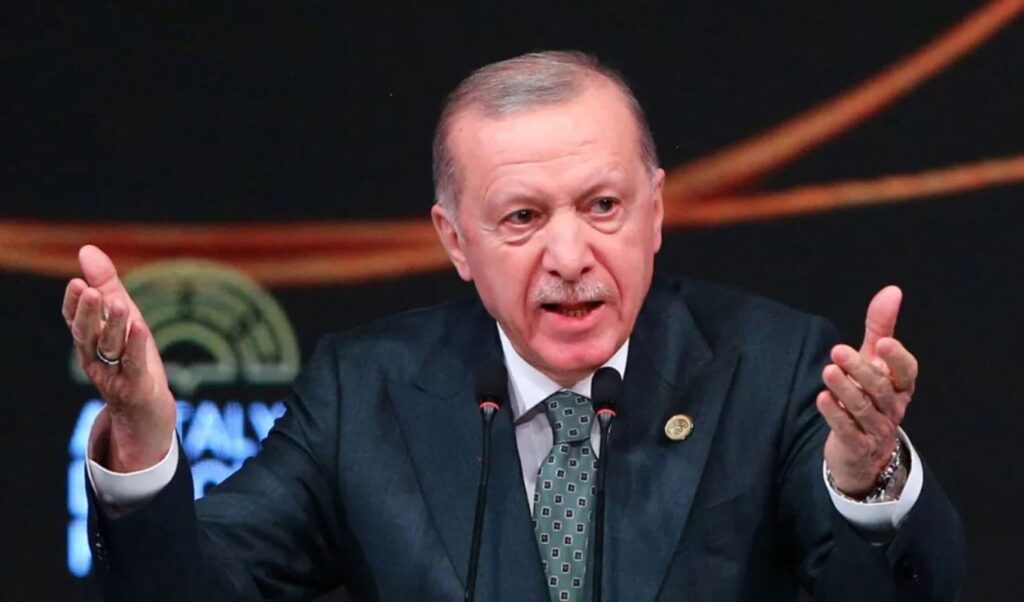
Turkey’s escalating rhetorical attacks against Greece’s defensive strengthening in Cyprus and Karpathos are causing concern. Official announcements from Turkey’s Ministry of Defense and Turkish press reports claim that Greece is using the war as a pretext to maintain military presence in the Mediterranean. “We do not accept Greece’s initiatives that serve no real purpose and aim to turn crises in our region into opportunities,” states the Turkish Defense Ministry announcement, adding that Ankara has taken necessary measures to respond.
The response from Foreign Ministry spokesperson Lana Zochios was immediate, declaring that “it was our historic obligation and obvious duty, when Cyprus was threatened and officially asked us – as the only legitimate Government representing the entire island – for defensive assistance to support them and show our solidarity in practice. Our assistance to Cyprus has a purely defensive character. Cyprus, the southeastern tip of the EU in the Eastern Mediterranean region, constitutes an island of stability and security in the broader region despite the ongoing 52-year illegal Turkish occupation of 37% of its territory. The illegal invasion and occupation does not legitimize any presence of Turkish military force.”
“Turkey’s reactions absolutely expected”
Professor of International Law and Director of the Cyprus Centre of the Oslo Peace Research Institute, Haris Tzimitras, characterized Turkey’s reactions as absolutely expected. As he tells parapolitika.gr, Greece’s position to send weapons systems acts as a catalyst for the crisis and argues that “both the action and reaction are expected. Cyprus is an interesting example for two reasons. The first is that naturally it is not actively involved in the war, or at least as the Cypriot President has said, it would never willingly participate in the war, leaving in my opinion a window open. But Cyprus is an interesting geography. Given that it is a country in the region but not a country of the region. It is an advanced outpost of the European Union. At the same time, this small island is one of the most militarized zones on the planet in relation to its size and population with nine armies. Further escalation and further militarization do no good.”
According to Mr. Tzimitras, Turkey’s military presence currently in Cyprus is very strong and has been developing since 1974. He notes however that it is worth taking seriously into account that the Treaty of Establishment with which the Republic of Cyprus was founded in 1960, provided for Turkey as a guarantor power, a fact that the neighboring country constantly invokes in any negotiation. For this reason, as he argues, Greece and Cyprus’s reaction to Turkey’s aggressive rhetoric should be done with sobriety. As he notes: “No escalations are needed from any side. Including, I mean, actions and reactions. It was absolutely expected that Turkey would react. Indeed, if you will, it is also a rather ‘measured’ move compared to what it could have done. Consequently, yes, it reacts in one way, but perhaps not outrageously compared to what it has continued to do to us in the past. At the same time, we don’t need to have discussions over the crisis regarding whether the British Bases should leave, or whether Cyprus should join NATO. Even if these discussions need to happen on these issues, they must happen, I think, with sobriety at another time and not now. The third thing is that the European Union, in a way, the member states, not the European Union, reacted, in my opinion, very late and very little. I didn’t see from the European Union side any diplomatic initiative and effort parallel to the operational part for resolving the war.”
The international law professor also argues that Turkey is a very important and decisive ally for Europe for the next day of security architecture in the region. Guarding Iran’s very extensive borders, security systems, control of Kurdish organizations are just some of the issues where the major EU states see Turkey as an important ally in this crisis and is the reason they cannot oppose it.