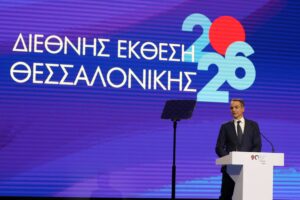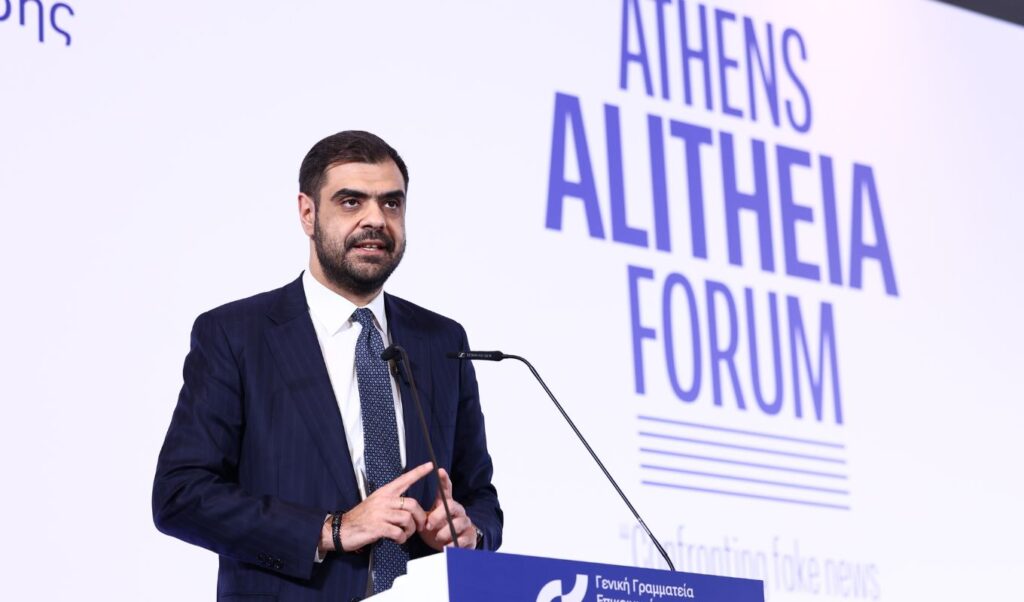
The importance of combating misinformation and toxicity in society and the media was highlighted by Deputy Minister to the Prime Minister and Government Spokesperson Pavlos Marinakis during his opening address on Tuesday (10/3) at the two-day Athens Alitheia Forum titled “Confronting fake news and toxic discourse.”
Pavlos Marinakis: “Combating misinformation is a collective responsibility”
“Combating misinformation is not the responsibility of one institution or one government, it is a collective responsibility that requires cooperation, knowledge and determination,” emphasized Pavlos Marinakis, adding that this is why “the Athens Alitheia Forum was not created by chance.” He stated that “our goal is for this conference to become established as an institution held annually, as a space where difficult questions are posed, proposals are submitted and substantial conclusions emerge, because democracy doesn’t need grand speeches, it needs action.”
“A climate that poisons public discourse is created daily”
The government spokesperson emphasized that “daily, a climate of tension, suspicion and confusion is created, a climate that poisons public discourse. This is essentially the breeding ground for most cases of fake news spread. A climate that often forces us to devote a very large part of our time and public discourse not to producing politics, with its inherent contradictions, but to debunking fake news” which are “constructed and reproduced to confuse citizens, create a climate of anger and undermine trust in institutions.”
At the same time, Mr. Marinakis emphasized that critical questions arise in the face of this reality regarding “what is ultimately the role of social media in informing citizens, whether they are simply communication tools or have been transformed into the main shapers of public opinion” and “what impact do they have on democracy, how necessary is it to seriously discuss age limits for social media use,” because, as he explained, “we cannot ignore that children are exposed daily to an ocean of information without filters” and must be able to “have the maturity to distinguish reality from fabricated news.”
As he added, freedom of speech, information, and expression is fundamental, but no freedom can function as a protective shield for those who choose to distort reality and truth for personal gain, especially when the recipients are children and adolescents” and “we must give them the tools to think critically.” He also praised the importance of “education in the digital age.”
“We aim to create conditions for real changes to strengthen journalists”
“We aim to create conditions for real changes to strengthen journalists, to enhance freedom of speech but also for even more policies and initiatives that will enhance transparency, protect citizens and safeguard truth and public discourse,” Mr. Marinakis emphasized, adding that the Forum aspires “to become something much greater. We want it to become the annual institutional dialogue for protecting truth and strengthening press freedom,” so that “criticism can be exercised without toxicity, different views can be expressed without fanaticism, truth can be sought without conspiracies and without ulterior motives.”
“Let the Forum also become an opportunity to reintroduce ourselves, to remember all the difference between easy shouting and documented journalism, between the preachers of media and so-called satirical shows and the masks of social media on one side, and on the other side journalism that investigates, cross-references, questions and documents, because truth is not a slogan, it is a responsibility.”