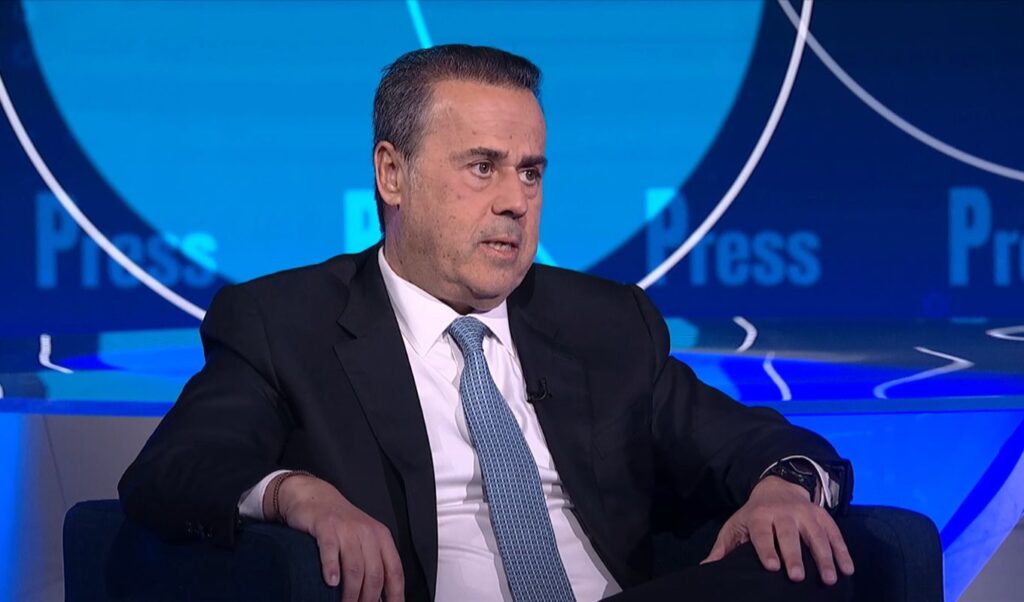
In an interview on ERT news’ Press Talk show, Environment and Energy Minister Stavros Papastavrou discussed developments in the international energy market and measures the government is preparing to address the global energy crisis.
Continuous government meetings on energy crisis
The minister stated that daily meetings between relevant ministries have been taking place since the first day of the crisis, with the primary goals of ensuring the country’s energy security and preventing market profiteering. As he noted, shortly before the interview, another meeting had concluded at Maximos Mansion, where specific proposals were examined to address energy price increases. “Another meeting just ended because since the first day of the crisis, daily meetings and consultations have been held with relevant ministries, with the objective goal of ensuring supply security and preventing profiteering phenomena,” he said characteristically.
Mr. Papastavrou emphasized that developments in international markets are extremely rapid and constantly changing. “Developments are almost not on a daily basis but minute by minute,” he said, noting that Brent oil prices showed large fluctuations within the same day. “As you mentioned, today Brent rose to 120. When I left it was 99,” he noted. As he stated, the relevant ministries have already formulated a package of proposals that has been submitted to Prime Minister Kyriakos Mitsotakis. “The relevant ministries have co-formulated a bundle of proposals to the Prime Minister to address profiteering phenomena,” he said, expressing the expectation that “before the end of the week we will have some announcements.” The minister noted that the government prioritizes protecting citizens and preventing unjustified increases in the energy market. “We live in a period where crises are a new normality,” he emphasized, adding that the government has proven that “it has the ability to take targeted measures that address problems as they develop“.
Renewable energy sources as a “shield”
Mr. Papastavrou made special reference to Greece’s energy mix, emphasizing that the increased participation of renewable energy sources provides protection against international price increases. As he explained, over 50% of electricity generation in the country now comes from renewable sources, while increased rainfall in recent months has also strengthened production from hydroelectric projects, which cover approximately 2% of annual energy demand. Thanks to this diversified energy mix, Greece does not depend exclusively on natural gas or oil, which to some extent limits the impact of international increases on domestic electricity prices. The minister even mentioned that at certain times of the day, Greece was among the five countries with the lowest wholesale electricity prices in Europe, a fact attributed precisely to the structure of the energy mix.
Energy security for at least three months
Referring to energy security, he emphasized that Greece has reserves that ensure market supply. “Supply security exists for at least the next 90 days,” he stated, noting that contacts have already been made with market companies to secure alternative supply sources. Regarding energy costs for industry, the minister said the government is in continuous communication with the European Commission to develop support measures that will be compatible with the European framework. “We are in constant communication with the European Commission, because it is important that the measures to be announced comply with the European Community framework,” he said.
Mr. Papastavrou also emphasized the now close connection between energy and geopolitics, noting that international developments directly affect energy product prices. Referring to statements by Russian President Vladimir Putin, he noted that the weaponization of energy proves the correctness of the European Union’s strategy for gradual independence from Russian natural gas. At the same time, he pointed out that during crisis periods, “energy realism” often emerges in international relations, without changing the basic strategic direction of Europe and its allies.
Need for common European strategy
The minister emphasized the need for a common European approach to the energy crisis, noting that until today many countries attempted to manage crises individually. “Europe must move with a unified strategy,” he said characteristically, noting that both in the Council of Energy Ministers and in European Union economic meetings, proposals are being discussed for common European interventions that will strengthen energy security and limit the crisis’s impact on member states.
Europe still has much to do on energy issues
The Environment and Energy Minister admitted that Europe has not yet achieved the goal of a unified energy market. “We are not satisfied,” he emphasized characteristically, noting that “at the level of a unified energy market, Europe has not succeeded.” Mr. Papastavrou recalled that in summer 2024, intense price differentiation was recorded between Central and Southeastern Europe. “There was a dividing line from Austria and above in relation to Southeastern Europe, where prices were double,” he noted, adding that in a truly unified energy market such deviations should not exist.
As he explained, Europe often proceeds with institutional changes after crises. “Europe evolved when it was shaken by crises,” he said, emphasizing that in the energy sector too, pressure from recent years leads to new initiatives. A central issue for the future of European energy policy, according to the minister, is strengthening energy interconnections between member states. As he mentioned, in the next European Union budget, funds for energy interconnection projects are increasing significantly. “From about 6 billion euros they reach almost 29.5 billion,” he said characteristically, emphasizing that this increase shows that Europe has now realized that “in reality there is no unified energy market.” As he explained, today it is not easy to transfer surplus energy from one region of Europe to another. Thus, “separate energy markets essentially coexist that are not truly interconnected.”
Stavros Papastavrou connected the energy issue with Europe’s overall position in global competition. As he emphasized, “energy has decisive importance for national security, for industrial competitiveness and for technological development.” He made special reference to artificial intelligence development, noting that “developments in the field of artificial intelligence are supersonic.” He even noted that if the European Union does not secure sufficient energy resources to support this new technological revolution, it risks falling behind internationally. The discussion also raised the question of whether Europe has simply replaced its energy dependence on Russia with a new dependence on the United States. The minister replied that “dependence on only one supply source is never good.” However, he distinguished between markets operating with private companies and cases where energy is used as a political tool. As he noted, in countries where a free energy market operates, like the United States, companies “move on market terms” and not with geopolitical criteria.
Greek strategy for hydrocarbons
A significant part of the discussion concerned the prospect of exploiting hydrocarbons in Greece and the upcoming contract for new drilling. Responding to opposition criticism that extractions contradict the government’s environmental policy, the minister argued that this criticism is unfounded. “It is not true,” he emphasized, recalling that Greece has drastically reduced lignite use.
“In 2005, over 60% of electricity came from polluting lignite. In 2025, this percentage is below 9%,” he said, adding that renewable energy sources have now exceeded 50% of the energy mix. According to him, natural gas continues to be considered a “transition fuel” for Europe and the potential exploitation of Greek deposits does not contradict sustainable development goals.
First exploratory drilling in the Ionian after half a century
The minister stated that within the next year, a significant step is expected for Greek energy research. “In about twelve months we will have the first exploratory drilling in the Ionian after almost half a century,” he said, emphasizing that it is necessary to determine whether commercially exploitable deposits actually exist. If the deposits prove exploitable, as he said, significant public resources could be created. “It may not make us Norway,” he noted characteristically, “but it can take us to another economic level.”
It’s time to see if there are commercially exploitable deposits
Additionally, Mr. Papastavrou mentioned that initial estimates by energy companies for the Ionian suggest significant possibilities for deposit existence, without wanting to proceed with specific predictions. He emphasized, however, that Greece is located in a region where many neighboring countries have already proceeded with hydrocarbon research and extraction. “We are located among areas where countries like Israel, Egypt, Libya, Cyprus, Italy, Albania, Turkey have proceeded with hydrocarbon exploitation,” he noted, posing the question: “Why not us?”.