
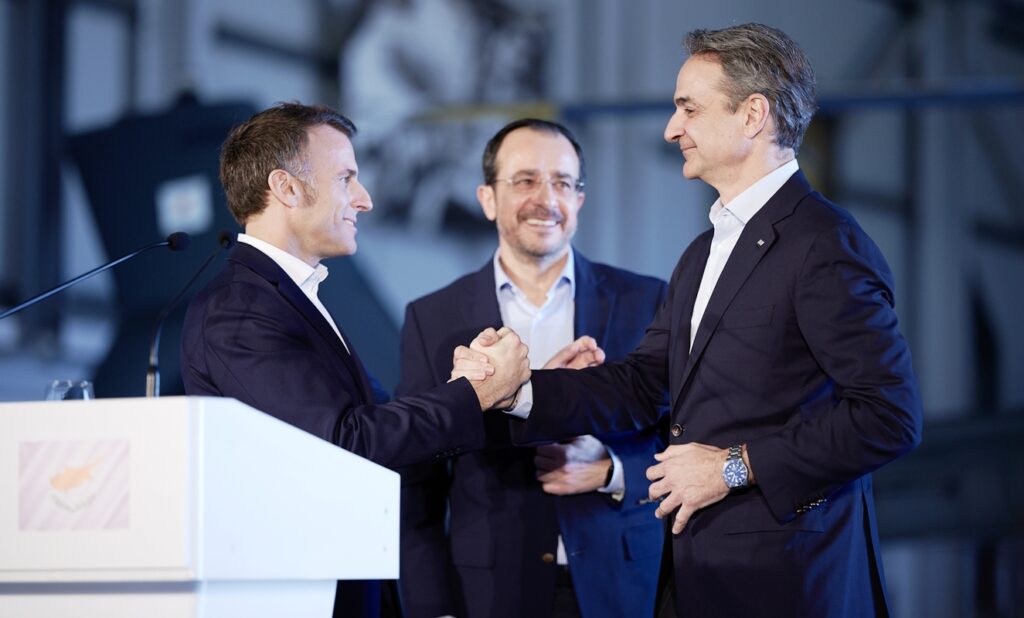
The trilateral meeting between Mitsotakis, Macron and Christodoulides in Paphos was not just another diplomatic photo opportunity, but a high-symbolism operation with even greater geopolitical weight, delivering three clear messages. First, that Cyprus will not be left alone at a time when the Middle East crisis now directly affects the Eastern Mediterranean. Second, that Europe wants to demonstrate military, political and naval presence in the region, without appearing to enter into direct military engagement logic. And third, that the next threat concerns not only drones, missiles or energy shock, but also potential population movements that could pressure Cyprus and Greece first, and then all of Europe. Kyriakos Mitsotakis openly warned about the possibility of major refugee flows, while Emmanuel Macron announced that France, together with partners, is preparing a defensive escort mission for commercial ships to ensure free navigation and gradually reopen the Strait of Hormuz maritime corridor. Reuters reported that Macron spoke of a “purely defensive” mission escorting container ships and tankers, while AP noted that his presence in Cyprus was directly linked to a European display of solidarity following the crisis escalation.
Read: Kyriakos Mitsotakis met with Greek F-16 pilots in Cyprus (Images)
Mitsotakis’ message: no complacency and fear of new refugee wave
Kyriakos Mitsotakis spoke with clearly harsher language than in other cases of international tensions. He spoke of constant vigilance, rejected any complacency and put on the table a scenario that sounds politically and socially explosive – that of major refugee flows due to the war in Iran and broader Middle East realignments. His position was not made on a theoretical level. He connected it to the “asymmetric threats” that Cyprus, Greece and the Mediterranean as a whole may face. In practice, the prime minister showed that Athens fears the crisis may produce not only energy instability but also pressure on maritime borders, precisely at a time when Europe already has many open fronts. Reuters recorded that Mitsotakis called on Europeans to strengthen the “Aspides” operation with more ships, while in Paphos he emphasized that the moves by Greece and Europe are purely defensive and their purpose is to protect an EU member state from any threat.
The Greek prime minister simultaneously chose to give a clear political message about Cyprus. With the phrase that the Republic of Cyprus is not and will never be left alone, he tried to transform the Greek and European presence into a tangible protection promise. He reminded that Greece from the first moment set the security of the island as a national priority and noted that two Greek frigates, including the “Kimon,” and four F-16 Viper aircraft were immediately deployed to Cyprus. AP confirmed that Greece has already reinforced Cyprus’ defense with F-16 fighter jets and two advanced frigates, while the French side supported the island’s defense with naval and anti-aircraft assets.
View this post on Instagram.
Macron’s message: attack on Cyprus means attack on Europe
Emmanuel Macron went to Paphos to say something that Paris wants heard across the continent: that when someone attacks Cyprus, they attack all of Europe. His phrase was perhaps the most politically weighty deterrent of the trilateral meeting, as it didn’t remain merely at the level of sympathy toward a member state, but elevated the concept of European defense to something immediate and tangible. The French president announced that his country will further strengthen its naval presence in the region. According to Reuters, France is deploying a total of about twelve warships in the Mediterranean, the Red Sea and possibly later toward the Strait of Hormuz, while the aircraft carrier “Charles de Gaulle” and other French assets are near Cyprus. He said France is considering with European and non-European partners a new purely defensive commercial ship escort mission, to gradually reopen the maritime corridor for international navigation after the most intense phase of the crisis.
This point is hugely significant, as it shows Europe is no longer limiting itself to statements of concern about oil prices and regional security, but is moving toward more tangible thoughts of naval protection. Reuters noted that the goal is to protect freedom of navigation and maritime security, while Macron emphasized that Europe’s stance must remain defensive but credible. In simple terms, Paris wants to say that Europe must be able to guard its sea routes, without appearing to pour more fuel on the fire.