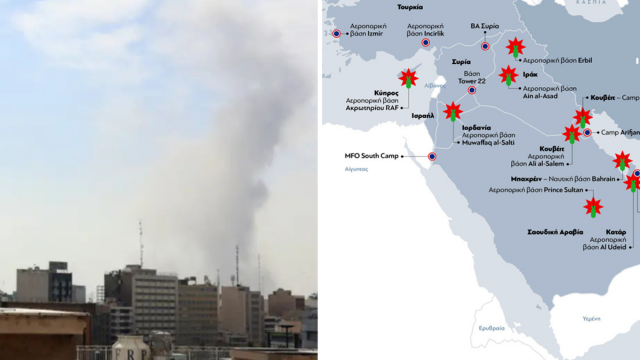
A regional war in the Middle East is in full swing following US and Israeli strikes against Iran. This is a war of attrition, aimed at overthrowing the theocratic regime (though nothing is absolutely certain with the “disruptive” and often “ambiguous” Trump), targeting the neutralization of air defenses, ballistic arsenal, and naval forces to pave the way for an uprising within Iranian territory – something that already appears to be in preparation, against the backdrop of Washington’s open channel with the Kurds (supported by Israel for shaping new balances).
The US-Israel-Iran war and initial data
Making a numerical assessment based on data provided by Americans and Israelis, US Joint Chiefs of Staff General Dan Cain stated this week that ballistic missile launches from Iran have decreased by 86% compared to the first day of conflicts. US Central Command (Centcom) also estimates that in the last 24 hours alone, there was an additional 23% reduction. Before the war, Iran was estimated (according to BBC analysis) to possess more than 2,000 short-range ballistic missiles. Additionally, it had manufactured tens of thousands of Shahed-type drones – technology that has also been transferred to Russia and is being used in the war against Ukraine.
However, according to Cain, Iranian drone launches have also decreased by approximately 73% from the first day of war. Analysts estimate the reduction may be due to both equipment losses and Tehran’s attempt to preserve its reserves for a prolonged conflict. Air defense is also critical, with the Israeli military announcing Thursday, the 6th day of war, that “we have destroyed 80% of air defense systems” and “we are entering the next phase of war with Iran,” during which, according to the Israeli Defense Forces (IDF) Chief of Staff, “we will intensify strikes against the regime’s foundations and military capabilities.”
Iran’s strikes on Gulf countries
These constitute significant data for the ongoing conflict, with Iran, however, showing no willingness to give up. It has extended the conflict to Gulf countries, which were hardly accustomed to such actions. A series of strikes (over 1,000 drones) have hit the United Arab Emirates (more than even Israel itself), Qatar, and Saudi Arabia, including the largest refinery of the country’s state oil giant, Ras Tanura.
Iranian Foreign Minister Abbas Araghchi, for his part, in his NBC News interview Thursday, denied any real issue with Gulf countries, stating “we have not attacked our neighbors, we have not attacked Muslim countries,” but rather American military installations and bases that “unfortunately are located on our neighbors’ territory.” The United States maintains at least 19 bases in the broader region, with eight being permanent.
Iran’s plan to involve its neighbors in the war
This appears to be Iran’s “bet”: making its neighbors participants in the war, aiming to pressure the US (primarily) to stop hostilities. Moreover, the choice to “spread” the conflict probably serves another goal: prolonging the conflict, which Tehran certainly desires, to make the war more expensive for its opponents, in a battle with money, time, and possible opposing wills that will become increasingly clear as the conflict deepens chronologically.
An Iranian Shahed (capable of traveling up to 2,500 km) is noted not to cost much, certainly not as much as shooting it down with a missile: $20,000-50,000, while an interceptor missile costs approximately $265,000 (200,000 British pounds, as reported by BBC). Here it appears that Ukraine could become a factor in the Middle East front, especially in drone interception, with Zelensky not “closing the door” on such possibilities.
The regime change scenario and Khamenei’s potential successor
Meanwhile, another element that seems to serve Iran is that it’s a vast country in terms of territory, allowing weapons and infrastructure to be hidden in many different areas, making complete destruction of its arsenal nearly impossible. In any case, and because “war is the continuation of politics by other means,” it’s worth referencing the aftermath, the next day, and who could be Khamenei’s successor.
One option that probably has basis, with continuity logic, is his son Mojtaba, though this doesn’t sound particularly pleasant to Trump, who according to his Axios statement considers him “insignificant,” indicating he wants to be “personally” involved in the matter. The name Pahlavi always appears in the public sphere, though it’s questionable whether he has any real support to consolidate power, while the framework shouldn’t exclude a “federalist,” “balkanized” Iran, with strong voice and presence given to individual tribes comprising this nation of 92 million.
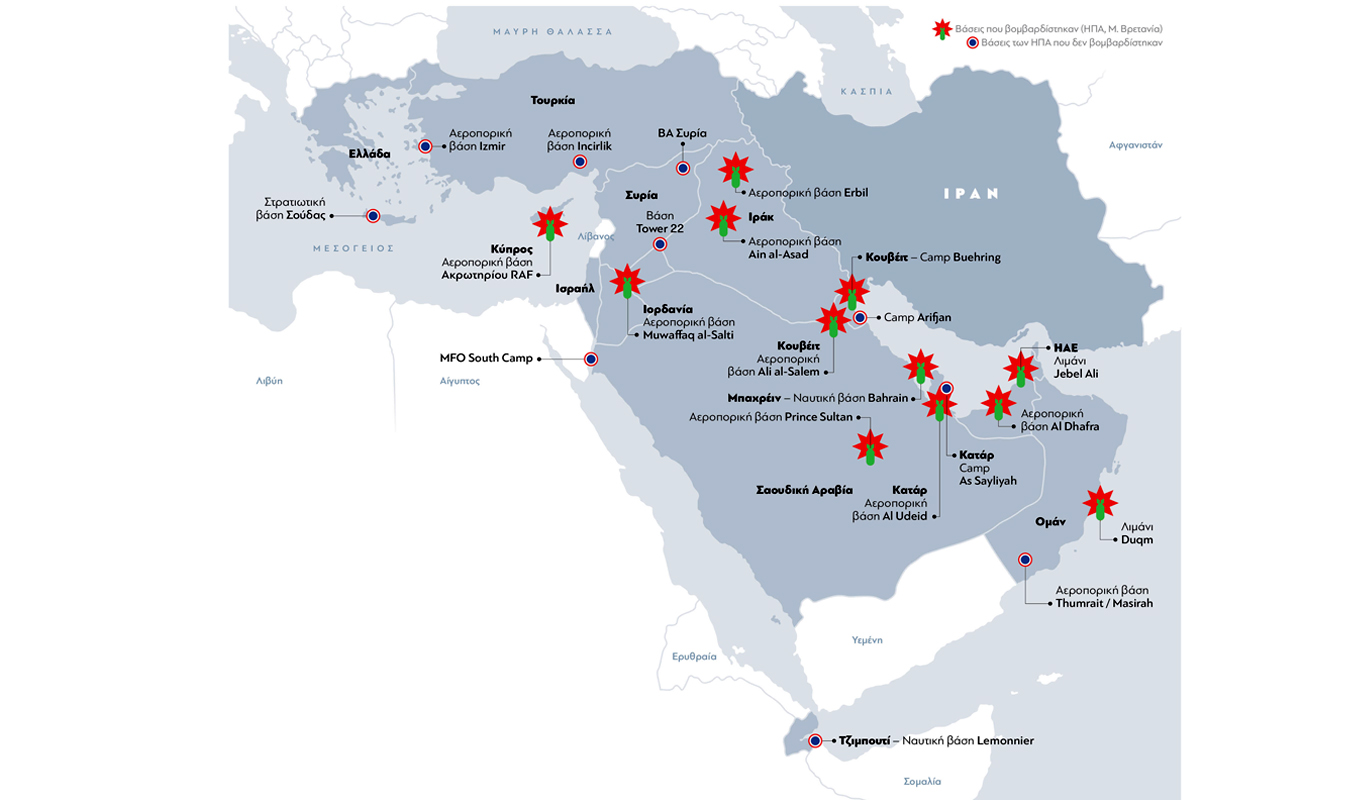
American military bases in the Eastern Mediterranean and Middle East
Greece, Crete
Souda Bay hosts US air and naval forces with personnel, equipment, offices, and ammunition. It’s of great strategic importance, as Americans can control areas of the Middle East, Eastern Mediterranean, Black Sea, and Red Sea from there.
Cyprus, Akrotiri
The only permanent operational base in the broader region is in Cyprus at the British sovereign bases in Akrotiri and Dhekelia. RAF’s Middle East operational headquarters is located at Al Udeid Air Base in Qatar. RAF also uses Al Minhad Air Base in the UAE, where it opened new facilities in March 2024, and Al Musannah Air Base in Oman.
Syria
The US has maintained military presence for years at a series of facilities in Syria, as part of international efforts against the jihadist organization “Islamic State.” However, these troops are withdrawing from the country, a process expected to complete within a month.
Jordan
Muwaff aq al-Salti Air Base in Azraq hosts the 332nd Expeditionary Wing of US Air Force Central Command, participating in missions throughout the Eastern Mediterranean and Middle East region.
Saudi Arabia
American soldiers, who according to a White House letter numbered 2,321 in 2024, operate in coordination with the Saudi government. Some troops are stationed about 60 km south of Riyadh at Prince Sultan Air Base, supporting US air defense systems.
Iraq
The US maintains presence at Ain al-Asad Air Base in western Anbar province, supporting Iraqi armed forces. It was targeted by Iranian strikes in 2020. At Erbil Air Base, located in the semi-autonomous region of Iraqi Kurdistan, US and coalition forces against jihadists are stationed.
Kuwait
Military installations include Camp Arifjan, US Army Central Command forward headquarters, and Ali al-Salem Air Base, about 40 km from the Iraq border, known as “The Rock.”
Bahrain
The small kingdom hosts an important US naval base where the 5th US Fleet is stationed. This port berths the largest American ships, including aircraft carriers. The base has been in use since 1948.
Qatar
This country houses Al Udeid Base, the largest US military installation in the region. Many Centcom command centers are located there. It also hosts fighter aircraft and aerial transport and in-flight refueling assets, intelligence units, and approximately 10,000 US troops are stationed there.
United Arab Emirates
Al Dhafra Air Base, located south of Abu Dhabi, is critical for the US Air Force. It has supported key operations against the “Islamic State” and reconnaissance missions throughout the region. Additionally, Jebel Ali port in Dubai is the largest receiving US Navy ships.