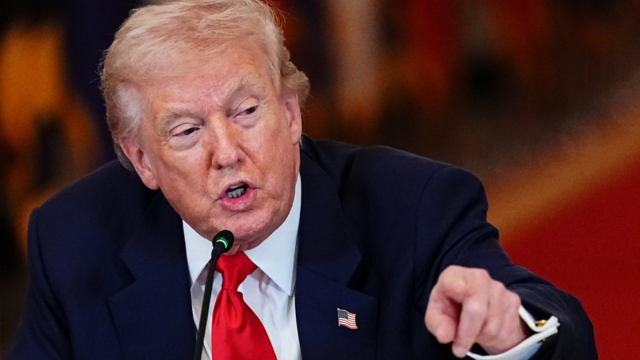
American President Donald Trump is seriously considering the possibility of sending American troops to Iranian soil, while simultaneously appearing to seek a role in the country’s future, even in selecting a new leader following the assassination of Supreme Leader Ayatollah Ali Khamenei.
According to information cited by NBC News, Trump has already discussed with close associates and Republican officials outside the White House the possibility of deploying ground forces in Iran. At the same time, he is reportedly presenting his vision for how the country’s political landscape could be shaped after the war ends.
Trump’s plan to send ground troops to Iran
As American officials report, according to NBC News, Trump’s thinking does not include a large-scale invasion. Instead, he is considering sending a small number of American troops that could be used for specific strategic missions. The same sources note that in the plan under consideration, a key objective is to secure Iran’s uranium, while the United States could cooperate with a new Iranian regime in the energy sector, mainly oil, following the cooperation model applied with Venezuela. Despite these discussions, the American President has not yet made a final decision nor given related orders to the military.
White House response
White House Press Secretary Caroline Leavitt disputed the news, arguing it was based on anonymous sources not belonging to the president’s national security team.
As she characteristically stated: “The story is based on assumptions from anonymous sources who are not part of the president’s national security team and clearly have not been briefed on these discussions. President Trump always prudently keeps all options open, but anyone trying to suggest he favors one option or another proves they don’t have a real seat at the negotiating table.”
Publicly, Trump has not ruled out the possibility of sending American troops to Iran, although military operations so far have been limited mainly to airstrikes. However, his private discussions show he appears perhaps more willing to consider this possibility than his public statements suggest.
In an interview with the New York Post, he stated: “I have no problem sending troops to the ground.” He also added that while other presidents have ruled out such an option, “I say it probably won’t be necessary.”
Trump wants a say in choosing Iran’s next leader
Meanwhile, according to a BBC report, Trump appears to be articulating his political aspirations for Iran’s future more clearly. The American President states he wants a say in selecting the country’s new leader after Khamenei’s death. As he mentioned, he wishes to see a “great and acceptable leader” emerge for Iran, following the country’s “unconditional surrender.” However, there is currently no indication that Tehran is considering such a possibility.
The succession battle after Ali Khamenei
The possibility of US intervention in the process of selecting a new leader is considered particularly difficult. Despite political differences between reformists, pragmatists, and hardliners in Iran, all sides seem to agree on one basic goal: maintaining the existing power system. One week after the conflict began, hardliners appear to maintain control.
Trump also stated he would not accept Mojtaba Khamenei, the 56-year-old son of the deceased supreme leader, as successor, who is considered by many to be the frontrunner candidate.
Who are considered potential successors
The process of selecting a new supreme leader is particularly secretive. The final decision is made by the Assembly of Experts, a body of approximately 88 senior clerics. According to reports, meetings continue even after recent bombings of buildings in Tehran and the holy city of Qom.
Among potential succession candidates mentioned are:
- Mojtaba Khamenei
- Hassan Khomeini, grandson of Islamic Republic founder Ayatollah Ruhollah Khomeini
- senior jurist Alireza Arafi
Additionally, there are estimates that collective leadership could be chosen instead of a single person.
Meanwhile, the Revolutionary Guards continue to play a decisive role in the country’s political and military system.
It is not yet clear when – or if – the successor will be announced, as Israel has warned that whoever assumes leadership could also become a target. So far, the only one speaking openly about the issue is Donald Trump, who commented: “Most of those we had in mind are now dead.”