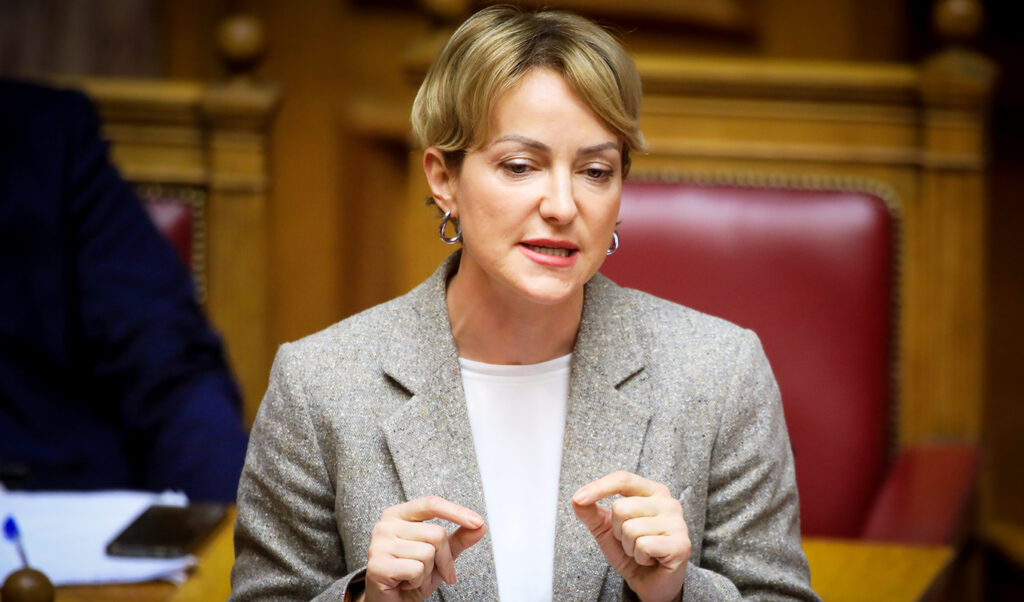
The government’s positions regarding Cyprus, war fronts and impending economic turbulence were reflected in the statements of Alexandra Sdoukou on three television stations (Action 24, ANT1, MEGA) and one radio station (Real FM) on Friday, March 6. The press spokesperson of New Democracy emphasized that the government “closely monitors developments and moves with readiness on all levels – diplomatic, defense and economic – to ensure the country’s security and interests.” The multiple open fronts require the state to remain in absolute vigilance. From Cyprus and Iran’s threats against the British base to economic turbulence, there is no time for relaxation – it is rather prohibited. The New Democracy spokesperson made special reference to the Republic of Cyprus, emphasizing that Cyprus’s security constitutes a permanent national priority.
Alexandra Sdoukou: Cyprus’s security is self-evident
Greece’s support for Cyprus is self-evident, according to Alexandra Sdoukou. “Greece stands by Cyprus, does its duty and will be there for as long as needed. Cyprus’s security for Greece is self-evident.” The New Democracy spokesperson also reiterated the position that Greece’s role on the island is purely deterrent: “The presence of Greek forces sends a clear message of deterrence and stability to the broader region. Greece is a security factor and we will stand by the Cypriots for as long as required.” She also emphasized that the government has made it clear that it will not enter into a war logic.
As she stressed, “the government’s position is clear, we will not engage in any conflict, we will not participate in any aggressive action. Greece’s role is defensive. We protect Hellenism and operate based on international law. However, we have the obligation to defend our rights and our national interests.” She underlined that “we are in favor of international law, in favor of avoiding further escalation and in favor of diplomacy.” She additionally noted that “Greece, fortunately, in 2026 finds itself in a phase where it has strengthened and upgraded Armed Forces, which are here, ready at any hour and moment, to do their patriotic duty wherever needed – something that obviously we all hope will not happen.”
“Right mix of foreign and defense policy”
Indeed, she emphasized that Turkey’s official complaints about the transfer of Patriot artillery to Karpathos highlight that Greece’s foreign policy is successful. Essentially, the Turks are bringing owls to Athens, since, as the government spokesperson commented, their accusations are not unprecedented. Specifically, “we have heard them many times in the past. The demilitarization issue has been fully answered. The regime of Greek islands in the eastern Aegean is governed by relevant treaties and there is nothing questionable.” She concluded the Karpathos issue with the phrase “it is an operational decision made by the competent authorities. Since they judged it so, it was done well, they can go to any part of Greek territory deemed appropriate each time.”
She also underlined that “in recent years we see that the initiative of moves has passed to the Greek side. From maritime spatial planning and maps of national marine parks, to energy cooperations and drilling with large international companies, Greece moves with a plan.” “The Greek side’s action provokes reactions from the Turkish side, because precisely our country follows the right mix of foreign and defense policy,” she noted characteristically.
“Europe follows”
Europe may not have a unified defense policy, but Alexandra Sdoukou emphasized that it is close when needed: “Europe does not have a unified foreign and defense policy, we know this. However, both from what has been happening in recent days in Cyprus, where forces now rush from France, Germany, Italy and Spain, and from the events at Evros, a clear conclusion emerges. If you are there, if you lead an effort, Europeans will follow. As in Evros we had seen Austrians, Poles and others.”
She said the government has “taken initiatives that were subsequently adopted by Europe. From vaccination, to support during the pandemic, to the joint defense initiative with Polish Prime Minister Tusk that became the precursor to the SAFE plan.” Referring to the economic dimension of the crisis, Ms. Sdoukou emphasized “there is also full vigilance at the economic level. It is important to constantly evaluate the data, how the situation evolves, what is the intensity and what is the duration of the crisis.”
“Decisiveness, seriousness and quick reflexes”
At the same time, she underlined that the government is fully aware that “citizens are rightfully concerned when there is international instability and that is why the government must be ready to protect the economy and social cohesion.” She noted that “Greece is not in the same economic situation it was some years ago, the work that has been done on the economy all these years allows us to be optimistic, but we must simultaneously be realistic and make decisions with very good analysis of the data, both of the economy and of developments in the conflict field. Different types of measures and interventions will be needed in a conflict of a few weeks and others in case it lasts some months.”
The New Democracy spokesperson underlined that Kyriakos Mitsotakis’s government has proven its ability to manage crises, as “it has given its credentials in the past. From immediate measures during the pandemic, to the energy crisis, to the Russia-Ukraine war, but also to the hybrid attack the country suffered at Evros.” In all these cases “the government showed decisiveness, seriousness and quick reflexes” she noted. She underlined the value of having “during crisis periods decisions made with composure and responsibility, not with rumors or alarmism. That’s why we need leaderships that correctly evaluate data, Kyriakos Mitsotakis has shown that he does this and that he takes the necessary measures quickly.”
“Situation serious, but not for Council of Leaders”
Ms. Sdoukou emphasized that “the Prime Minister is absolutely available to brief any political leader who requests it.” She reminded that “institutional briefing at the National Council of Foreign Policy by Foreign Minister Giorgos Gerapetritis” has already taken place. Regarding the request for convening a Council of Leaders, she noted “it would give a wrong signal about where we stand. The situation is serious, but not at the level that requires a Council of Leaders. Those who proposed it should have known this, but perhaps their internal problems lead them to the need for greater legitimization of their role as leaders.”
Referring to statements by KKE secretary Dimitris Koutsoumbas regarding drones and their supposed course toward Greece, she noted that “the competent Defense Minister was absolutely clear, saying there is no such information and added that he considers we would have it. The minister even mentioned that we see the trajectories of any system starting from Lebanon, meaning Hezbollah or from Iran and there was nothing like that. So I would say that Mr. Koutsoumbas should be more careful both in what he says and on which sources he relies, perhaps he should even have said how he concluded it, what evidence he had. Unless his source is ‘someone from the village, whom we don’t know.’ This is not the time for rumors or alleged information. It is time for seriousness and responsibility.”