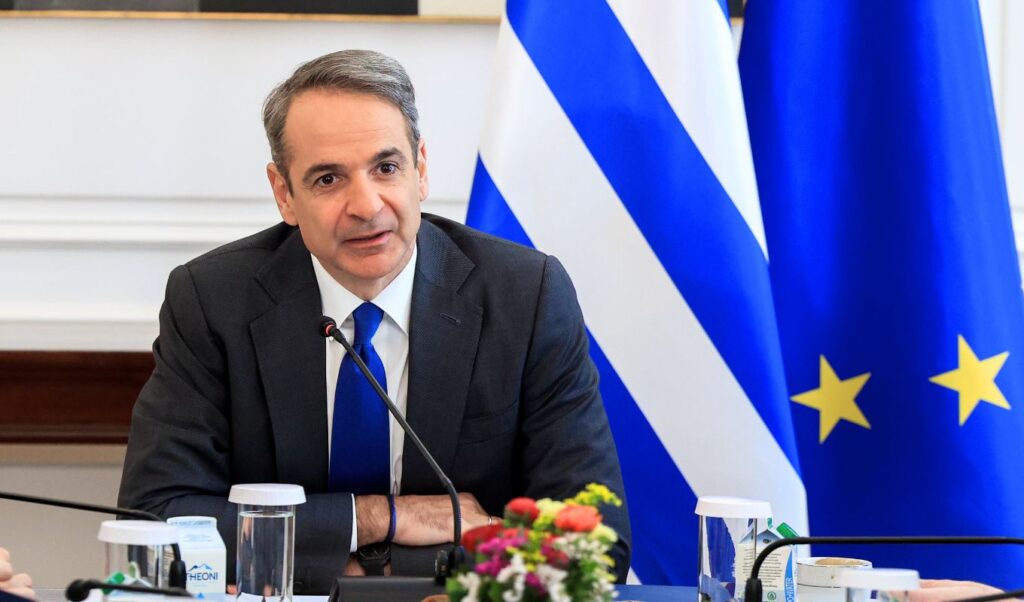
Prime Minister Kyriakos Mitsotakis will attempt to highlight the value of two powerful “weapons” of the country – diplomacy and the Armed Forces – in his speech to Parliament, expected to begin at 11:00 am, within the framework of the plenary session discussion on the Interior Ministry’s draft law for postal voting by Greeks abroad and the creation of a separate trilateral electoral district for the diaspora.
Kyriakos Mitsotakis will address these issues, but will mainly focus on how upgraded Greek diplomacy and strengthened Armed Forces give power to our country – and provide support to Cyprus – amid a very difficult and multifaceted crisis in the Middle East and our broader neighborhood. He will raise the issue of the need for de-escalation and highlight the need for stability in Greece during an unstable period.
Regarding the Livanius bill, during his speech Kyriakos Mitsotakis is expected to point out that it provides the possibility for postal voting by diaspora Greeks in national elections, thus responding to a long-standing demand of theirs to have the same rights as voters in Greece. He is also expected to emphasize that in practice it is a deeply democratic initiative, as it expands the electorate and responds to the trends of the times – namely indifference, abstention and resignation from participation in public affairs.
At the same time, he will emphasize, according to information, that the draft law under discussion also constitutes a national response to the specific turbulent international situation, as it strengthens the bonds between diaspora Greeks and the motherland. And thus makes Greece stronger, as it unites world Hellenism within and beyond the country’s borders, which is why he will ask Parliament for a common stance and the vote of all MPs on this specific bill.
A little later, specifically at 13:00, the National Council of Foreign Policy will convene under the chairmanship of Foreign Minister Giorgos Gerapetritis, with the topic being developments in the Middle East. Around the same time, the frigate “Kimon” – the first of four ultra-modern Belharra (FDI) type frigates recently integrated into the Navy – and the frigate “Psara”, which carries the “Centaur” system, will arrive in Cyprus. This is the integrated anti-drone system, which is a product of cooperation between the Hellenic Center for Defense Innovation (HELKAKI) and EAB and has been successfully tested during operation “Aspides” in the Red Sea. Already, our country is sending a pair of F-16 fighter jets to the Republic of Cyprus, with Mitsotakis noting that “the Greek government responded to Cyprus’s request to provide additional military assistance and support” and that “any threat against the Republic of Cyprus, a member state of the European Union, is in principle unacceptable”.
These statements were made before the start of the meeting with Nikos Androulakis, which is worth noting was the prime minister’s first with the opposition leader after 15 full months and was conducted in a good and consensual atmosphere, as evidenced by Androulakis’s statements. The PASOK president expressed the position that “our military presence under the current conditions in the Eastern Mediterranean should be connected with the protection of Hellenism, and specifically Cypriot Hellenism, which is closer to the war zone, and that there should be no scenario of the country’s involvement in the war being waged by the United States of America and Israel with Iran”.
The government’s priorities, as emerged once again from Mitsotakis’s statements, remain the protection and safe repatriation of the thousands of Greeks who are currently trapped in various states around the Persian Gulf, as well as the safety of sailors on Greek and Greek-owned ships in the region. “Very serious preparatory work has already been done, but, as everyone understands, until airspace opens to allow flights to be scheduled, their evacuation at this time is difficult,” the prime minister said regarding the evacuation of Greek citizens from the United Arab Emirates and other nearby countries. Regarding Greek sailors, Maritime Affairs and Island Policy Minister Vassilis Kikilias spoke to Reuters and mentioned that ten ships with Greek flags are in the Gulf and that communication with sailors is ongoing.
Mitsotakis continues his round of contacts with regional leaders, as on Tuesday he spoke by telephone with Lebanon’s President Joseph Aoun, Israeli Prime Minister Benjamin Netanyahu, and Jordan’s King Abdullah. The prime minister recognized Israel’s right to self-defense, but emphasized the need to avoid further escalation and prevent opening a new front through extensive ground operations in southern Lebanon. In the communication with Israel’s prime minister, the unprovoked attack against the Republic of Cyprus and the defensive support provided by Greece were also discussed.