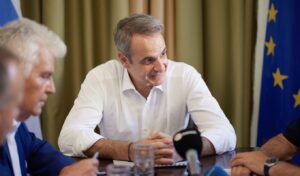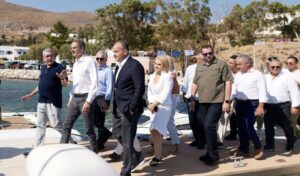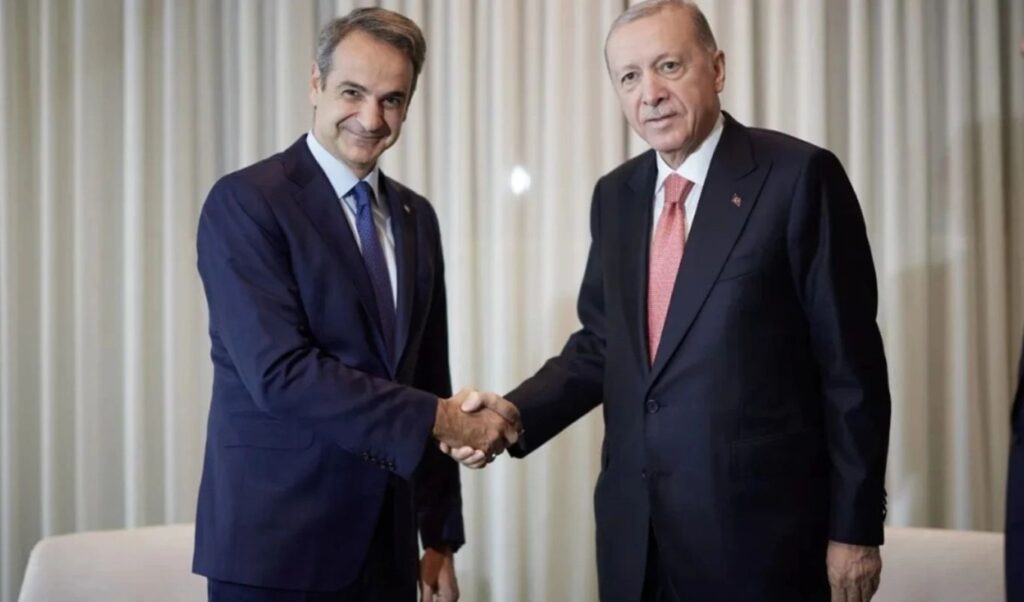
In a climate of underlying tension, Athens and Ankara are preparing to conduct the High-Level Cooperation Council, within the framework of which the postponed meeting between Greek Prime Minister Kyriakos Mitsotakis and Turkish President Recep Tayyip Erdogan is expected to take place in Ankara.
However, as the date approaches, both countries are making their “red lines” clear. Athens, through Foreign Minister Giorgos Gerapetritis, clarifies through a series of public interventions that sovereignty issues are not part of the dialogue with Turkey.
“The only difference we have that can be brought before an international procedure is the delimitation of EEZ and continental shelf in the Aegean and Eastern Mediterranean, a difference which historically constitutes the underlying cause of major tensions between the two countries. Dialogue does not mean retreat, weakness, or abandonment of national interest. Dialogue is the safety valve for calm, stability and good neighborliness,” the head of Greek diplomacy told the newspaper “Ethnikos Kiryx” shortly before his departure for New York (where he will hold a series of meetings within the UN framework).
New provocation from Turkey ahead of the Mitsotakis-Erdogan meeting
While Athens declares that extending territorial waters to 12 nautical miles is an inalienable right that it will exercise unilaterally at a time of its own choosing, Ankara provokes once again by announcing two NAVTEX covering half the Aegean for the unusually long period of two years, while simultaneously referring to a “demilitarized status” of 23 Greek islands.
This Turkish tactic causes concern in Greece. According to geopolitics professor Yannis Mazis, who spoke to parapolitika.gr, “going to a meeting with a two-year NAVTEX that divides the Aegean at the 25th Meridian following the Blue Homeland doctrine, I consider wrong policy and diplomatically unacceptable. If this NAVTEX is not withdrawn, there is no reason for the meeting to take place. Because what does it prove? It proves that Greece is in a position of retreat, in a fearful position, and under such an impression in the international community, especially as it is shaped, particularly as NATO proves to evolve, it is particularly harmful to the country’s national interests.”
What diplomatic sources estimate about the Mitsotakis-Erdogan meeting – The “Donald Trump” factor
In the complex international environment that has formed, however, diplomatic sources estimate that even under these conditions, with Turkey’s now well-known tactics, dialogue is preferable to maintaining tension. This is also proven by the results of the Political Dialogue and Positive Agenda, conducted at regular intervals between the two countries, with significant results in areas such as migration, tourism (with significant benefits for Eastern Aegean islands) and economic cooperation.
Moreover, the current situation does not allow Athens to ignore the good personal relations and open channels maintained by the Turkish president with the unpredictable American president, which makes many agree that they may potentially affect Greek-Turkish issues.
According to Mr. Mazis, the Trump-Erdogan relationship should not worry Greece, because the American President only seeks temporary benefits. As Mr. Mazis argues, “given that Mr. Trump wants to complete a major strategic plan, the IMEC, he needs certain footholds in the Middle East region at this time and achieves them this way. For example, the approach of many high-power naval units to Spain and the Persian Gulf and the threat of attacking Iran, which is one of the obstacles in Mr. Trump’s perception for IMEC implementation, shows me that he wants to use Turkey and its intelligence networks in Iran to achieve his goal.
Whether he is a friend would be shown by delivering F-35s and F-16 Vipers. Which he didn’t do. But he set conditions for Turkey – simultaneously patting Mr. Erdogan’s back and taking about 50 billion from him for purchasing civilian aircraft from American industry. What should worry Greece, and I heard with great joy from the Greek Prime Minister, provided he means it, is that ‘it’s not the power of our values, but the value of our power.'”
The exact date of Kyriakos Mitsotakis’s meeting with Tayyip Erdogan appears not yet finalized. However, it is estimated to take place between February 14 and 17.