The Greek government is engaged in a very difficult balancing act as the arm-wrestling between the United States and the European Union becomes increasingly harsh and the distance separating the two continents seems to widen. Whether through harsh characterizations from Vice President J.D. Vance about Europe, increased tariffs on European products, Washington’s stance on the war in Ukraine, or the crisis regarding Greenland, transatlantic relations appear to have changed radically.
The US-EU arm-wrestling and Athens’ difficult balance – Energy and geostrategy: Alexandroupoli, ExxonMobil, Chevron and F-35
Within this new environment taking shape, Kyriakos Mitsotakis seeks to maintain and even expand the strategic relationship between the US and Greece: Our country has gained a pivotal position in American energy planning with the Vertical Corridor for natural gas transport from Alexandroupoli to Odessa, two American giants -ExxonMobil and Chevron- are preparing for potential natural gas extractions in Greek waters, while the first fifth-generation F-35 fighter jets are expected at Andravida air base in 2028.
At the same time, he seeks to strengthen our country’s position among the “frontline” states of the European Union, reintroducing the proposal he submitted long ago for the need to strengthen European strategic autonomy, aligning with Emmanuel Macron on this issue. This means more resources for Defense, support for the domestic European defense industry, and strengthening EU competitiveness within the international environment.
Mitsotakis to Euronews: “Open to cooperation only for Gaza and with clear framework”
Regarding the “Peace Council” for the Gaza Strip, in which our country has been invited to participate, from the outset both in Athens and generally in most European capitals there was concern that this initiative appears to undermine the role of the United Nations. In any case, Greece wishes to be present in Middle East developments and is seeking the appropriate formula that would allow this. As Kyriakos Mitsotakis said in an interview with Euronews in Brussels, “if there is a way to cooperate with the US, but exclusively for Gaza and for a limited time period, Greece would certainly be particularly willing to take a leading role in seeking consensus in this direction.”
“It is a legally complex issue, which we are examining in consultation with our European partners,” government sources note, as Greece has not yet accepted the invitation to participate and does not appear on the horizon to do so. “The general framework of the peace process based on President Trump’s 20-point plan is provided for, moreover, in Security Council Resolution 2803, which Greece voted for. Greece, an elected member of the UN Security Council, always operates within the United Nations framework,” the same sources add.
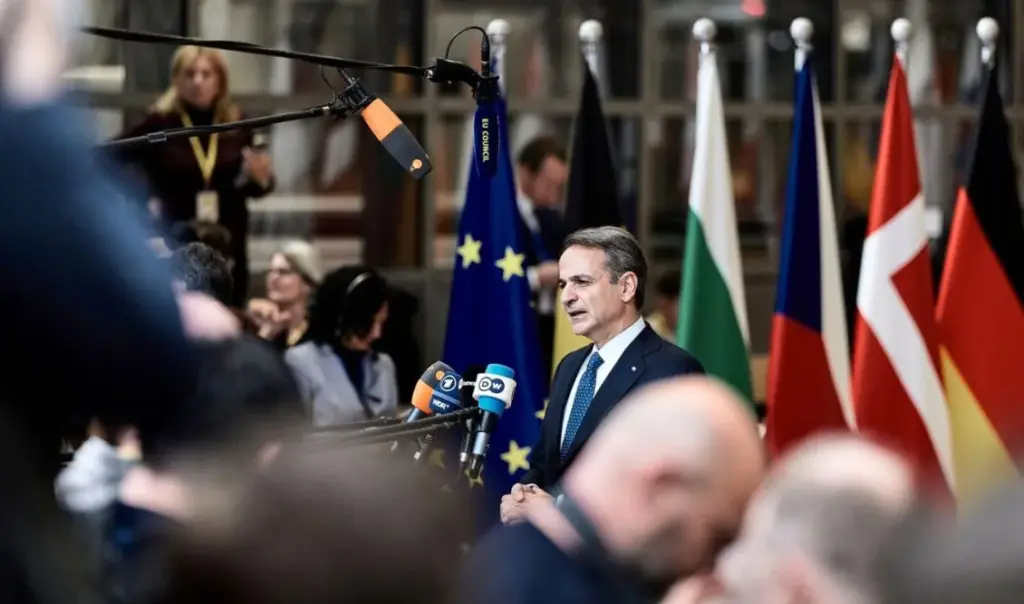
The compromise proposal presented by Mr. Mitsotakis at the extraordinary Summit, which concluded late Thursday evening in Brussels, was for the 13 countries invited to participate in the Peace Council to co-sign their accession, but only for the issue concerning the next phase of the peace process in Gaza and for as long as this requires. As he revealed speaking to journalists after the Summit’s conclusion, “both Ms. Kaja Kallas (the EU High Representative) and many other countries found the idea quite interesting to explore if not our open participation, because this may be legally difficult, but somehow taking European initiatives so that this Peace Council returns to its original destination.”
Greenland: Clear message of support to Denmark and status quo
Regarding Greenland, the European Council united (except Hungary) expressed its full support for Denmark and Greenland, an issue on which Donald Trump had earlier lowered the tone and withdrawn threats. The Greek Prime Minister has already openly expressed the position that Greenland is NATO territory and any attempt to change this status quo would be catastrophic. “We’re talking about European territory and this is something that under no circumstances, not only Greece, but Europe as a whole, will negotiate,” was the government’s position, as formulated by government spokesperson Pavlos Marinakis.
The leaders of the “27” will have the opportunity to discuss again soon in person, specifically on February 12, at the informal European Union Summit at Alden Biesen castle in Belgium, while the next day, on February 13, the Prime Minister plans to travel from Belgium to Germany, to participate in one of the most important annual international security conferences, the Munich Security Conference in Munich. Before these, next Friday, January 30, Mr. Mitsotakis will travel to Zagreb for the informal summit of the European People’s Party leadership and EPP party leaders.
Published in Parapolitika