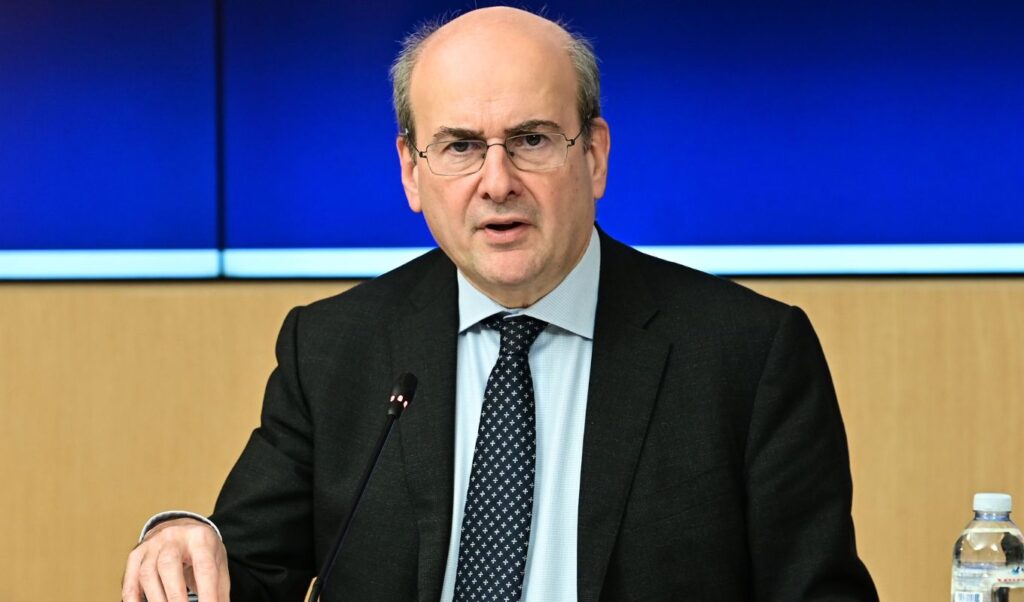
“Nobody wants the old OPEKEPE system of New Democracy, PASOK and SYRIZA,” emphasized Deputy Prime Minister Kostis Chatzidakis in a Thursday morning interview (22/1), while stressing that the promoted reform and transfer of responsibilities to the Independent Authority for Public Revenue aims to create a fairer system with clear focus on genuine producers.
Following Prime Minister Kyriakos Mitsotakis’ proposal for establishing a Cross-Party Parliamentary Committee to develop proposals for strengthening the primary sector, which was approved yesterday (21.01.2026), Kostis Chatzidakis, speaking on SKAI radio, called on opposition parties to make use of the remaining time until elections, so we can move away from the perception that the Ministry of Rural Development is merely a ministry of compensations and subsidies, and transform it into a ministry for comprehensive rural development.
He also noted that this is an opportunity to record views, invite experts and conclude with a body of proposals that will be useful for the path ahead. “We should do the same for the new Lyceum and National Graduation Exam, which was a PASOK idea. We all should contribute to forming a framework that will be positive for our children,” Kostis Chatzidakis emphasized.
“The effort has difficulties, but we cannot identify problems and remain inactive. In my political career I have dealt with various reforms. I don’t give up easily, many say ‘don’t do it, there’s political cost.’ I’m not saying I’ve been infallible, but with inaction and public relations we get nowhere,” he underlined.
Kostis Chatzidakis: Greece has strategic cooperation with the US
Regarding international developments and EU-US relations, Kostis Chatzidakis noted: “Greece has strategic cooperation with the United States and is simultaneously an organic member of the European Union. The traditional relationship between the two sides of the Atlantic is beginning to change, hopefully the pieces will be reassembled, but it will be difficult. This makes the crossword puzzle of our foreign policy more difficult, emphasizes the need to be very careful and reminds us of the added value of a serious and effective government at all levels, but certainly in foreign policy and defense.”
“We navigate,” he added, “on the international stage with international law as our axis. And we don’t ignore that in stormy seas you must travel with the strongest vessel and protect yourself as much as possible.”
On polls and 2026 planning
Additionally, when asked about recent polls, Mr. Chatzidakis highlighted two characteristics, one usual and one not. “The usual one concerns the government. We are in the second term, it’s expected that there’s fatigue in part of the electorate, but despite the fatigue and any mistakes, New Democracy remains higher than the second party by a large margin.
The unusual thing is that opposition parties, who invoke real or non-existent government mistakes, make criticism and fierce attacks, see their percentages falling. And the reason for this is that there’s no alternative solution for voters moving against New Democracy. There’s unprecedented unreliability of opposition parties. This is good for ND, because ND emerges as the only serious political force, but also bad because it can lead to complacency,” he commented.
Finally, regarding 2026 planning presented this week, Mr. Chatzidakis highlighted as most important reforms the new Code for Local Government that absolutely clarifies things, as he said, the new Lyceum that will proceed after national dialogue, and the “deep state” bill he will submit himself, addressing “stories of daily madness” in the public sector, as he characteristically noted.
“At the level of benefits and declaring good intentions, we cannot compete with the opposition. We have chosen to move with the logic of ‘say little to do everything’ and at the end of the term to say ‘we said it-we did it.’ We will present our proposals for Constitutional revision, for Greece 2030, for how the country should move in a turbulent world and for a new prospect giving realistic hope,” he concluded.