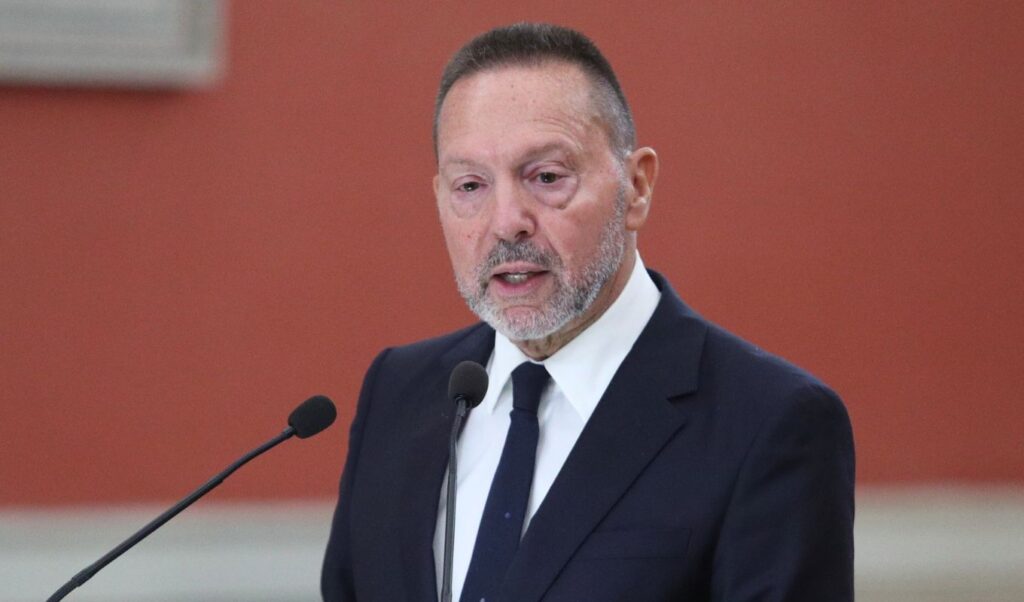
Growth “should not and cannot be based solely on consumption” stated among other things the governor of the Bank of Greece Yannis Stournaras, during his speech at the Hellenic Institute of Customer Service today, Thursday (22/01), emphasizing the need for the development model to shift from consumption towards investments.
Yannis Stournaras: The development model must shift from consumption to investments
Yannis Stournaras highlighted that based on Bank of Greece estimates, the real GDP growth rate is estimated to have reached 2.1% in 2025 and is projected to remain at 2.1% in 2026, while the average eurozone rate for the 2025-2026 period is positioned at 1.3%. For 2026, private consumption is expected to increase by approximately 2%, while investments are estimated to grow at a rate slightly above 8.5%.
The Bank of Greece recognizes that after 2026, the investment growth rate will moderate, but estimates that the impact of projects and reforms will continue, along with inflows from Structural Funds, foreign direct investment, and the Public Investment Program.
Yannis Stournaras, focusing on productivity at the center of his intervention, emphasizes that its rise allows higher real wages without jeopardizing competitiveness and employment, and that it requires investments in innovation, cutting-edge technologies, human capital, and digital skills. At the same time, he links the shift in the mix towards more outward-looking activities with greater resilience and a better current account balance picture.
The Bank of Greece regarding inflation reports that the harmonized index was 2.9% in 2025 from 3.0% in 2024 and is projected to decline to approximately 2.2% in 2026 and 2027, while for 2028 there is reference to a one-off increase to 2.5% due to the impact of the expanded emissions trading system. The labor market shows steady improvement, with unemployment at a 17-year low and a slowdown in unit labor costs, a development linked to strengthening cost competitiveness.
Yannis Stournaras in the fiscal field speaks of consistently high primary surpluses and rapid reduction of public debt, attributing revenue outperformance to improved compliance and digitization. Regarding banks, he notes that the 2025 stress test confirms resilience, with the non-performing loans ratio at 3.6% in September 2025, while business financing is moving close to 10% on an annual basis and household financing is positive, recently close to 2%.
Finally, particular reference is made to the “post-RRF” period: by the end of 2025, Greece had received approximately 65% of available resources and had completed nearly 50% of targets and milestones, while disbursements to businesses can continue until 2029. 2026 is described as a critical turning point, in an international environment of increased uncertainty, with geopolitical tensions, tariffs, and trade risks reinforcing the need for growth to be supported on more resilient foundations beyond consumption.