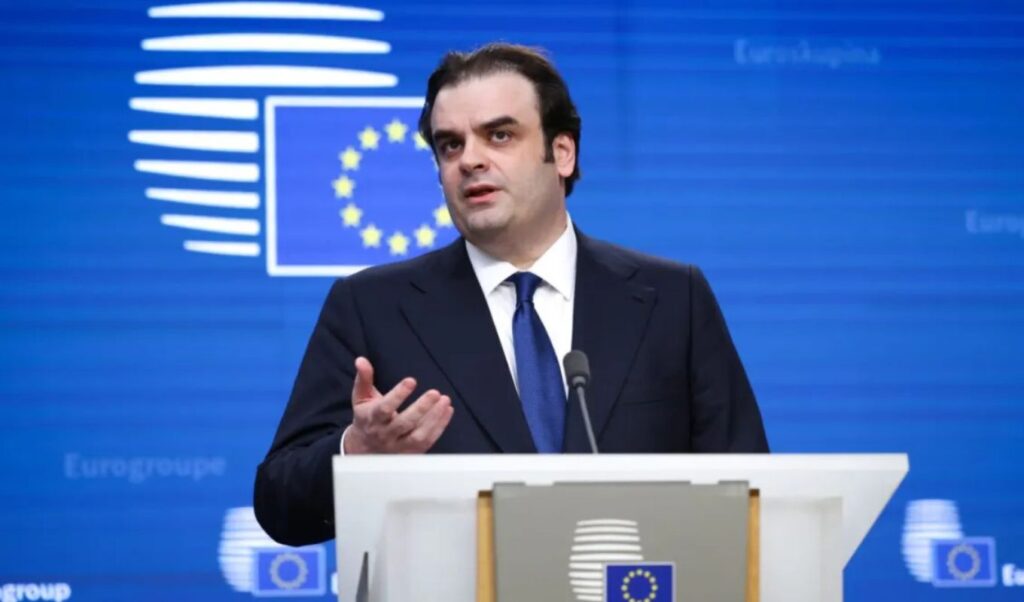
In an extremely tense international environment, with Europe facing an unprecedented diplomatic crisis with the United States over the Greenland issue, Kyriakos Pierrakakis is preparing to make his first appearance as president of the Eurogroup, diving straight into deep waters. A central theme of the agenda will be Bulgaria’s official entry into the eurozone, with the presence of the Bulgarian Finance Minister and representatives of the European Central Bank. This development expands the common currency to 21 member states and serves as a strong message of cohesion for the eurozone.
Economic Policy Recommendations for the 2026-2027 period are also expected to be tabled, as outlined in the recent institutional report. The document highlights ensuring fiscal sustainability as a basic priority, while simultaneously creating “space” for strategic investments, particularly in defense and competitiveness sectors.
Finance ministers are also called upon to strengthen the effectiveness of public finances and accelerate the completion of Recovery and Resilience Plans that constitute the main pillar of support for eurozone economies. Particular emphasis is placed on the need to strengthen public and private investments in research and innovation, industrial decarbonization, clean energy, and digital transformation. At the same time, the report notes that the European economy must strengthen its economic security and reduce strategic dependencies in value chains, with the main tool being the removal of barriers in the Single Market and the simplification of regulatory frameworks.
On the employment front, the recommendations call for strengthening labor markets through skills upgrading, improving education, increasing workforce participation, and supporting job quality. Simultaneously, it proposes addressing poverty and the housing crisis, with clear emphasis that wage increases must align with productivity. A significant chapter of the meeting will also be the briefing from the G7, with French Finance Minister Roland Lescure presenting the Group’s key priorities. In a period of increased international uncertainty, the focus is on financial system stability, energy developments, and support for Ukraine.
The candidate vice presidents of the Eurogroup
Meanwhile, the Eurogroup will examine the selection of the new ECB vice president, with six candidacies on the table and the decision requiring a majority of 16 out of 21 eurozone countries. Among the candidates are Portuguese and former Eurogroup president (2018-2020) Mario Centeno, Finnish and particularly well-known in Greece Olli Rehn, Latvian central banker Martins Kazaks, Estonian Madis Müller, Lithuanian Finance Minister Rimantas Sadzius, and Croatian central banker Boris Vujcic. The final selection requires a majority of 16 out of 21 eurozone countries.
The serious diplomatic crisis with the US
Despite the internal economic agenda, the meeting takes place under the shadow of a serious diplomatic crisis with the United States. In recent days, US President Donald Trump announced the imposition of 10% import tariffs from February 1st on eight European countries – including France, Germany, and Denmark – with the argument that these countries oppose American aspirations to purchase or control Greenland. The tariffs are expected to increase to 25% from June 1st, 2026, if the US does not receive an “agreement” for the purchase of Greenland, the autonomous territory belonging to Denmark.
This move has provoked strong reactions in Europe. The European Union and member state governments characterized Trump’s threats as “blackmail,” preparing responses that may include economic countermeasures and “freezing” the upcoming US-EU agreement. EU officials and leaders like Emmanuel Macron have emphasized that there is no consensus in Europe for surrendering sovereign rights or compromising on Greenland’s sovereignty, while an emergency meeting of EU ambassadors has been scheduled to address the crisis.