The US-EU trade agreement agreed just last year is being put “on the table” by Europe as it plans a harsh response to Donald Trump’s unprecedented “bullying” over Greenland.
Read: These are the 8 European countries Trump threatens with tariffs over Greenland
The so-called “bazooka” or EU Anti-Coercion Instrument (ACI), offers a series of punitive measures that can be used against trade rivals who attempt to threaten the bloc. Among these are restrictions on investments and access to public procurement programs, as well as intellectual property protection limits.
The measures are not limited to tariffs alone, but extend to intellectual property, trade restrictions, access to public contracts and markets, and investment restrictions, while unanimous decision from all member states is not required to activate countermeasures – a qualified majority is sufficient.
New Trump tariffs on eight European countries
On Saturday, the American president threatened to impose new tariffs on imported goods from eight European countries – Denmark, Norway, Sweden, France, Germany, Britain, the Netherlands and Finland – which deployed military forces to Greenland, which Donald Trump covets.
“These countries, which are playing a very dangerous game, have raised the level of risk to an unacceptable level,” Donald Trump judged via Truth Social, threatening to impose new tariffs of 10% from February 1 and 25% from June 1 if a “complete purchase agreement” for the island by the US has not been achieved in the meantime.
The EU committed to giving a “harsh” response to the new tariffs Trump imposed Saturday on the eight European countries that sent troops to Greenland to participate in joint exercises with Denmark (Operation Arctic Endurance) – in an attempt to undermine the US government’s argument-pretext that Europe cannot protect the Arctic island. Meanwhile, they warned the American president that his decision undermines transatlantic relations and risks a dangerous downward spiral.
“Bullying and threats will not affect us”
European leaders, including French President Emmanuel Macron and Norwegian Prime Minister Jonas Gahr Støre, characterized these threats as “unacceptable.” The European Union warned against a “dangerous” development in relations. “No bullying practice or threat will affect us, neither in Ukraine, nor in Greenland, nor anywhere else in the world when we face such situations,” Macron wrote in a post on X.
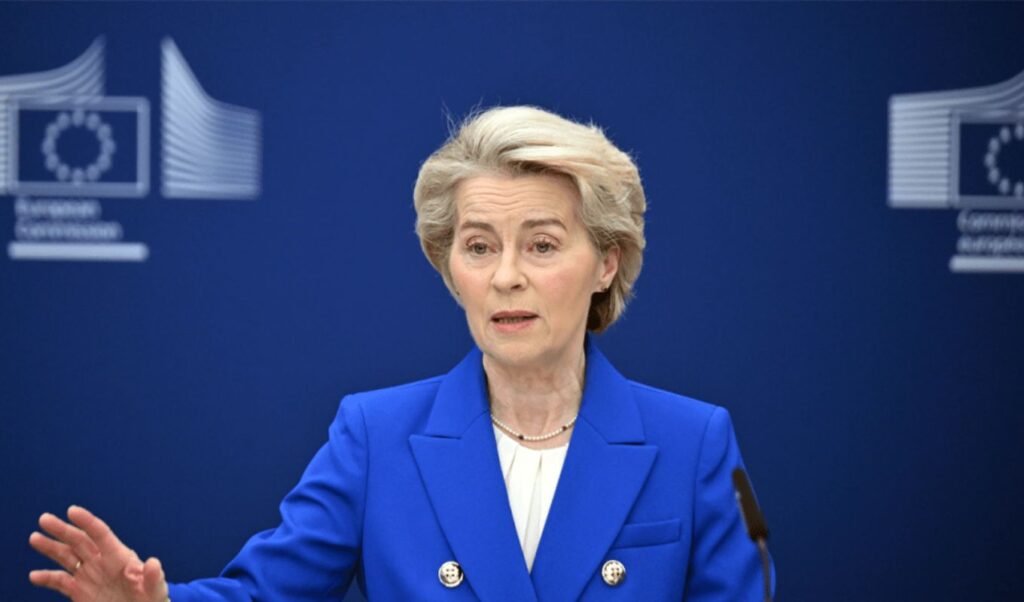
“Tariffs would undermine transatlantic relations and risk a dangerous downward spiral,” warned European Commission President Ursula von der Leyen, in her first reaction via platform X to Trump’s new threat to impose additional tariffs on certain European countries over Greenland.
“Europe will remain united”
The Commission President added that “Europe will remain united, coordinated and committed to safeguarding its sovereignty.” At the same time, she emphasized that the EU stands in full solidarity with Denmark and the people of Greenland. “Dialogue remains essential and we are committed to building on the process that already began last week between the Kingdom of Denmark and the US,” she added. The Commission head also noted that territorial integrity and sovereignty constitute fundamental principles of international law and emphasized that “they are essential for Europe and for the international community as a whole.”
She also pointed out that the EU has repeatedly emphasized “our common transatlantic interest in peace and security in the Arctic, including through NATO,” adding that the pre-coordinated Danish exercise, conducted with the participation of allies, responds to the need to strengthen security
One of the most prominent ministers of Greenland’s government, Naaja Nathanielsen, praised Saturday the reaction of European countries affected by Donald Trump’s new threats to impose additional customs tariffs, due to disagreements over the future of the vast island, an autonomous territory of Denmark. “I am amazed by the first reactions of the targeted countries. I am grateful and full of hope that diplomacy and alliances will prevail,” said Greenland’s Minister of Mineral Resources.
Territorial integrity and sovereignty are fundamental principles of international law.
They are essential for Europe and for the international community as a whole.
We have consistently underlined our shared transatlantic interest in peace and security in the Arctic, including…
— Ursula von der Leyen (@vonderleyen) January 17, 2026
Emergency meeting of EU ambassadors
In any case, Trump’s new tariff attack raised alarms in Europe. The ambassadors of the 27 EU member states will meet in emergency session tomorrow, Sunday, regarding Trump’s threat. Cyprus, which holds the rotating six-month EU presidency, announced late Saturday that it convened the emergency meeting, which, according to diplomatic sources, is expected to begin at 6 PM.
Since returning to power, the Republican president frequently refers to Washington’s desire to “take control” of the vast Arctic island, part of the Kingdom of Denmark, to counter what he characterizes as “advances” by Russia and China in the Arctic region. According to the most recent poll published this month, 85% of Greenlanders oppose annexation of the island to the US. Only 6% support the idea.
France, Sweden, Germany and Norway, along with the Netherlands, Finland, Britain and Slovenia, sent military personnel to the island this week for a reconnaissance mission, which is part of a Danish exercise called “Arctic Endurance,” organized in cooperation with Copenhagen’s NATO allies. Analysts commented that they saw the deployment of European military forces as a “strategic message” from Europe to the US.
American warning on trade agreement
Meanwhile, US Trade Representative Jamieson Greer warned Europe on Saturday not to attempt to link Donald Trump’s tariff threats against certain European countries over Greenland with the US-EU trade agreement. Greer added that it’s up to Europe to do so if they want, but implied they should avoid it for their own good.
“If I were in the Europeans’ position, I would probably try to isolate it, if they can. If they want to raise the issue in the context of the trade agreement, that really depends on them and not us,” Greer said speaking to reporters at the Detroit auto show.