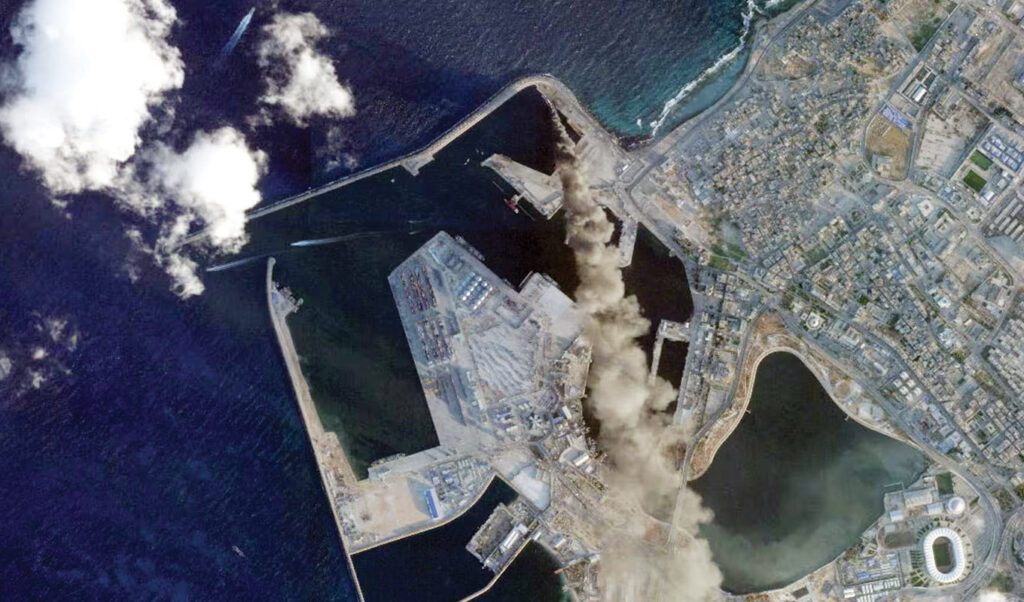
Athens is watching with close attention and without a trace of complacency as the Russia-Ukraine war extends its reach into the Mediterranean. Ukraine’s operation against Russian vessels in Benghazi — less than 500 kilometers from Crete — is fundamentally reshaping the security environment south of Greek territory. The geographic proximity of the conflict, combined with years of destabilization in Libya and the presence of competing foreign powers on its soil, is creating new realities for Greek diplomacy and military leadership.
How officials are assessing the situation in Libya
The assessment of the situation in Libya, according to informed sources who spoke to Parapolitika, is as follows: “This is a state that has been in collapse since 2011, which is why we are seeing these phenomena as a direct result of foreign powers penetrating the country. What is particularly alarming is that some of these powers are in conflict with one another.” From this perspective, the same sources told this reporter: “The operational planning of the Hellenic Armed Forces is now being shaped with potential security threats from the south of the country taken firmly into account.” Maritime surveillance, enhanced early warning capabilities, and countering asymmetric threats are emerging as critical pillars of the new security architecture. The use of unmanned surface vessels and underwater vehicles is transforming the traditional rules of naval warfare, making it imperative to protect not only military infrastructure, but also commercial shipping and energy installations.
How scenarios of Greek involvement in the Russia-Ukraine war emerged — and the claims of a Turkish professor
An additional dimension to this issue has been added by the cultivation of scenarios involving Greek participation in the Russia-Ukraine war by Turkish media outlets. International Relations Professor Ufuk Necat Taşçı, speaking on CNN Türk, attempted to arbitrarily link a naval drone discovered last May near Lefkada to the Ukrainian operation in Benghazi — without presenting any evidence to support his claim. Invoking Article 51 of the United Nations Charter, he argued that if the operation had been launched from Greek territorial waters, Greece would become a belligerent against Russia. This narrative is, of course, not grounded in any factual evidence, yet it is being voiced against a broader backdrop of insecurity surrounding international shipping, which is facing multiple flashpoints — from the Mediterranean, the Black Sea, and the North Sea to the Strait of Hormuz and the Red Sea.
Haftar: The Benghazi strike upends the balance of power — why he is turning to Turkey, Qatar, and Egypt
The sinking of the Russian corvette Merkury in Benghazi and the strike on the cargo vessel M/V Angara also mark a turning point for the Haftar family. Eastern Libya — a key node in Russia’s military supply network to Africa — is now becoming a battleground between Moscow and Kyiv. The near-simultaneous diplomatic overtures by the Haftar family toward Ankara, Doha, and Cairo can be read as a manifestation of a multi-front political survival strategy. Their traditional reliance on Russian protection no longer provides sufficient security guarantees. Khalifa Haftar is now reaching out to Turkey — once his adversary — whose military intervention derailed his plans to seize Tripoli in 2019–2020. His successor, Saddam, is seeking military and economic cooperation channels with Qatar, while Belqasem, tasked with Libya’s reconstruction, is working to preserve privileged ties with Egypt.
This is, in essence, an attempt to diversify the family’s external support base in anticipation of a potential further escalation of the Russia-Ukraine conflict. Athens is watching with close attention the geopolitical dimension of the Ankara-Benghazi rapprochement. The presence of the heads of the Turkish Armed Forces and the MIT intelligence service at the Erdoğan-Haftar meeting — alongside the participation of Turkey’s energy minister in the broader talks — is indicative of the scope of the cooperation being pursued. By investing in the unification of Libyan institutions, Ankara is seeking to consolidate its influence across the whole of Libyan territory, secure preferential access to the country’s energy resources, and strengthen its negotiating position on migration by controlling the flow of refugees and migrants. The publication of the Turkey-Libya memorandum in Libya’s Official Gazette has deepened concerns. Article 4 provides for the possibility of jointly exploiting cross-border hydrocarbon deposits, while Article 5 makes the consent of both parties a prerequisite for any amendment to the agreement. Athens has stated that “whether published or not, ratified or not, the Turkey-Libya memorandum remains invalid and does not legitimize future actions. The Libyans have made a political choice. We will now reassess everything. Any unilateral actions by Libya will have consequences” — a thinly veiled threat to cut off European funding to Libya.
Athens puts technical talks with Libya on ice while accelerating coordination with Egypt
Athens is conducting a comprehensive reassessment of its relations with Libya — keeping diplomatic channels open while temporarily suspending technical talks on maritime zone delimitation. At the same time, coordination with Cairo is accelerating over the expansion of the landmark 2020 agreement, while Greek diplomacy is leveraging the European Union’s condemnation of the Turkey-Libya memorandum and the possibility of applying economic pressure through European funding mechanisms. For its part, Ankara — through its National Security Council — is reaffirming its commitment to dialogue and diplomacy, while making clear that it remains unyielding in the defense of its claims.
Published in Parapolitika