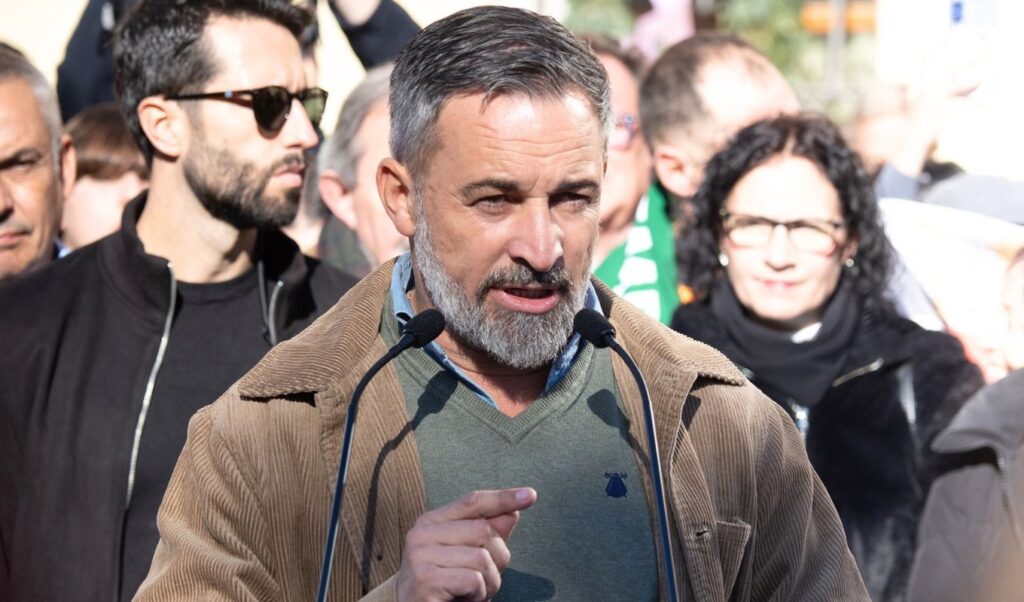
A decade ago, Santiago Abascal was a politician with limited influence, leading a party that struggled to gain a parliamentary foothold in Spain. Today, at 50, he is contending for a role in the next government of the eurozone’s fourth-largest economy, with the prospect of his far-right Vox party joining a governing coalition emerging as one of the central issues ahead of this coming Sunday’s elections. If Vox enters central government, it will be the first time since the restoration of democracy in Spain that a far-right party has participated in governing the country.
Read also: Spain’s electoral map: Madrid on the verge of a far-right turn in the post-Franco era — the agenda and the contenders
Santiago Abascal: From the political margins to the center stage
The New York Times has devoted an extensive feature to Abascal, examining how a politician who spent years on the fringes of Spanish political life managed to position himself at the heart of the action — capitalizing on the immigration debate, widespread dissatisfaction with Pedro Sánchez’s government, and deep-seated anxieties about national identity. The possibility of Vox entering government alongside Alberto Núñez Feijóo’s conservative People’s Party also revives a historical debate that has shadowed Spain for half a century: the relationship between the modern Spanish right and the legacy of Francisco Franco.
Who is Santiago Abascal — childhood years in the Basque Country
Santiago Abascal was born on April 14, 1976, in Bilbao and grew up in Amurrio, in the Basque Country, in a family with deep roots in local politics. His grandfather had served as mayor of Amurrio during Franco’s dictatorship and the early years of the democratic transition, while his father was a businessman and a member of the People’s Party.
His childhood was marked by the activities of the Basque separatist organization ETA. As El País reported in an earlier profile, at just nine years old he learned from television about the murder of someone he knew — the postman of Amurrio.
Abascal’s family faced repeated threats because of their political activity. In 1999, his father’s clothing shop was set on fire. When the family rebuilt it, they installed bulletproof glass. Abascal, today a father of five, has said he recounts these family stories to his children, believing such experiences can strengthen their character.
Defending Spain’s territorial integrity and opposing greater autonomy for the Basque Country and Catalonia have since been central pillars of his political journey. Unlike many leaders of the European far right, however, Abascal did not emerge from outside the traditional political establishment.
From the People’s Party to the leadership of Vox
He joined the People’s Party in 1994 at the age of 18 and remained within its ranks for nearly two decades. From 1999 to 2007 he served as a municipal councillor in Llodio, and from 2004 to 2009 he was a member of the Basque regional parliament.
As early as 2008, he had voiced his disagreement with the People’s Party’s approach toward regional nationalist parties, arguing that he would sooner support an agreement with the Socialists than with political formations that questioned Spain’s unity.
The definitive break came in 2013, during Mariano Rajoy’s premiership. Abascal left the party, criticizing its handling of separatist movements. He subsequently aligned himself with the newly founded Vox, taking over its leadership in 2014.
Immigration at the center of Vox’s election campaign
Vox’s early years gave little indication of the electoral rise to come. The party struggled to gain parliamentary representation, while most conservative voters continued to rally around the People’s Party. The Catalan crisis and the 2017 independence referendum gave Abascal the opportunity to bring his Spanish nationalist positions to a national audience.
In December 2018, Vox entered the regional parliament of Andalusia with 12 seats. In April 2019 it won 24 seats in the national parliament, and in the repeat elections of November that year it increased its tally to 52.
The trajectory has not been uniformly upward, however. In the July 2023 elections, Vox was reduced to 33 seats, losing roughly 600,000 votes compared to the previous contest. In this year’s campaign, Abascal has visited more than 30 cities and towns, seeking to strengthen the party’s presence in smaller constituencies where the distribution of seats tends to favor larger political formations.
While the defense of Spain’s unity dominated Vox’s early years, immigration now sits at the core of its campaign. The party’s current electoral platform, titled “Common Sense,” calls for tighter border controls, the deportation of migrants, and priority access to public services for Spanish citizens.
Abascal described the mass crossing of Moroccans into the Spanish enclave of Ceuta last July as an “invasion,” and he chose the Canary Islands — where migrant arrivals have surged — as the launch site for his election campaign.
This stance contrasts sharply with that of Pedro Sánchez, who argues that immigration contributes to economic growth and helps fill labor shortages in critical sectors.
Vox is seeking to link immigration to the cost of living, housing access, and pressure on public services. However, the causes of Spain’s housing crisis are broader, including insufficient construction of new homes and rising demand. This shift allows the party to appeal to voters beyond those traditionally mobilized by the question of national unity.
Ties with Meloni, Le Pen, Orbán, and Trump
Abascal’s political influence extends beyond Spain. The Vox leader has cultivated relationships with Italian Prime Minister Giorgia Meloni, Marine Le Pen in France, and Alice Weidel in Germany, and since 2024 has led the European political alliance “Patriots for Europe.” According to the New York Times, Vox received loans in 2023 and 2024 from a bank partly owned by the Hungarian state under Viktor Orbán, in order to help finance part of its campaign activities.
These international connections reflect a broader collaboration among European nationalist parties on issues such as curbing immigration, strengthening national sovereignty, and opposing certain EU policies. A potential Vox entry into the Spanish government would lend this alliance considerably greater political weight, given the size of the Spanish economy and the country’s position within the European Union.
Abascal has also sought to cultivate ties with the American conservative movement, attending international events at which Donald Trump has been the central figure. The New York Times, however, recalls a rather awkward moment from 2023: at the CPAC conference, Trump attempted to greet the Vox leader but confused both his surname and his first name, ultimately saying: “Thank you, San Diego.”
Despite the incident, several of Abascal’s policy positions on immigration and the prioritization of Spanish citizens’ interests bear a resemblance to Trump’s “America First” approach.
He rejects the label “far-right”
Spain’s situation presents a significant historical peculiarity compared to the rise of the far right in other European countries. Francisco Franco ruled Spain from the end of the Civil War in 1939 until his death on November 20, 1975. His dictatorship was defined by the abolition of civil liberties, the persecution of dissidents, censorship, and the suppression of political opposition. The restoration of democracy and the adoption of the 1978 Constitution established a new political system in which the far right remained on the margins for decades.
Abascal rejects the far-right label, presenting his positions as an expression of common sense. Yet according to coverage of the New York Times piece in the Spanish press, he has also made comparisons favorable to Franco when contrasting the dictator with current Prime Minister Pedro Sánchez.
Sánchez, for his part, has invoked the historical memory of the dictatorship to warn voters about the consequences of a People’s Party–Vox coalition government. Political analysts speaking to the Associated Press note, however, that references to Franco resonate less with younger generations, who have no personal experience of the dictatorship and assess parties primarily on the basis of today’s social and economic challenges.
The polls and the prospect of a coalition with the People’s Party
The latest poll by 40dB, published on November 22, placed the People’s Party at 31.9% and Vox at 16.9%. In the previous national elections, the People’s Party had secured 137 seats and Vox 33, while Pedro Sánchez’s Socialists had won 121 seats. An absolute majority in the Spanish parliament requires 176 of the 350 seats. The composition of the next government will depend on how seats are distributed and on the negotiations between parties.
The People’s Party and Vox already have experience of working together at the regional level, though their relationship is not without tensions. The two formations diverge on immigration policy, regional governance, and European integration.
For Abascal, Sunday’s elections represent the most significant political test since he left the People’s Party in 2013. For Spain, they once again raise the question of far-right participation in central government — half a century after the restoration of democracy.