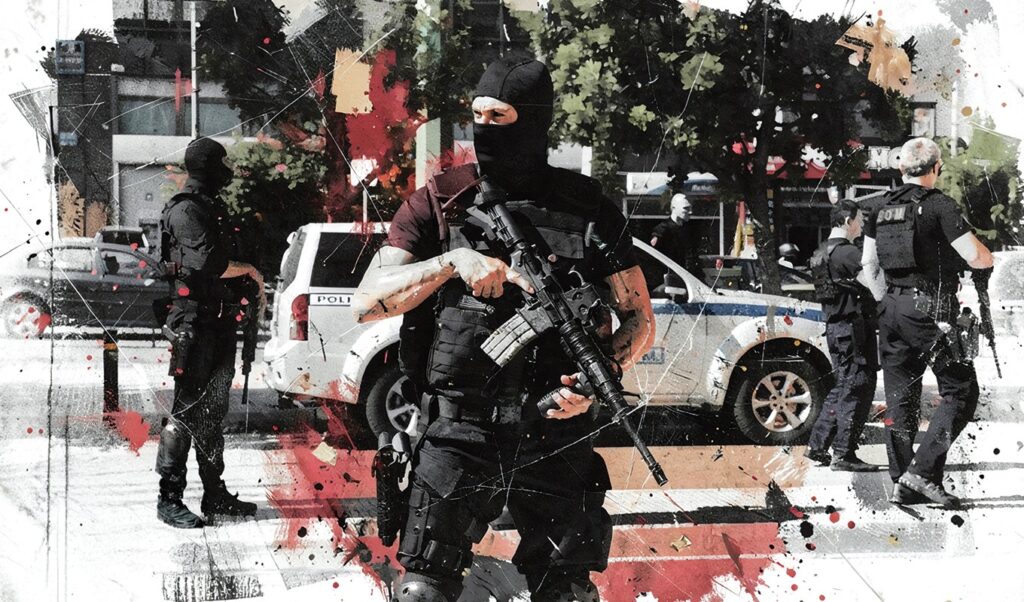
A large group of North Macedonian criminals, primarily linked to Nikola Gruevski — who faces numerous corruption charges in his home country and now resides in Budapest after obtaining Hungarian citizenship — appears to have supported one of the five arrested suspects in carrying out a plot to assassinate a Greek-Jewish business executive, acting on orders from Iranian intelligence services.
The 35-year-old suspect, arrested on October 27 at the Kipoi border crossing in the Evros region following intelligence provided by Mossad, had been under surveillance for months as he repeatedly entered and exited Greece, staying at properties belonging to the former North Macedonian prime minister in Athens, Thessaloniki, and Halkidiki.
His movements around the home and Jewish synagogue of the prominent target immediately raised suspicions. Both he and his four accomplices — arrested in the neighboring country and remanded in custody on November 12 — carry serious criminal records, and had been making trips to Turkey, specifically to its southern coast, either through Greece or Bulgaria. This coastal region is home to one of the operational headquarters of the network’s masterminds: Iranians Edris Mavaneh and Naji Zindasti.
Greek intelligence (EYP) also identified two additional targets of the alleged hired killers: a Turkish dissident and a fellow countryman who operates as a people smuggler, primarily trafficking Palestinian extremists. This individual is alleged to have informed on the Palestinians arrested last June in Crete and Cyprus, who had been plotting a terrorist attack against Israeli tourists aboard a cruise ship.
Gruevski, who has since abandoned any plans to return to politics, is considered a key link in the organized crime chain, commanding a powerful network of state officials in Skopje who help direct criminal operations.
Accomplices
The names mentioned above, along with secondary figures such as Çetin Koç and brothers Orhan and Ilgan Ungan — also major drug traffickers — appear on Mossad’s list as collaborators with the notorious Unit 840, a covert branch of Iran’s state security directorate, VEVAK.
During Zindasti’s trial in April 2024 before the Three-Member Court of Appeal for Felonies in Piraeus, where he was acquitted due to reasonable doubt, the court acknowledged that he had also functioned as an agent for the United States Drug Enforcement Administration (DEA).
Recruitment
The Achilles’ heel of these narco-warlords lies in their method of recruitment: for what they frame as “political and national crimes,” they enlist random foreign nationals — individuals who are easily traceable and entirely expendable. In one notable case in March 2023, Pakistani migrants working as agricultural laborers in Laconia and Zakynthos were recruited for a mere €10,000 to carry out a bombing attack on a Jewish restaurant in the Psyrri neighborhood of Athens. A similar pattern emerged with the Palestinian recruits, whose confessions proved instrumental in uncovering critical intelligence.
An empire
Beyond drug trafficking, Zindasti’s operations are deeply intertwined with Iranian state terrorism. According to the U.S. Department of the Treasury, his organization functions as an informal arm of Iran’s Ministry of Intelligence and Security (MOIS). In exchange for absolute protection and financial impunity, his network takes on the elimination of dissidents and journalists.
Perhaps the most striking case is that of Habib Chaab, an Iranian-Swedish dissident who in 2020 was lured into a trap in Istanbul. Zindasti’s men drugged him and smuggled him back to Iran, where he was ultimately executed in May 2023. Other operations attributed to the same network include the assassinations of Said Karimian, founder of GEM TV, in 2017, and former Iranian intelligence officer Masoud Molavi Vardanjani in 2019.
Zindasti’s story began in Urmia, in western Iran. Although sentenced to death in 1996 on drug-related charges, he managed to escape during a prison transfer, leaving a prison guard dead behind him, and found refuge in Turkey. There, he built a drug trafficking empire. According to investigations by Iran International, he secured his dominance through the protection of high-ranking members of the Islamic Revolutionary Guard Corps (IRGC). His organization is estimated to have controlled up to 20% of total drug trafficking in Iran and 35% in Tehran alone.
The Bindi connection
Also active in the Balkans is a middle-aged Iranian known as Ehsan Bindi, who in 2020 was expelled from both Greece and Albania — the latter being home to a community of Iranian dissidents living in a camp north of Tirana. Bindi and two Iranian diplomats were in direct contact with the late commander of the Quds Force special operations unit, General Qasem Soleimani, who was killed in January 2020.
While imprisoned in Egypt, Bindi maintained parallel contacts with the military regime there. Iranian intelligence subsequently attempted to relocate him to Austria, Finland, or Denmark, but all three countries refused to accept him. Traveling on an Iranian passport, he was eventually sent to Turkey, then Romania, before finally ending up in Albania and Greece.
Warnings
The then-director of Mossad, David Barnea — succeeded today by Ronen Bar — stated at the time that Israeli intelligence had cooperated with partner agencies to dismantle 27 groups that had attempted to organize Iran-directed attacks abroad. In the United States alone, at least five cases of alleged Iranian-linked assassination or kidnapping plots have been recorded, three of which involved hired killers.
According to a Reuters report, Iranian extremist operations were also attempted in Athens in both 2021 and 2022, though they were neutralized in time.
Published in Parapolitika