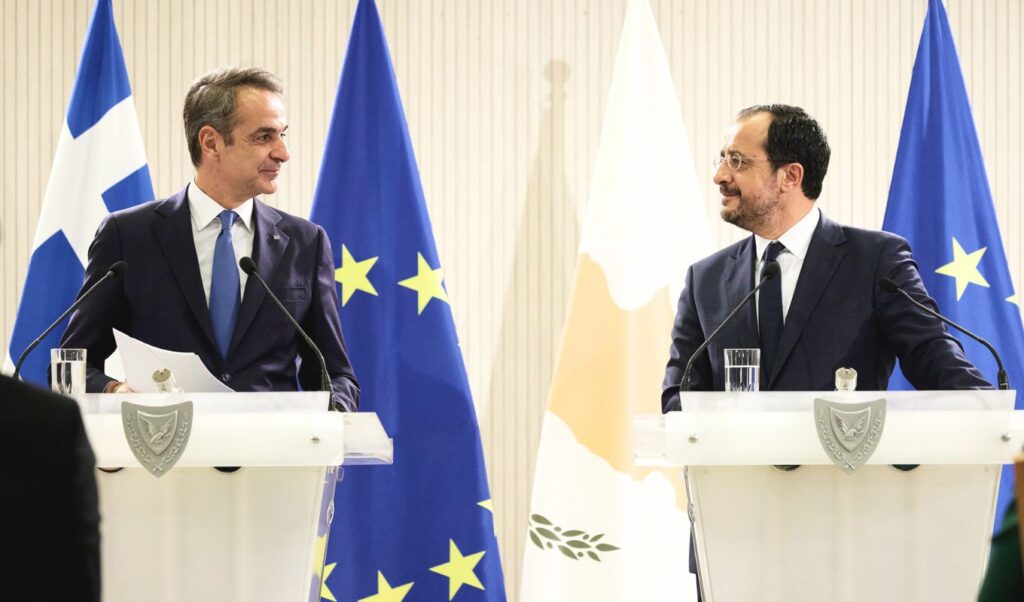
The Cyprus issue is entering a new phase of diplomatic activity, with the coming weeks shaping up to be critical for the prospect of resuming negotiations, amid intense behind-the-scenes movement along the Brussels–Nicosia–Ankara axis. During the fourth Greece–Cyprus Intergovernmental Summit, held on Wednesday in Nicosia, Kyriakos Mitsotakis and Nikos Christodoulides reaffirmed the common course of Athens and Nicosia, with the Greek Prime Minister reiterating his support for efforts to restart talks, guided by the bizonal-bicommunal federation framework — in direct opposition to Turkey’s insistence on the partition of the island.
Read also: Trump is closely following the Cyprus issue and wants it resolved: What journalist Matthew Boyle reveals exclusively to Parapolitika
Trilateral meeting
According to information available, next Tuesday at 3:00 p.m., the President of the Republic of Cyprus is expected to meet with the self-styled leader of the breakaway north, Tufan Erhürman. The plan envisages that, following this meeting, UN Secretary-General António Guterres will invite both leaders to a trilateral meeting, tentatively scheduled for early December on neutral ground — specifically, a European city. The outcome of this trilateral will determine the UN chief’s next steps. Should Mr. Guterres conclude that sufficient ground exists to advance the process, he is expected to proceed with convening a broader conference involving all three guarantor powers: Greece, Turkey, and the United Kingdom.
Behind-the-scenes pressure
Meanwhile, behind closed doors, the UN Secretary-General is reportedly pressing the European Union to demonstrate movement on the EU–Turkey relations front, in an effort to create more favorable conditions for Ankara’s return to the negotiating table. Against this backdrop, particular significance attaches to yesterday’s meeting in Ankara between European Commission Executive Vice President Raffaele Fitto and Turkish Foreign Minister Hakan Fidan. According to the same sources, the Turkish side is seeking a concrete “quid pro quo” in exchange for agreeing to restart the Cyprus talks. That concession is none other than the resumption of negotiations over the modernization of the EU–Turkey customs union — a longstanding Ankara demand with significant economic and political dimensions.
In the meantime, the “prime minister” of the breakaway north, Ünal Üstel, announced the “New Famagusta” project — a plan for the radical transformation of occupied Famagusta that would reshape the city and reconnect it with the sea. He claims it will turn the city into one of the most powerful tourist destinations in the region, envisioning the demolition of old hotels to make way for resorts and the conversion of occupied properties — left in ruin since the invasion — into vacation retreats. He also rejected President Christodoulides’s proposal to place the walled city under EU administration.
The key question now is whether Turkey’s European perspective can function as a lever of pressure for meaningful progress on the Cyprus issue, and as a bulwark against the provocative plans of the breakaway administration. In any case, the diplomatic contacts of the coming days are expected to reveal whether the apparent momentum can be translated into a substantive negotiating process.
The background of the Gerapetritis–Fidan meeting and the “rehearsal” of the “Blue Homeland”
With lines of communication open, yet with Athens bracing for the possibility of new provocations from Ankara, Greek–Turkish relations are entering a new period of testing.
The meeting between Giorgos Gerapetritis and Hakan Fidan in Brussels — finalized at the last minute and lasting approximately half an hour — was the first since the unblocking of research activities related to the undersea cable. The Greek Foreign Minister directly raised with his Turkish counterpart the need for the electricity interconnection project to proceed without obstacles, emphasizing its European dimension.
Telling was the stance of the Turkish diplomatic chief who — according to reliable sources — avoided voicing objections, while nonetheless stopping short of providing any assurances regarding the way forward.
On the Turkey–Libya memorandum, Mr. Fidan attempted to shift the burden of developments onto the Libyan side. Regional developments in the Middle East were also on the table. The two ministers are expected to have another opportunity to meet on December 2nd, on the sidelines of the NATO ministerial summit.
Cairo’s move
One development that Athens views positively is Egypt’s latest intervention at the United Nations. In a verbal note dated November 5th, Cairo not only reiterates its non-recognition of the 2019 Turkey–Libya memorandum, but also comprehensively rejects all subsequent Turkey–Libya energy agreements based upon it. Of particular significance is Egypt’s declaration that it reserves the right to defend its sovereign rights and to oppose any attempt to violate them.
Cairo’s move is considered exceptionally important for two reasons: on one hand, it comes at a time when Athens and Cairo have agreed to begin consultations on extending the landmark 2020 maritime agreement. On the other, it reinforces the assessment that Egyptian leadership has no intention of yielding to Turkish overtures for a bilateral maritime zone delimitation — despite the lure of a more generous sea allocation, as this publication had previously revealed.
The next major test for Greek–Turkish relations is expected, according to the Greek government, to be the tabling of the “Blue Homeland” bill in the Turkish National Assembly. While some believe this is a matter of weeks away, the prevailing view in Athens is that developments are not quite so imminent. What is of particular importance is that Greece’s response is expected to materialize from the moment the bill is tabled — not after it is voted into law. Among the options in Greece’s quiver is the extension of its territorial waters to 12 nautical miles south and west of Crete, though this is not the only tool available. Ankara, meanwhile, appears to be gradually laying the groundwork. Following the announcement last summer of Turkish maritime parks, the so-called “Blue Plan” — with a horizon extending to 2050 — was presented days ago at the Antalya Summit. Under the guise of an environmental initiative, the plan aspires to define the framework of Turkish maritime activities for decades to come, and there are many who see behind it a preparatory move toward the institutionalization of the “Blue Homeland” doctrine.
Published in Parapolitika