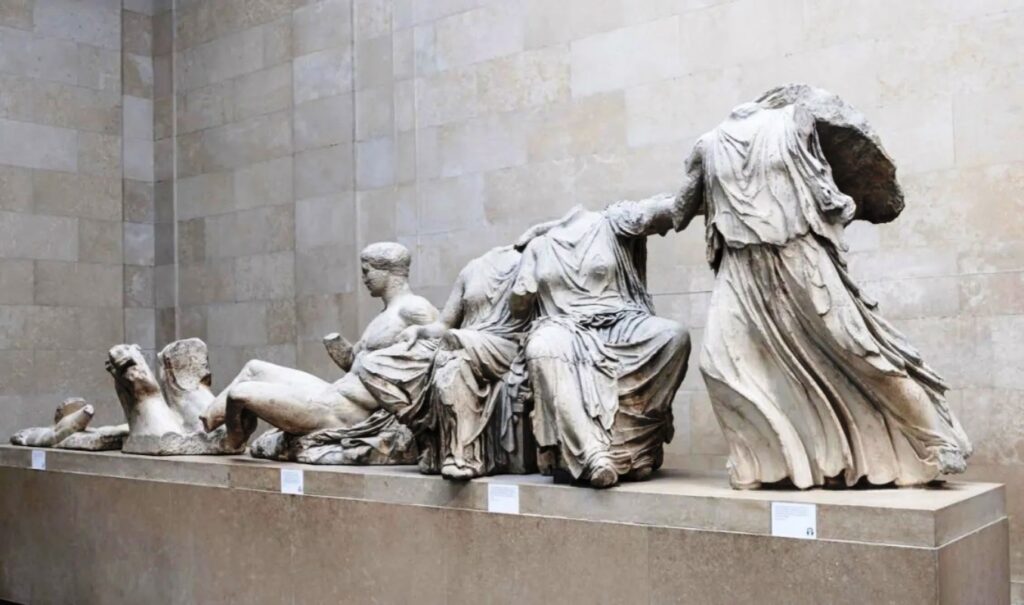
The British government has no intention of changing the legislation that prevents the permanent return of the Parthenon Sculptures to Greece, yet it reaffirms its support for ongoing talks between the British Museum and the Greek side. This position was formally stated in the House of Lords, where several members raised the issue of reuniting the Sculptures and challenged the restrictions imposed by the existing legal framework. London maintains its refusal to pursue legislative intervention, while leaving open the possibility of a mutually acceptable agreement through negotiations currently underway.
Read also: British Museum: Activist appears at gala wearing a dress reading “Return the Parthenon Sculptures” (Photos)
Parthenon Sculptures: How the British government responded
The debate was triggered by a question from the independent Earl of Clancarty, who asked whether proposals for the permanent return of the Sculptures had been considered. Culture Minister Baroness Twycross clarified that no such assessment had been carried out, reiterating the government’s established position. “The government has no plans to change the law or introduce legislation that would allow for the permanent return of the Parthenon Sculptures,” she stated. She did, however, welcome the ongoing discussions between the British Museum and Greek ministers.
The case for return: voices in favour
The Earl of Clancarty argued that the matter is fundamentally an aesthetic one, drawing a comparison with Picasso’s Guernica and questioning how the world would react if such a masterpiece were split between different museums. He proposed a limited amendment to the British Museum Act 1963 that would grant the institution the authority to make its own decision regarding the Sculptures.
Labour peer Lord Dubs sought clarification on the available legislative options, while Baroness Chakrabarti challenged the loan solution by invoking the hypothetical scenario of removing British Crown Jewels. Baroness Hussein-Ece highlighted Greece’s long-standing claim and pointed to the existence of the Acropolis Museum as a fitting home for the Sculptures.
The legal barrier and the loan solution
Baroness Twycross explained that the British Museum Act 1963 prohibits, with very limited exceptions, the permanent removal of objects from the British Museum’s collections. She reiterated that the Museum could consider a loan arrangement, provided its ownership was formally acknowledged and a binding guarantee of return was given. The loan of the Bayeux Tapestry from France to Britain was cited as a potential model for such an agreement. Conservative peer Lord Hailsham, however, cautioned that returning the Sculptures could set a precedent for other antiquities held in British institutions. The British government ultimately reaffirmed its support for finding a resolution within the existing legal framework, citing the strong historical and cultural ties between the two countries.