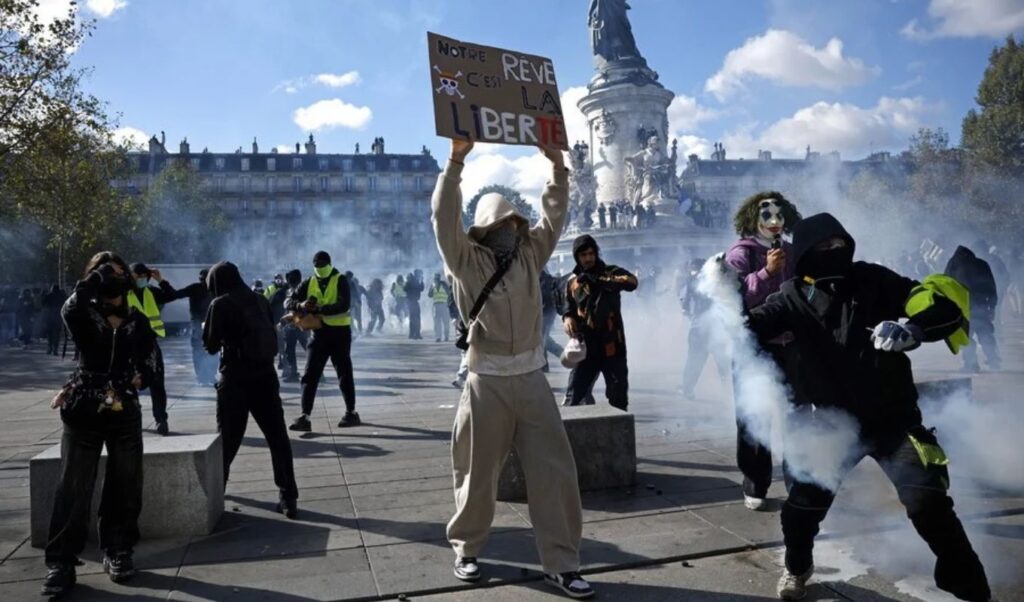
Demonstrations and mobilizations began early morning across France, as the country braced for a major nationwide protest against the cost of living crisis and the erosion of a social model designed to guarantee basic opportunities and social protection. High school students, farmers, climate activists, and members of the Yellow Vests movement coordinated their actions, voicing their anger over the social and economic situation — all this six months before the presidential elections, with authorities warning of potential violent clashes.
Read also: France: Yellow Vests return to the streets on Saturday alongside students
The mobilizations are evoking memories of the massive Yellow Vests social movement that shook France in 2018 and 2019, initially triggered by fuel tax hikes. At the time, scenes of violence on the fringes of protests — particularly on the Champs-Élysées — made global headlines. The call to revive that movement, which defined the first presidential term of Emmanuel Macron, urging protesters back into the streets to block roundabouts and strategic locations in protest against the “high cost of living,” resonated strongly with ongoing student demonstrations that have been taking place since mid-September, demanding better conditions in schools and universities.
In the eurozone’s second-largest economy — heavily indebted and under tight scrutiny from financial markets — this potential “convergence of struggles” is unfolding against a backdrop of high social tensions, fueled by rising fuel prices and declining purchasing power.
The full scale of the day’s protests remains difficult to predict, falling on the first day of school holidays, while unions have called on both public and private sector workers to demonstrate and strike on November 5.
In the morning, several previously announced actions and blockades failed to materialize, including at the toll plaza on the Île de Ré bridge on the Atlantic coast and in Bordeaux. In Rennes, Brittany, around twenty people erected an improvised roadblock using garbage bins near a large shopping center.
🚨🇫🇷 ALERTE INFO | Des manifestants ont ATTEINT les QUARTIERS CHICS de Paris. (@LibreQg) https://t.co/js5UKTJsfC
— Impact (@ImpactMediaFR) October 17, 2026
🔴 🇫🇷 FRANCE URGENT Gros débordements à la Guillotière (Lyon). Tirs de mortiers, jets de projectiles, affrontements violents. Situation chaotique. À suivre. #Lyon #Guillotière #17Octobre https://t.co/HFboyrvuxJ
— Geocrises FR (@geocrises) October 17, 2026
Christophe, a 47-year-old carpenter and veteran Yellow Vests protester, says he was injured during the 2018 demonstrations after being struck by a flashball launcher — a weapon whose use by law enforcement remains highly controversial. “Today, we’re seeing repression being used against our own children,” he told Agence France-Presse with visible outrage.
Police have faced criticism over their response to the demonstrations, following a series of serious injuries among protesters — including a 15-year-old who lost his hand when a flashball device exploded. The police internal affairs unit is currently investigating at least 24 complaints of police violence.
Following the teenager’s injury, authorities suspended the use of flashball launchers. However, the Interior Minister stated that they could be deployed again if deemed necessary.
Prime Minister Sébastien Lecornu announced that more than 900 police officers had been injured during protests in recent weeks.
Demonstration dispersed in Paris
Police presence was heavy in central Paris, particularly near landmark locations such as the Champs-Élysées and the Arc de Triomphe. Around one hundred protesters attacked the headquarters of the CNews television network — owned by conservative billionaire Vincent Bolloré’s media group — hurling objects at the windows, according to Paris police, who reported 21 arrests.
A further forty people were arrested “primarily for possession of protective equipment or prohibited weapons” in the capital, where protest bans have been issued across large swathes of the city.
In Lyon, around forty people attempted to block traffic on a bridge, while others tried to gather near a refinery, according to local prefecture officials.
In Marseille, the central Prado avenue was briefly blocked using garbage bins and scooters, but protesters were quickly dispersed by police. Approximately 1,500 actions — demonstrations or blockades — had been announced across France for the day. According to sources close to the Interior Ministry, around 500 “planned” actions and more than 90 scheduled marches were expected.
🔴⚠️ URGENT La situation est chaotique au centre-ville de Marseille. #17octobre https://t.co/7BWDYDMIUM
— confrontation française (@confrontfr) October 17, 2026
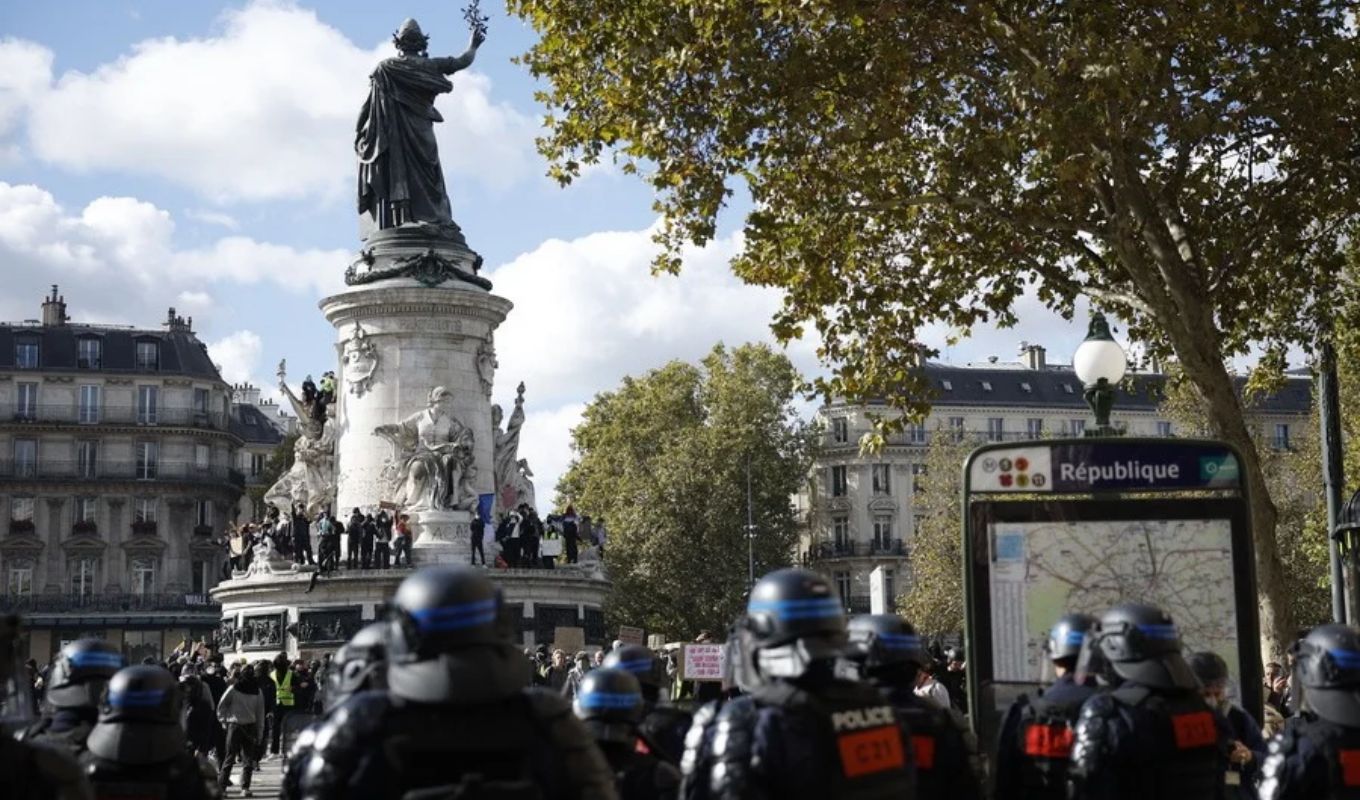
France: Tear gas and tensions ahead of Place de la République march in Paris
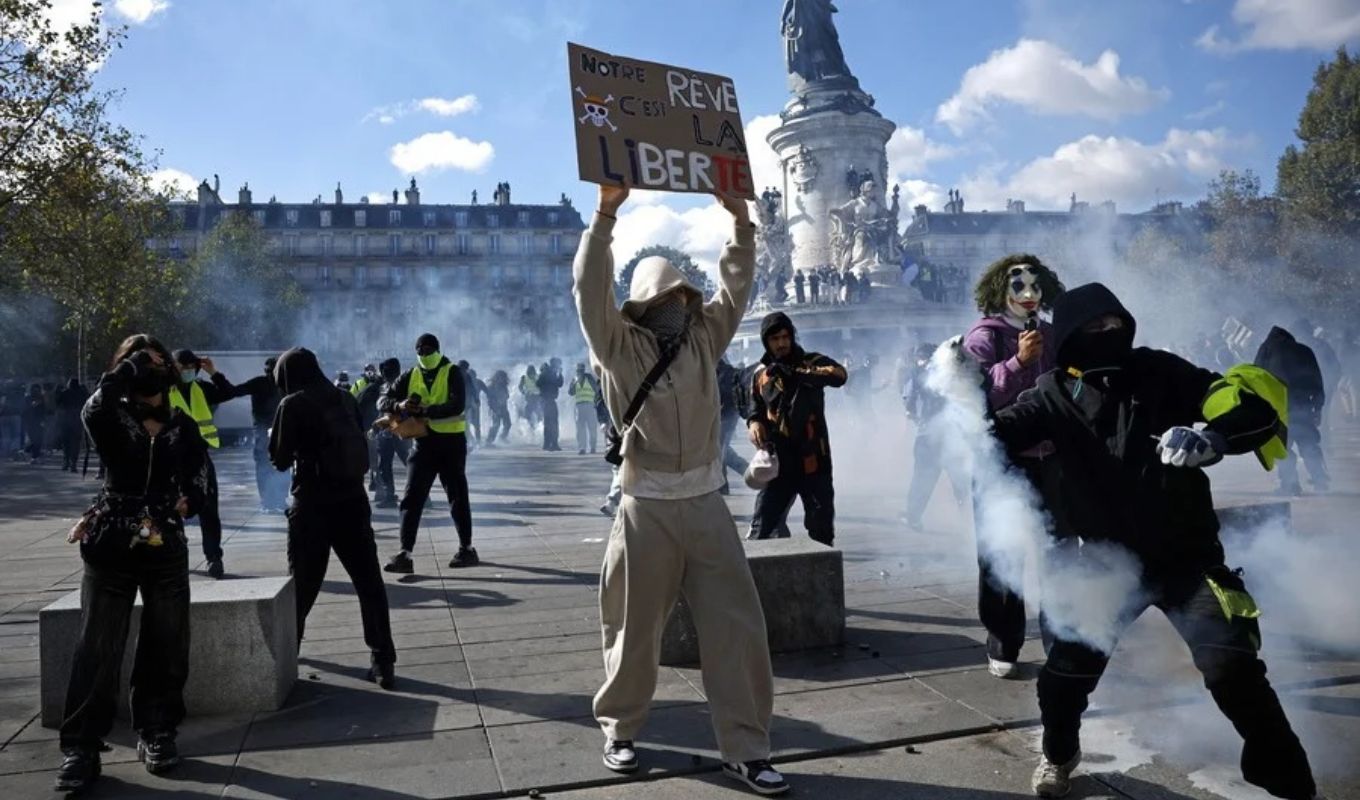
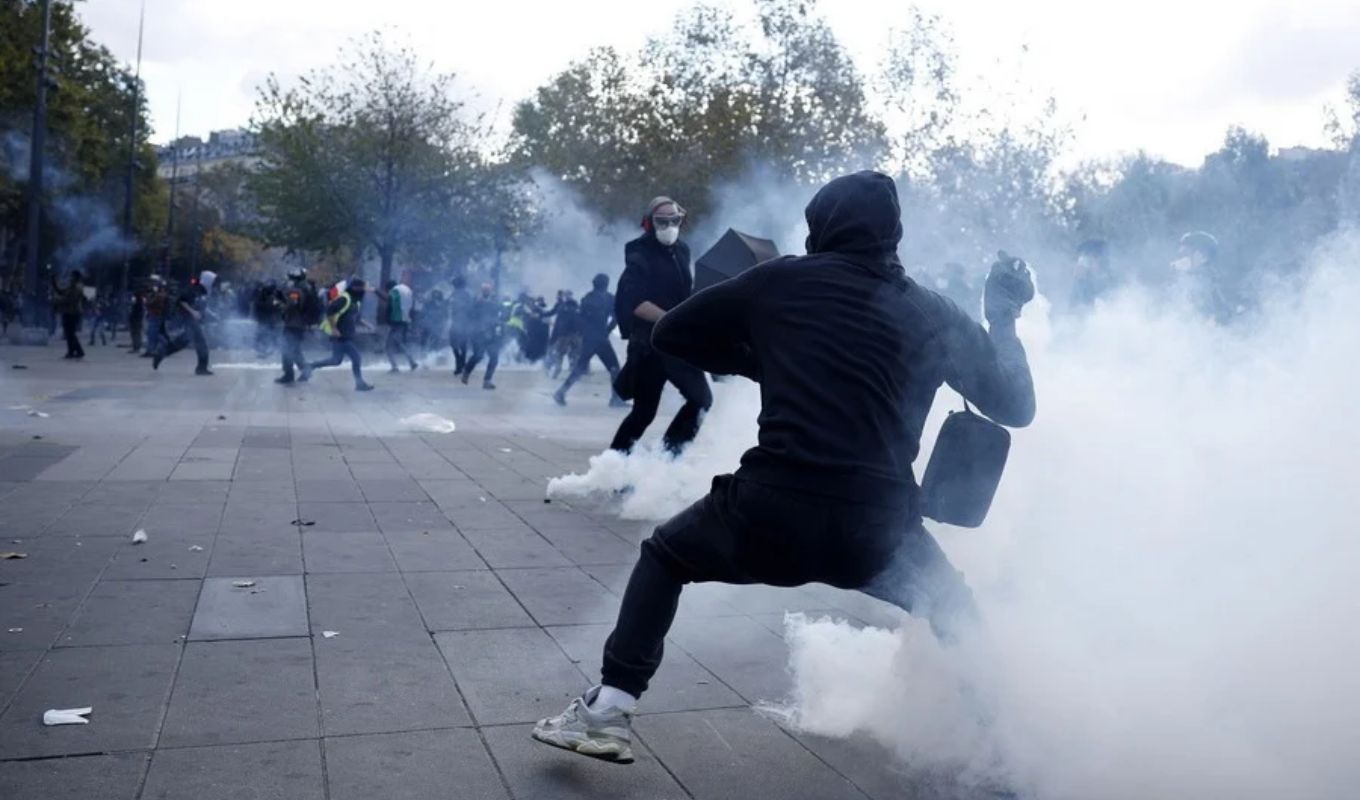
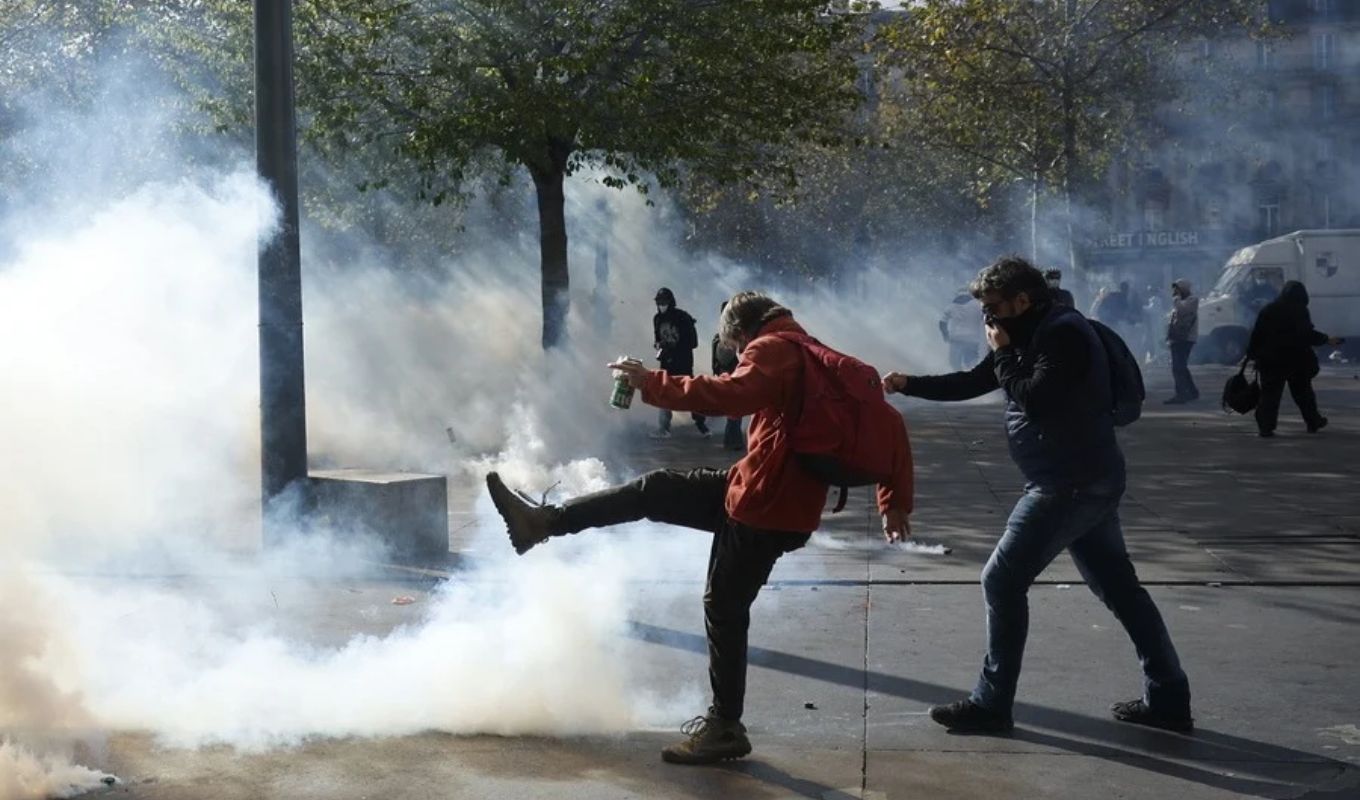
Clashes erupted between protesters and police at midday at the central Place de la République in Paris, from where a major march had been scheduled to depart at approximately 2:00 p.m. local time (3:00 p.m. Greek time), according to AFP journalists on the ground.
Police repeatedly deployed tear gas against several hundred protesters, most of whom were wearing masks and dressed in black, while some fired fireworks at officers, according to an AFP correspondent at the scene.
Clashes also broke out in Marseille, where demonstrators hurled objects at police, who responded with tear gas.
“By midday, authorities had recorded 140 demonstrations involving 32,800 people across the regions, and 166 arrests nationwide,” according to sources close to Interior Minister Laurent Nunez. Incidents were also reported elsewhere. A university building in Rouen, Normandy, suffered damage early in the day from a fire likely caused by arson, according to a source close to the investigation.
In Marseille, a local police station was targeted by protesters. In Lyon, police used tear gas to disperse nearly 300 people who had gathered outside a university, AFP reported. However, AFP journalists on the ground observed far fewer blockades than protesters had previously announced.
In Toulouse, law enforcement intervened to prevent blockades at train stations and a roundabout.
A call for calm
President Emmanuel Macron, speaking from Brussels on Thursday, called for calm, stating that the “right to protest” must be accompanied by “respect” and must not involve “insults” or “vandalism.” “Clashes are expected during marches, particularly in Paris and other major cities,” warned sources close to Interior Minister Laurent Nunez.
According to a police source, approximately 150,000 protesters are expected outside the greater Paris area, with around 40,000 anticipated in Paris itself.
“Whatever happens on the 17th, we won’t solve the problem in a single day. We need to make our voices heard for much longer,” urged Jérôme Rodrigues, one of the most prominent figures of the Yellow Vests movement, who lost an eye during a protest in Paris in January 2019.
The radical left party France Insoumise (LFI) is hoping to capitalize on an anticipated high turnout at the protests. This comes even as Marine Le Pen, the far-right candidate, currently leads in the polls. The government has accused France Insoumise of stoking the mobilizations — an accusation the party firmly denies.