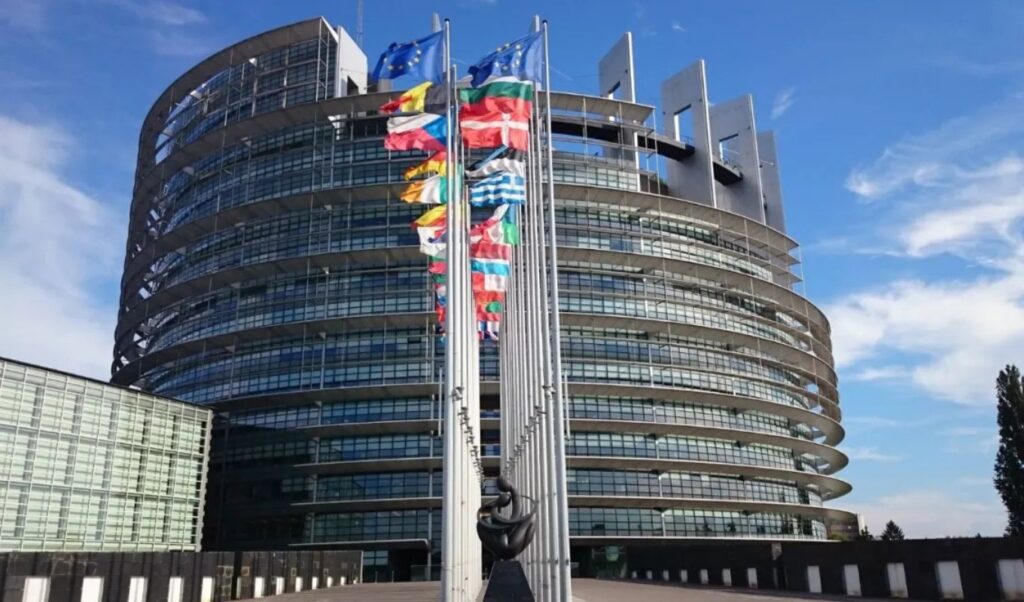
The European Parliament has placed strong emphasis on the need to protect democratic institutions from foreign interference — with a particular focus on the internet and electoral processes. On Tuesday, MEPs approved (420 votes in favour, 220 against, 26 abstentions) the report documenting the findings of the Special Committee on the European Democracy Shield. The text includes specific recommendations on how the EU can better protect its democratic institutions and strengthen its existing tools, while identifying Russia, Belarus, China, Iran, and North Korea as threats to European democracy through the conduct of hybrid attacks.
The Parliament’s special committee was established in December 2024, with a mandate to assess the escalation and impact of hostile actions against the EU — including information manipulation and interference by third countries, hybrid attacks, and coordinated disinformation campaigns. In their conclusions, MEPs argue that the EU is currently addressing these threats in a fragmented manner, as no single member state can effectively tackle them alone.
New EU body to defend democracy
MEPs support the establishment of a European Centre for Democratic Resilience, as announced by the European Commission in its Democracy Shield strategy and in line with proposals put forward by the Parliament during the previous legislative term. According to the Parliament, this body should function as an independent “centre of excellence” for combating information manipulation and disinformation, while simultaneously coordinating the actions of member states. The new entity must not duplicate existing tools, but rather consolidate EU efforts into a single body with a clear vision, a clear mandate, its own budget, and the capacity to act. Participation in the Centre should be mandatory for all member states, and parliamentary oversight must be guaranteed.
Russia identified as the primary threat to European democracy
The report highlights Russia’s frequent hybrid attacks on critical infrastructure, including cyberattacks, sabotage, arson, espionage, and signal jamming. Similar attacks also originate from Belarus, China, Iran, and North Korea. MEPs are calling for sanctions to be extended to all individuals who facilitate the spread of disinformation and to those who help circumvent existing sanctions. They also condemn the politically motivated blacklist compiled by Russia — targeting EU officials, journalists, and MEPs — describing it as a hybrid warfare tool.
Online interference — “Platforms must be held accountable”
Since these attacks are conducted primarily in the digital realm, the Parliament is calling for strict enforcement of existing digital rules — such as the Digital Services Act and the AI Act — rather than the introduction of new legislation. It is also calling for online platforms to be held accountable, to take greater action against bot interference in electoral processes, and to protect democratic discourse. As the report states, freedom of expression and information are rights that protect people — not digital entities.
EU sovereignty and reducing dependence on China and the US
MEPs are urging the EU to reduce its reliance on externally controlled technologies in critical sectors — particularly from American tech companies and Chinese-made equipment. Among their proposals is a balanced strategy of preference for European products in critical infrastructure investments, as well as a shift toward more trustworthy partners for the supply of critical raw materials.
Electoral resilience
To better protect the integrity of electoral processes from evolving threats and prevent third-party financing and interference, MEPs are proposing that electoral infrastructure be designated as a critical entity. They are calling for a “know your donor” principle to apply to political donations made in cryptocurrency, for measures to be taken against malicious deepfake content and misleading advertising, and for stronger protections for female candidates.
MEPs also consider it essential to work closely with EU candidate countries and partner nations to strengthen their resilience as well. At the same time, they condemn the weaponisation of migration as an unacceptable attempt to exert political pressure on the EU.
Media freedom and civil society
MEPs regard media literacy and AI literacy as critically important, alongside the existence of a strong and independent civil society. They are calling for long-term commitments to fund media freedom and investigative journalism, guarantees against illegal spyware, and support for civic participation in public life.
Societal preparedness — Large-scale drills and the 72-hour readiness guide
Preparedness is a collective responsibility shared by governments, businesses, academics, and citizens alike, with the aim of ensuring that European society can function under exceptional or disruptive conditions caused by hybrid threats or full-scale crises. The EU should draw on the expertise of partners such as Taiwan in countering “grey zone” warfare, MEPs stress. They are also proposing that large-scale drills be conducted on a regular basis, that an EU-wide early warning app be created for crisis situations, and that 24 February — the anniversary of Russia’s full-scale invasion of Ukraine — be established as “European Preparedness Day.”
Specifically, the report sets out the following:
Empowering citizens and societies
Preparedness tools: An EU-wide, interoperable crisis warning app should provide real-time, multilingual information during emergencies, alongside an EU-level household preparedness guide offering practical advice on emergency supplies and self-sufficiency for at least 72 hours.
Education and training: The Erasmus+ programme should be expanded to include preparedness training for workers in critical sectors and for the general public. Regular, large-scale, EU-coordinated exercises simulating cyberattacks, critical infrastructure disruptions, and coordinated disinformation campaigns should be conducted, with enhanced coordination through shared situational awareness platforms and rapid information exchange with international partners.
Institutional, technological, and financial resilience
Annual reporting: An annual EU activity report, publicly accessible, should provide a structured overview of the state of preparedness in each member state, including institutional readiness and civil-military cooperation.
Secure communications: Accelerated implementation of IRIS² and the European Critical Communications System is required to ensure telecommunications resilience and reduce external dependencies.
Funding: The 2028–2034 Multiannual Financial Framework should include targeted instruments such as a “European Defence Mechanism” or a “European Security Mechanism.”
Strengthening institutional security: Contingency plans for military conflicts must be upgraded, and the highest levels of physical and information security must be ensured within EU institutions, including certified secure communication channels. MEPs and staff should be provided with secure institutional devices, and systematic spyware screening should be extended to all devices.
“Protecting our democracy from foreign influence operations”
As the report’s rapporteur in the European Parliament stated: “This report does not seek to impose restrictions on political opinion. It is about protecting our democracy from influence operations conducted by third countries. Russian bot activity is not freedom of speech. Foreign interference is not freedom of speech. And certainly, the manipulation of our elections is not freedom of speech.”