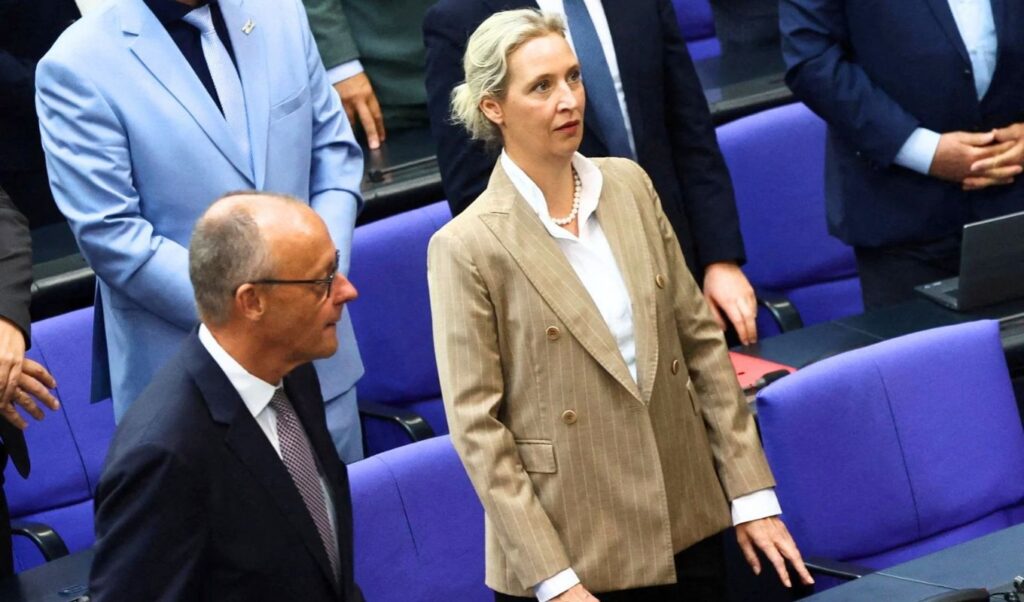
German Chancellor Friedrich Merz launched an unprecedented attack against the far-right Alternative for Germany (AfD) party, equating its “remigration” policy with ethnic cleansing. The explosive confrontation unfolded on the floor of the German Bundestag, just days after the AfD’s historic electoral breakthrough in Saxony-Anhalt.
Read also: How German and international media are covering AfD’s triumph in Saxony-Anhalt: Merz’s “painful dilemma,” the far-right celebrates across Europe, and the “shared stance” of the US and Russia
Merz and AfD in a fierce Bundestag showdown
During a highly charged parliamentary session on Wednesday, Friedrich Merz declared — to applause from lawmakers across all other parties — that the term “remigration” is nothing more than a synonym for ethnic cleansing based on ancestry and skin color. The confrontation marks the chancellor’s first major public clash with the far-right party since its sweeping victory in the regional elections. Addressing the AfD parliamentary group, which repeatedly interrupted him with shouts and jeers, the German chancellor stressed that millions of workers with immigrant backgrounds are an indispensable part of German society and its economy.
Sehr harte Worte des Kanzlers: „Das Wort Remigration ist nichts anders als ein Synonym für ethnische Säuberung nach Herkunft und Hautfarbe”, sagt Merz mit Blick auf die AfD. pic.twitter.com/34TtF8qtpk
— Rixa Fürsen (@rixa_fursen) September 9, 2026
The Saxony-Anhalt election shock and its fallout
The AfD secured a remarkable 44% of the vote in the Saxony-Anhalt regional elections, recording the strongest performance by a far-right party in a German state since the Nazi era. Despite this historic result, the party fell short of an outright majority, finishing just three seats away from its target. The election outcome sent shockwaves through Germany’s political establishment and forced Merz into a new phase of aggressive political confrontation. The AfD’s sweeping victory simultaneously dealt a serious blow to Merz’s own party. The chancellor himself acknowledged that his low approval ratings contributed to the dramatic collapse in the Christian Democratic Union’s (CDU) electoral support in Saxony-Anhalt, which fell by roughly half.
The economic dimension of immigration policy
Merz placed strong emphasis on the economic consequences that implementing the AfD’s remigration policy would have for Germany. According to the chancellor, if workers with immigrant backgrounds were forced to leave the country, skilled professions would cease to function:
- Not a single care home would remain open
- Not a single hospital would be able to operate
- Not a single restaurant would be able to stay in business
The chancellor argued that the AfD’s rhetoric is driving a deep wedge through German society and undermining the very foundations of the country’s economic prosperity.
Merz’s strategy on immigration
Despite his fierce offensive against the AfD, Friedrich Merz has himself adopted a hard line on immigration, seeking to win back voters who have drifted toward the far right. The German chancellor acknowledged that the country continues to face significant challenges in this area, noting that there are many people who should not hold permanent residency status.
Nevertheless, Merz argued that his government draws a clear distinction between those who work, contribute to Germany’s prosperity and are welcome — and those who have no right to permanent residency and must be deported. “There is consensus within the governing coalition that more people must be deported,” he stated pointedly.
Germany’s Chancellor Merz:
One in six employees in the skilled trades has a foreign passport.
If the people who work in Germany have to leave the country because you put “remigration” on your banner, then the skilled trades in Germany will no longer be able to function.
Not a… pic.twitter.com/xW3sa9eJWu
— Clash Report (@clashreport) September 9, 2026
Allegations of electoral fraud and Russian interference
The chancellor moved to downplay the election result, reminding the AfD that 56% of voters in Saxony-Anhalt did not vote for them. He also accused AfD’s lead candidate Ulrich Siegmund of electoral fraud, alleging that he had already broken a pre-election pledge not to attempt to govern the state without an outright majority.
Friedrich Merz also attacked the AfD for its opposition to military aid for Ukraine, accusing the party of making common cause with Russia. The chancellor stated that there is clear evidence the failed drone attack on Leipzig Airport last month was planned in Russia and specifically targeted Germany. Despite this evidence, the AfD remained silent.
🇩🇪 Merz and Weidel erupt into a heated clash in the Bundestag
AfD leader Alice Weidel repeatedly heckled Chancellor Friedrich Merz from her seat as he compared her anti-immigration agenda to ethnic cleansing and warned it could effectively paralyze Germany — with one in six… pic.twitter.com/Ey1GpHZAjr
— NEXTA (@nexta_tv) September 9, 2026
Alice Weidel fires back: “Your time is up”
For her part, AfD co-leader Alice Weidel celebrated the party’s landmark electoral victory, declaring that the Christian Democratic Union had been decimated and describing the result as a referendum on Merz’s leadership. She attacked the government over its immigration policy, linking it directly to rising crime and security concerns.
“Your time is up. The public wants a change of direction — and they will get one,” Weidel declared, reaffirming the AfD’s goal of forming a federal government in the foreseeable future.
“Herr Merz, Sie haben die Botschaft nicht verstanden, die Ihnen die Wähler in Sachsen-Anhalt am vergangenen Sonntag geschickt haben. Das ist nicht weiter relevant, denn Ihre Zeit ist ohnehin abgelaufen. Die Bürger wollen den Politikwechsel, und sie werden ihn bekommen.” pic.twitter.com/6G2UrNW5xl
— Alice Weidel (@Alice_Weidel) September 9, 2026
Merz’s approval ratings have fallen sharply over the 16 months he has been in office, as his government faces mounting criticism over sluggish economic growth and a rising cost of living. Polls indicate that his fragile governing coalition would not secure a parliamentary majority if an election were held today, while the AfD leads with between 28% and 29% support. Turning directly to the AfD co-leader, Germany’s chancellor declared: “You will not secure a majority anywhere in Germany. You are, and will remain, a destructive force.”