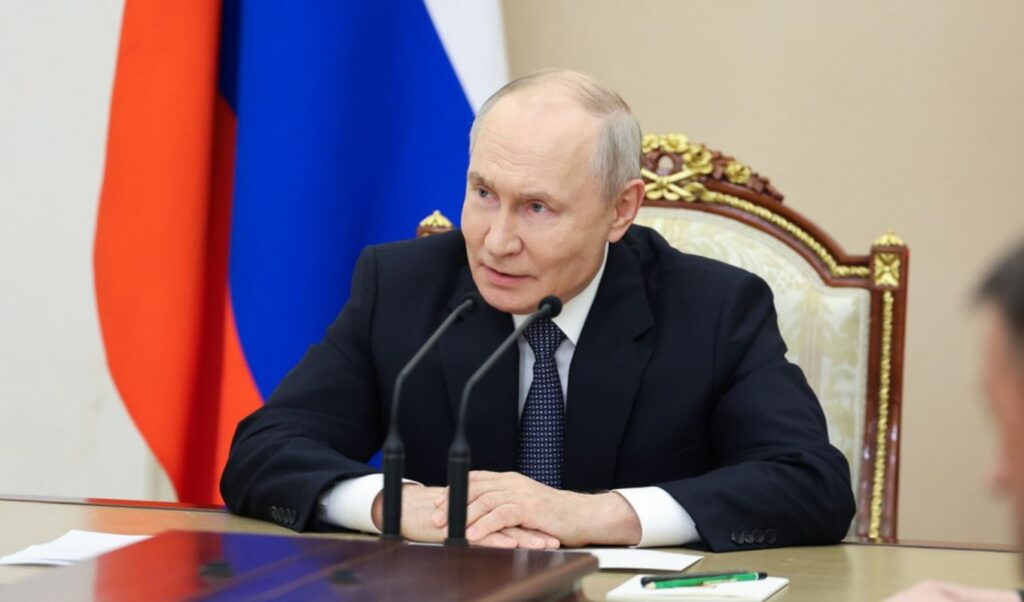
There is an ancient saying perfectly suited to how Vladimir Putin is reportedly thinking about NATO: “When the oak has fallen, every man becomes a woodcutter.” Russia’s president is not the only one who sees a problem — but he is the one positioned to exploit it. Putin may be persona non grata in the Western world, yet he has identified the cracks forming between the allies. The United States has made those fractures visible, and the war in the Middle East has brought longstanding American grievances with its allies to the surface. Donald Trump’s threats to withdraw from the alliance — and his complaints about European allies failing to contribute to military operations against Iran — are precisely the kind of “areas of opportunity” Putin is probing. According to a report by the Wall Street Journal, Putin is actively considering an attack on a NATO member state — if for no other reason than to test the alliance’s unity.
Vladimir Putin: Washington is watching
Vladimir Putin is reportedly considering an “under the radar” attack on a NATO member state — one that would unfold gradually and below the threshold of a formal military confrontation. Much depends, of course, on how the war in Ukraine evolves. Russia appeared to have the upper hand through late 2025, but Ukraine has since managed to stabilize a situation that had been turning against it. Drone strikes on Russian military infrastructure have exposed serious vulnerabilities, leading Putin to seriously contemplate opening a second front — both as a diversionary tactic and as a way to gauge whether the alliance holds together under pressure. American analysts have identified a potential second offensive window between autumn 2026 and 2029. That said, it could happen within as little as a month.
According to the same report, three scenarios are on the table. The first and least severe involves a large-scale cyberattack against a NATO member state or other hybrid operations targeting critical infrastructure. The second involves unmarked armed forces — modeled on the so-called “little green men” who appeared in Crimea in 2014 — seizing a limited amount of territory while deliberately obscuring the identity of the aggressors. The third scenario carries the lowest probability but cannot be ruled out. In fact, U.S. assessments suggest that as time passes, the risk of a limited ground incursion into NATO’s eastern flank is gradually increasing.
The line he must not cross
NATO operates much like the ancient Greek city-states in the Homeric world before they united to march on Troy: attack one, and the others respond in kind. This principle is enshrined in Article 5 of the North Atlantic Treaty, under which an attack on one ally is considered an attack on all. For Russia to act without triggering a collective response, it would need to obscure attribution or operate precisely at the boundary of what constitutes an attack. Drone incidents over Romania and Denmark, and missile strikes near Poland, have already set a troubling precedent — NATO did not invoke collective defense in those cases, though it offered verbal support to the affected allies.
Former Pentagon official and American Enterprise Institute researcher Heather Conley notes that Putin’s Russia has consistently sought to test the limits of the alliance and drive a wedge between the United States and its European partners. As she points out, cyberattacks, sabotage operations, and limited hybrid actions create a “gray zone” in which a collective military response is far from automatic.
Is the US facing a weapons deficit?
According to current assessments, the United States may be facing a serious munitions shortfall. The Pentagon is reportedly concerned about stockpiles of certain critical weapons systems. Years of military support to Ukraine, combined with ongoing U.S. operations in the Middle East, have significantly depleted advanced weapons inventories.
The report highlights concerns over stockpiles of long-range Precision Strike Missiles (PrSM), ATACMS, Stinger anti-aircraft missiles, and interceptors including Patriot, THAAD, and SM-3 systems — all considered critical to both European and Indo-Pacific deterrence. The Pentagon, however, pushes back on assessments of an operational gap. Spokespeople insist that U.S. armed forces possess all the resources necessary to fulfill any mission ordered by civilian leadership, and the White House has confirmed that a defense production enhancement program is already underway.
One more headache
The Wall Street Journal report does not point to a single threat — it is a stark illustration of the multiple open fronts the United States is simultaneously managing, whether as a combatant or a mediator. The war in Ukraine continues on one side; developments in the Middle East continue to demand significant military resources on another; and China remains Washington’s greatest long-term strategic challenge in the Indo-Pacific. Against this backdrop, Putin may well be calculating whether NATO’s united front is as solid as it appears — or whether the oak is already beginning to fall.