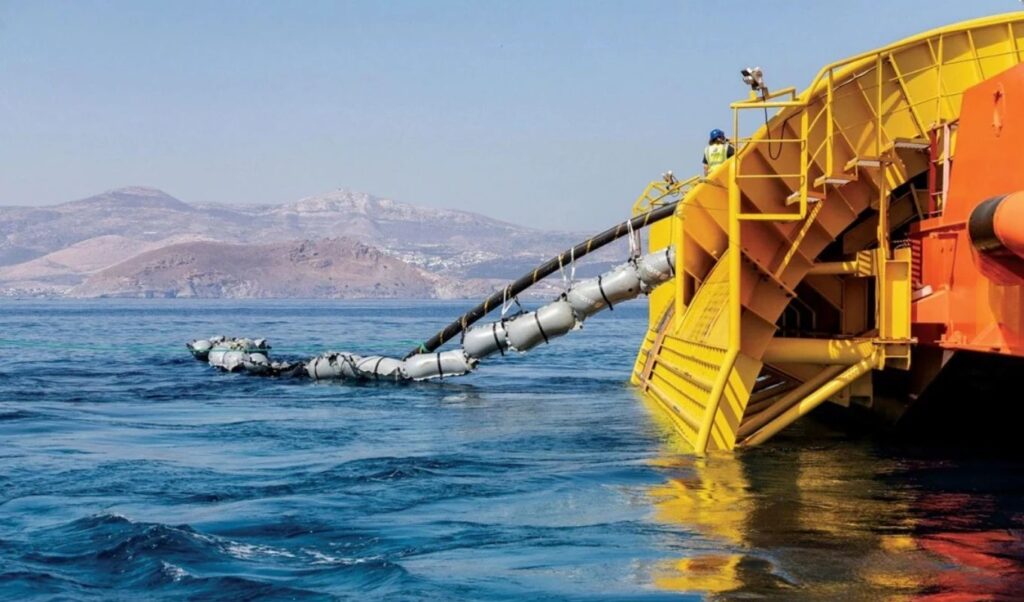
The issuance of a Navtex notice — which will allow the French research vessel Abeille Marengo to depart after a ten-day wait in Heraklion, Crete — is now a matter of days, if not hours. The notice will enable the resumption of bathymetric surveys for the laying of the GSI submarine electricity cable. According to sources, the Inter-Ministerial Committee (ECHAET) has approved the French company’s request and given the Ministry of Foreign Affairs the green light to instruct the Hellenic Navy’s Hydrographic Service to issue the NAVTEX. The research vessel is expected to begin operations in the sea area off Kasos — the zone where bathymetric surveys are most challenging and where, in 2024, Turkish naval frigates appeared and halted operations.
A key factor in the decision to restart operations appears to be the conclusion of the US midterm elections, as well as the resolution of a series of issues following a phone call between Emmanuel Macron and Recep Tayyip Erdoğan approximately ten days ago. However, it has not yet been confirmed whether Ankara received the written notification that Turkish Foreign Minister Hakan Fidan had demanded in an interview with the Greek newspaper Nea.
The possible scenarios for managing the cable project
According to Professor of International Relations Sotiris Roussos, if Ankara had received “notification” from the French side, it would have made a public announcement — consistent with its established practice of highlighting when its demands are met. That has not happened yet. Professor Roussos outlines two possible scenarios: either Turkey is formally notified and issues its own Navtex asserting sovereign rights over the area, or it is not notified and dispatches frigates to obstruct the project. As he told parapolitika.gr, “if the French company notifies them, the Turks won’t keep it quiet. They’ll say that ‘we were informed and we give our approval — we agree’ — given that they also claim sovereign rights or entitlements in the area.”
GSI cable: Athens does not expect a strong Turkish reaction following Trump’s midterm setback
Athens believes that the current geopolitical landscape — shaped in part by Trump’s weakened position following the midterm elections — does not favour scenarios involving a strong Turkish reaction. When asked in a recent ANT1 interview whether Turkey might again attempt to obstruct the project, Greek Foreign Minister Giorgos Gerapetritis stated: “That is something I don’t believe will happen,” adding that “for every eventuality, we have all scenarios ready. And I want to make it very clear that it is obvious that everyone bears the weight of their own actions. If Turkey attempts to obstruct, it will find Greece standing squarely against it.”
However, Professor Roussos argues that the inward-looking state of the White House following the midterm results — with President Trump and his cabinet preoccupied with internal challenges — could actually give Turkey greater room to act aggressively. As he explains: “The Turks believe that over the longer term — that is, until the new Congress is formed — they will face more obstacles, particularly regarding weapons systems. But in the interim, and in terms of their actions, they will be more aggressive. Because right now they don’t see a strong, stable US administration that would stand in their way. Decisions regarding Turkey won’t be made by Congress. So if Turkey were to send frigates tomorrow morning and say ‘this cable isn’t passing through — you didn’t ask our permission’ — it would be much harder for Trump to impose his will on them.”
Athens and Nicosia on an open line
Athens is nonetheless weighing all possibilities, even as it assesses that Ankara’s response will be limited. In his recent public statements, Foreign Minister Gerapetritis has repeatedly affirmed Greece’s readiness to handle any scenario. As he put it: “There are contingency plans for any potential obstruction of the project — and I would assume equivalent plans exist on the part of both the French company and the French government. On the other side, Turkey would find itself up against the European Union, since this is an EU co-funded project. A country that aspires to become part of the Union while simultaneously obstructing European projects is, as you can understand, closing the door on itself.”
The Cypriot side, which now fully supports the project, is awaiting Greece’s move before disbursing its €25 million tranche. Greek Foreign Minister Gerapetritis, in a phone call with his Cypriot counterpart Constantinos Kombos, briefed him on the impending Navtex issuance so that the Republic of Cyprus can proceed with its corresponding steps.