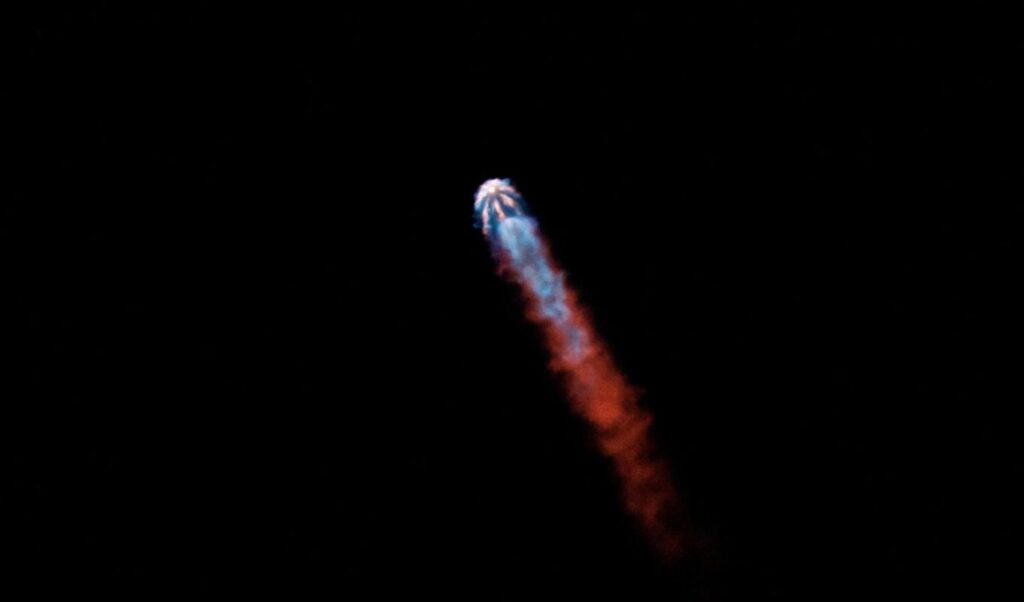
A SpaceX rocket segment — specifically from the Falcon 9 — is estimated to have crashed into the Moon approximately 19 months after its launch from Earth, according to scientific assessments. The impact is expected to be officially confirmed through observations by specialized telescopes in the United States that have been tracking the object’s trajectory and collision data.
Read also: SpaceX: New Starship test flight coming in August with two critical trials — NASA also in focus
Calculations indicated that the rocket segment was set to strike the lunar surface at approximately 8,400 kilometers per hour — nearly seven times the speed of sound — most likely carving out a brand-new crater on impact.
The collision is estimated to have released energy equivalent to roughly three tons of TNT, unleashing a massive cloud of lunar dust and causing a notable alteration to the Moon’s surface at the point of impact.
A 4,000 kg SpaceX Rocket Stage Is About to Crash Into the Moon. On August 5, 2026, a Falcon 9 upper stage launched by SpaceX in January 2025 is expected to collide with the Moon after more than a year drifting through space. The rocket successfully delivered two private lunar… pic.twitter.com/z5y2FTLNRk
— Stellarix (@Stellarixorine) July 28, 2026
It is worth noting that this particular rocket was launched as part of a joint American-Japanese mission to transport a pair of lunar landers and scientific equipment to the Moon in 2025.
The space object remained in orbit until its impact with the Moon
A segment of the Falcon 9 rocket had originally been designed to return to Earth and be reused in a future mission. However, as is the case with a number of space objects, certain rocket stages end up remaining in orbit — effectively becoming space debris — until they are drawn in by the gravitational pull of a celestial body.
The specific rocket segment was roughly the size of a five-story building, and its mass on Earth is estimated to have exceeded four metric tons.