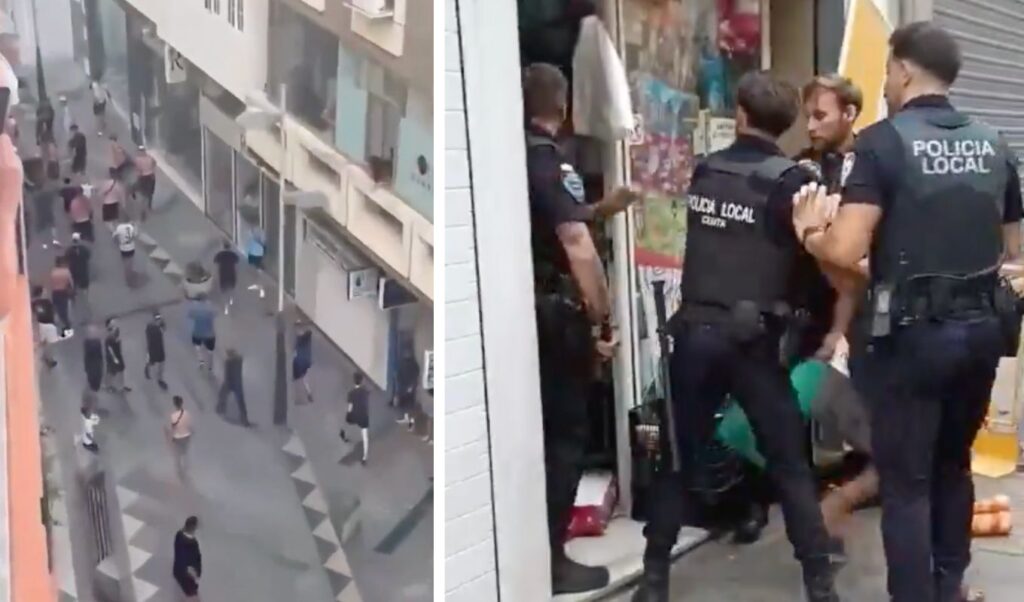
Scenes of intense unrest unfolded in Ceuta, Spain, where clashes broke out between migrants who crossed en masse from Morocco and security forces. Videos circulating online show groups of young migrants moving through the central streets of the Spanish enclave, entering stores, and clashing with security forces, while local residents watch the unfolding events with growing alarm.
🚨#BREAKING: The Moroccan Muslims who have invaded the small Spanish city of Ceuta are now BREAKING INTO STORES by the HUNDREDS.
Police are completely overwhelmed.
Migrants can be seen running from one store to the next, grabbing items and running.
WHERE IS THE MILITARY?!!!!! pic.twitter.com/NjqQAI4zgD
— Matt Van Swol (@mattvanswol) July 31, 2026
In another unverified video circulating online, a man from within a large group can be seen attacking another man — apparently with a knife — who then collapses unconscious to the ground, as bystanders and police rush to his aid.
A mass influx of nearly 60,000 migrants and at least 57 dead
Ceuta and Melilla, Spanish autonomous cities located in northern Morocco, represent the European Union’s only land borders with Africa. Both cities periodically experience surges in crossing attempts by migrants seeking to reach Europe, but the scale of Thursday’s mass influx appeared unprecedented.
The mass crossing — primarily involving young men and teenagers — into the Spanish enclave is the largest recorded since May 2021, when approximately 10,000 people entered Ceuta within just a few days due to a relaxation of border controls amid a diplomatic crisis with Spain.
Spain’s Ministry of the Interior stated that approximately 50,000 people crossed the border from Thursday morning alone — with local Ceuta authorities putting the total figure at up to 60,000 over the past two days. At least 57 migrants lost their lives on the Spanish side of the border, with additional casualties potentially recorded on the Moroccan side.
The Spanish government’s representative in Ceuta stated that some individuals drowned while others were crushed as they attempted to climb the breakwater that supports the border fence.
Efforts to prevent a new mass crossing
Meanwhile, Spain announced that 48,300 people had been turned back or had returned to Morocco by Friday afternoon.
According to Reuters, hundreds of migrants voluntarily returned to Morocco through border checkpoints and gaps in the fence, with some stating they could find neither food nor shelter in Ceuta. In one notable case, a 20-year-old Moroccan man who swam for five hours to reach Ceuta said he was returning home because “there was no food inside Ceuta and the (Spanish) army drove us away harshly.”
⚡️ Street clashes erupt in Spain’s Ceuta
Spanish authorities have deployed the army to the city.
Around 2,000 undocumented migrants have entered Ceuta in recent days, prompting the authorities to declare a state of emergency.
Italy is also reportedly prepared to suspend… pic.twitter.com/ZC5J17dEl4
— NEXTA (@nexta_tv) July 31, 2026
Heavily reinforced police and military units have been deployed throughout the Spanish enclave in an effort to maintain order and prevent a new mass crossing from Morocco. The main Tarajal border crossing has already been blocked by armored vehicles and significant military forces, while pedestrian access to Ceuta has been suspended.
Additional Guardia Civil personnel are being added to forces already on the ground, while specialist diving units (GEAS) are being dispatched from Andalusia to conduct operations at sea. On the other side of the border, Moroccan forces pushed back crowds overnight using batons, tear gas, and water cannons in an effort to prevent further crossings at the Ceuta gates.
Political crisis in the EU as unprecedented images spark debate
Nationalist parties and governments across the EU blamed the incident on Spain’s relatively permissive immigration policies, calling for the country’s suspension from the Schengen Area and using the unprecedented footage to advance their anti-immigration agendas.
While outright exclusion from Schengen is not a feasible option, a member state can temporarily reinstate border controls for reasons of security or mass population movement. Italy has already announced the suspension of the Schengen Agreement with Spain, and France has decided to strengthen controls along its border with Spain. Giorgia Meloni’s proposal found support from the governments of Denmark and Finland, while France and Germany offered their support to Spain in managing the crisis.
European Commission President Ursula von der Leyen described the scenes as unacceptable, calling for the dismantling of smuggling networks and swift deportations. Meanwhile, Donald Trump used the images from Spain to warn of similar scenarios unfolding in the United States should the Democrats win, attributing the crisis to the policies of the “radical left.”