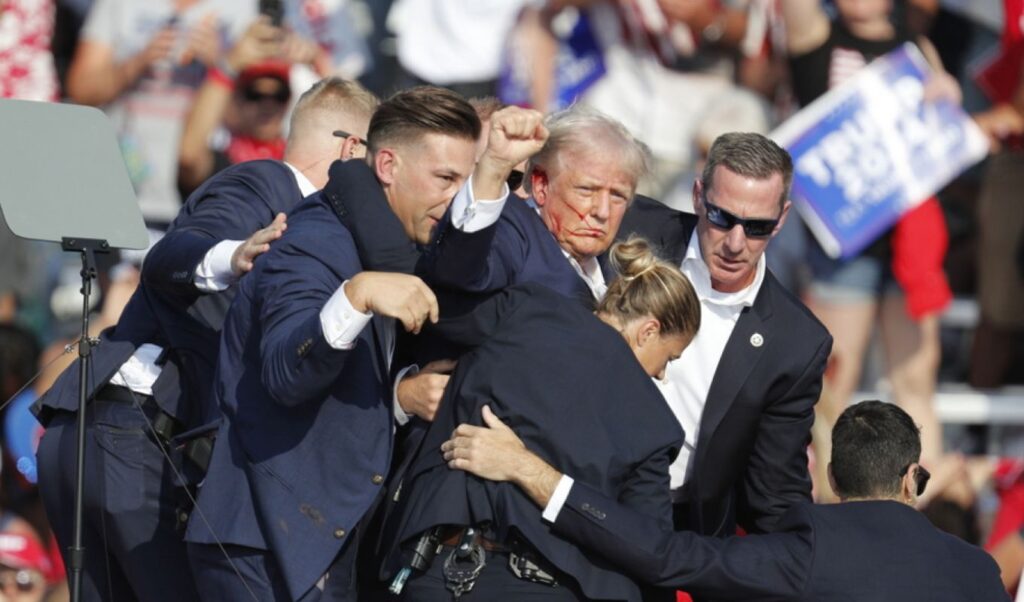
Serious failures and gaps in coordination within the U.S. Secret Service — failures that could have prevented the assassination attempt on Donald Trump in Pennsylvania in 2024, when he was still a presidential candidate — have been documented in two oversight reports made public on July 2, 2026.
The findings largely confirm previous internal and external investigations into the July 13, 2024 assassination attempt on Donald Trump in Butler, Pennsylvania, where Trump was wounded in the ear by a gunshot during a campaign rally, one attendee was killed, and a police sniper ultimately neutralized the shooter.
Shooter Thomas Matthew Crooks was already spotted on a rooftop with a rifle
According to the report, shooter Thomas Matthew Crooks had already been spotted on a rooftop with a rifle approximately two minutes before he opened fire on Trump — yet no timely warning was relayed to the presidential security detail. The Secret Service emphasized that it has already corrected many of the issues identified by the Department of Homeland Security’s Inspector General.
“The U.S. Secret Service today is a stronger and more capable agency than it was in 2024, thanks to significant institutional reforms and investments in technology, personnel, and operational security capabilities,” the agency said in a statement. The assassination attempt had already prompted a leadership overhaul at the agency, following the incident in which Trump was shot and an attendee was killed before security forces neutralized the gunman at the campaign rally.
Where the Secret Service failed
The most recent report from the U.S. Department of Homeland Security’s Office of Inspector General found that the Secret Service failed to:
– Detect a drone used by the shooter, Thomas Crooks, to surveil the event venue, due to inadequate operator training and equipment malfunction.
– Warn agents surrounding Trump that Crooks was carrying a long-barreled weapon and had climbed onto the roof of the American Glass Research International building, because no shared communications center had been established with local authorities.
– Secure the area outside the event perimeter, even though the Pennsylvania State Police had shared a plan showing that area would remain uncovered.
– Use available resources to block the line of sight toward Trump.
“The Secret Service’s overall lack of policies and procedures, combined with limited information sharing and poor cooperation and communication with protective personnel and state and local authorities, created the conditions that led to missed opportunities to prevent and detect the assassination attempt,” the report states.
A second report found that the agency was understaffed by an average of 21.4% during fiscal years 2023 and 2024, relying on overtime and support from other agencies to meet its operational needs. Agents also logged 1.2 million overtime hours, with back-to-back shifts and minimal rest time — a factor that contributed to burnout and attrition, according to the report.
The Secret Service stated that it has prioritized staff retention and training while streamlining its hiring process. The average onboarding time is now 326 days for special agents and 256 days for officers, according to the agency. “The Secret Service has also simplified its hiring procedures, reducing the old, bureaucratic process and allowing us to bring in the best candidates more quickly,” the statement read.