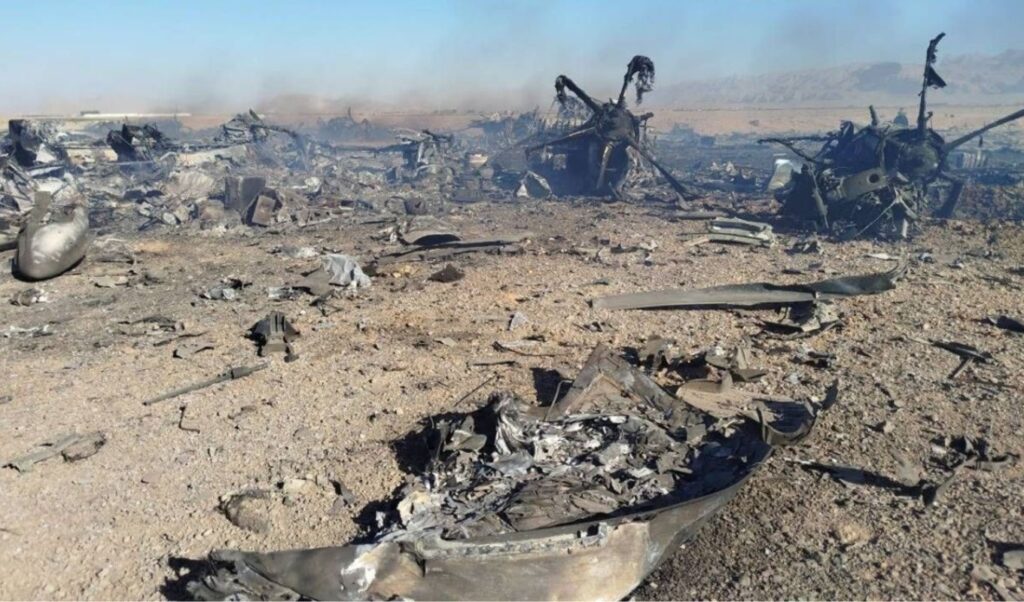
The American pilot of the fighter jet F-15, who was rescued by U.S. special forces following the shootdown of his aircraft over Iran in April, provided U.S. intelligence agencies with a remarkable account of what he witnessed moments before ejecting from his aircraft. According to a CNN report citing four sources familiar with the matter, the pilot described observing multiple Iranian drones moving in a coordinated formation across the sky — an image he likened to a “jellyfish.”
According to CNN, which cites four sources with knowledge of the incident, the pilot saw large drones moving as a single unit, while smaller ones were positioned beneath them, “like tentacles.” One of the sources described the phenomenon as “extraterrestrial.”
Read more: American F-15 shot down over western Iran
This account has sparked intense debate within U.S. intelligence circles, as confirmation of the sighting would suggest that Iran has made significant advances in its drone capabilities. While the exact cause of the F-15 shootdown is still under investigation, initial assessments suggest the formation may have played a role in bringing down the aircraft, according to two of the sources.
Timeline of the American F-15 shootdown
In April, Tehran shot down an American F-15 fighter jet carrying two crew members — a pilot and a weapons systems officer.
The pilot was rescued within hours of the aircraft being downed, while the weapons systems officer remained hidden in a mountainous region of Iran for more than a day before being located and rescued. The shootdown of the F-15 marked the first time an American aircraft had been brought down over Iran during the course of the war.
During the rescue operation, a second aircraft — an A-10 — was also shot down, though its pilot managed to eject safely outside Iranian airspace.
U.S. intelligence officials expressed skepticism toward the pilot’s account, noting that he had sustained a concussion during the crash. Additionally, this was the second time one of his aircraft had been shot down during the war — he was also one of the pilots involved in a friendly fire incident with Kuwaiti forces at the outset of hostilities. “Was he witnessing a previously unknown Iranian operational capability? A pilot program? An optical illusion?” one of the sources told CNN.
The technology described by the pilot is known as “one-to-many meshed networking” — a system that allows multiple drones to operate as a unified swarm.
Although U.S. intelligence agencies initially believed Iran did not possess this type of technology, there are multiple reports suggesting that Tehran has received assistance from China and Russia, both of which have comparable capabilities, according to two sources who spoke to CNN.
Experts warn that if Iran’s already sophisticated combat drone program has indeed achieved such an advancement, it could become a serious cause for concern for American forces and their allies throughout the Middle East.