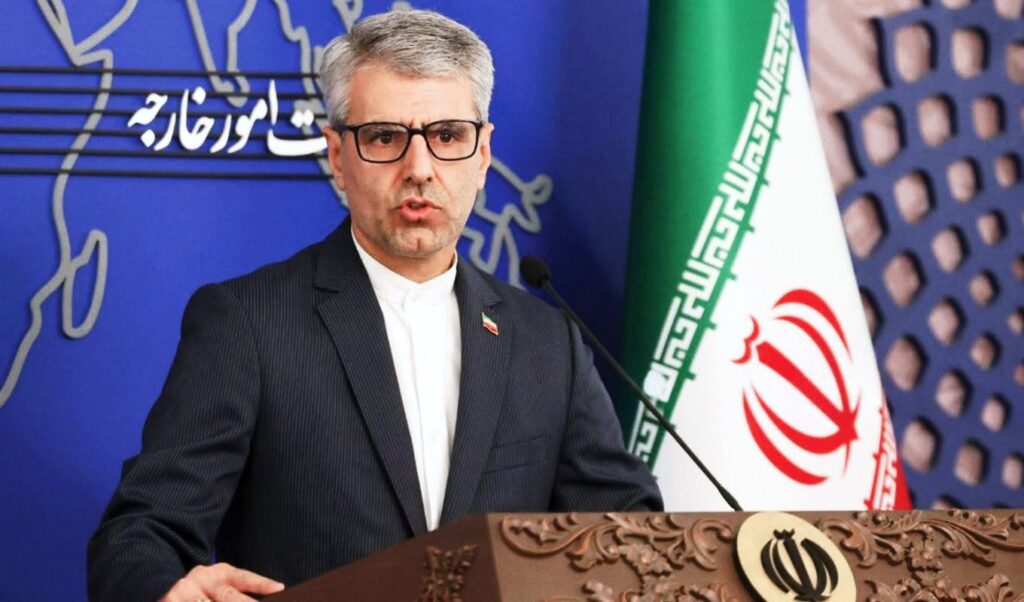
Iran’s Ministry of Foreign Affairs announced today that it will seek ratification from the UN Security Council for the final agreement currently being formulated with the United States, which will include Tehran’s nuclear program issues. “We expect the final agreement to be supported by a United Nations Security Council resolution, 60 days after” its signing, said Iranian diplomatic spokesperson Esmail Baghaei during the weekly press briefing, noting that Tehran “will draw lessons from the past.”
Read: Netanyahu against Trump: Iran agreement causes rift in US-Israel relations
Iran: “The deep distrust toward the US is the consequence of a long history of mistakes by American leaders”
Baghaei added that the US must guarantee that Israel commits to ending the war in Lebanon. “The US must honor their commitments. They must ensure that the Zionist regime (i.e., Israel) will keep its own commitments regarding Lebanon,” the spokesperson said, emphasizing that Tehran “has no trust in either Israel or the US.” “Unfortunately, we must acknowledge that the deep distrust toward the US is the consequence of a long history of mistakes by American leaders” and “much still needs to be done before they earn the trust of Iranians,” he added, estimating that the agreement to be signed on Friday represents only “a step toward reducing tensions and ending the war.”
“The release of Iranian assets and compensation constitute two fundamental points”
According to Baghaei, Washington has committed to releasing Iranian assets that remain “frozen” abroad and to provide compensation for war damages as part of the peace agreement. “The release of Iranian assets and compensation constitute two fundamental points” of the agreement and “the American side committed to take measures in these two areas,” the Iranian official said.
Earlier, Baghaei stated that Iran will not charge “tolls” but “maritime service fees” for ships passing through the Strait of Hormuz. “We have always maintained that we do not seek to collect transit tolls, but fees for maritime services, environmental protection, ship safety, and other necessary services,” he explained.