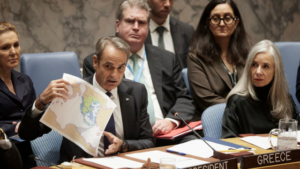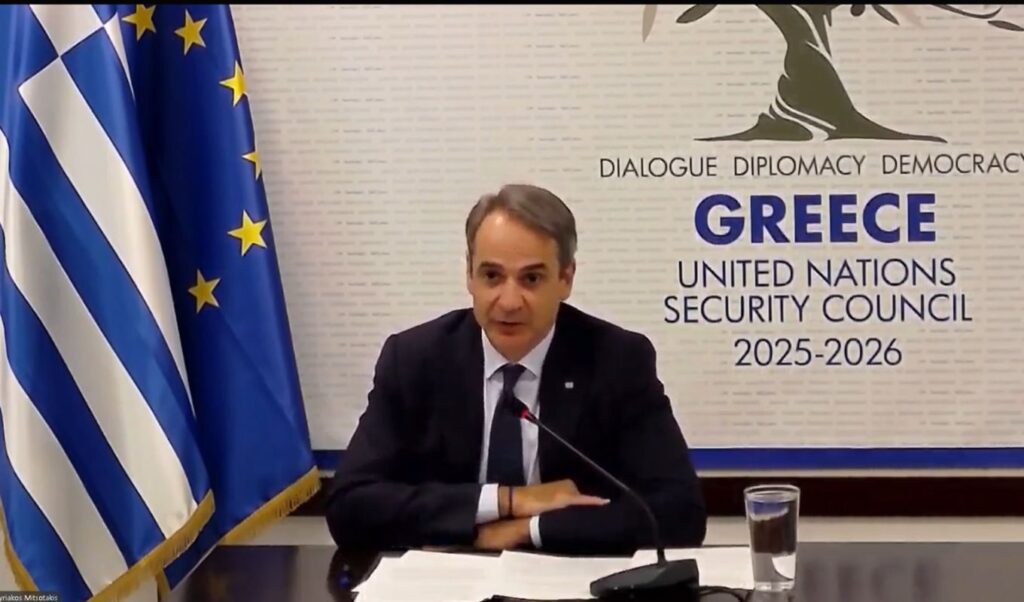
Greek Prime Minister Kyriakos Mitsotakis once again focused on the illegal nature of the Turkey-Libya maritime memorandum during his discussion with Bastian Giegerich, Director General of the International Institute for Strategic Studies (IISS), at the IISS Manama Dialogue 2026 held in Bahrain. The Greek Prime Minister reiterated the same position he expressed during his address to the UN Security Council on Thursday, October 29, over which he presided — that Libya and Turkey agreed on maritime boundaries that disregard Greek islands. The memorandum was recently ratified, though it was originally signed in 2019. Mitsotakis remained firm on Greece’s position that holding major energy projects hostage is unacceptable. It took him no more than four words to make his government’s stance crystal clear: “We will not accept it.” He once again characterized the deal as “illegal and void,” stressing that it runs contrary to the fundamental principles of international law — unlike the maritime delimitation agreement Greece has reached with Egypt. He concluded by stating that only respect for international rules can bring about a resolution to disputes in the Eastern Mediterranean.
“We are optimistic that we will win the elections”
On the subject of the upcoming Greek elections, Kyriakos Mitsotakis expressed confidence and highlighted the significant progress made by the Greek economy. “We will have elections, but we are optimistic that we will win them,” he stated, adding that Greece now enjoys political stability and has become a hub for international economic and geopolitical partnerships. He went on to describe the Greek economy as “a European success story,” noting that no one could have predicted a few years ago that Greece would be borrowing at lower interest rates than G7 nations — which has since become a reality.
The “Aspides” mission must be expanded
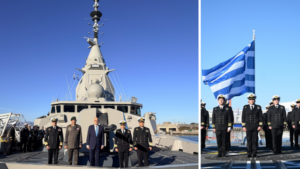
Mitsotakis also spoke about Greece’s potential role as a communication and connectivity hub between Europe and the countries of the East. In this context, he referenced the IMEC economic corridor, the EMC data cable, and Greece’s role as an LNG entry point for the Balkans and Ukraine, linking these infrastructures to the energy security of European nations. He also commented on the commissioning of the second Belharra frigate, the “Nearchus,” and the opportunities for defense cooperation with Gulf states. Mitsotakis highlighted that Greece allocates 3.5% of its GDP to defense, and called for broader participation in the European “Aspides” naval mission, urging countries such as Greece, Italy, and France to deepen their involvement.