Society is restless, problems are piling up, and global uncertainty is growing. And yet, opinion polls keep delivering roughly the same picture: New Democracy in first place, far ahead of SYRIZA, PASOK in third, with minor shifts that slightly narrow or widen the gaps — but never overturn the order. How is it possible that almost everything is changing in citizens’ daily lives, while the political balance of power remains frozen?
The polls needle is stuck
Based on nationwide surveys published up to October 22, the standings of the top three parties look as follows:
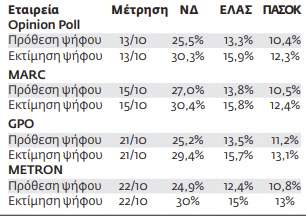
A clarification is needed, however. The needle is not completely motionless. In the MARC poll, New Democracy slips to 30.4%, down from 31% in September; SYRIZA drops from 16% to 15.8%, while PASOK climbs from 11.5% to 12.4%. The key point, though, is that no reversal trend is yet visible: the government’s erosion is not translating into a corresponding surge for any challenger. At the same time, an overwhelming majority of respondents cite the cost of living as the dominant issue; seven in ten believe the country is heading in the wrong direction, and six in ten favour scenarios of political change. All of this is unfolding against a highly uncertain geopolitical backdrop that is not only shifting day by day, but directly affecting people’s everyday lives — particularly when it comes to energy costs and inflation.
Erosion without a breakthrough
The first explanation lies in the distinction between dissatisfaction and choice. There is a difference between viewing a government as inadequate and trusting a specific party to replace it. The cost of living, rising rents, and soaring electricity bills can push a voter away from New Democracy. They do not, however, dictate where that voter goes next. If the alternatives are unconvincing, they may remain undecided, consider abstaining, or stick with their previous choice — only with less enthusiasm. These are all plausible paths; aggregate polling figures alone cannot reveal which one is dominant.
One factor to consider is that New Democracy, after seven years in government and despite significant erosion, remains the dominant political force — even if well short of an outright majority. What tends to be overlooked is that much of its decline has already happened and is already reflected in its current support levels. Repeated problems do not automatically produce equal new losses every month. Those who have already left cannot leave twice. Those who remain fall into distinct categories: voters who approve of government policy, those with strong party loyalty, and those who make a comparative choice — viewing the alternatives as less credible.
First place can therefore be sustained even amid widespread public discontent. For SYRIZA, meanwhile, there has been a sharp landing from the initial optimistic projections. A slight but visible decline is apparent, with PASOK notably closing the gap on the second-place party in the polls. It appears that Alexis Tsipras’s name recognition and his previous governing experience can sustain a core electorate, but are not sufficient to broaden the party’s appeal.
Citizens beyond the already-committed supporters need to be persuaded that there is a concrete answer to today’s problems. The call for change is more mobilising when it comes with a clear vision of the content, the people, and the capabilities of the next government. For now, that defining image remains elusive.
PASOK faces the opposite obstacle: its incremental gains have not yet reached the scale that would transform its role. That said, certain qualitative data deserve attention. In the MARC survey, PASOK ranks first on the question of which party offers the most substantive opposition, at 16.6%, versus 9.2% for SYRIZA. Yet recognition as an effective opposition voice does not automatically translate into votes. A citizen can appreciate a party’s interventions without being convinced that the same party is capable of leading a government. Meanwhile, discontent has many recipients.
Different social groups attribute different causes to the same pressures and seek different solutions. Shared anxiety over the cost of living does not automatically produce a shared political preference. When protest votes are dispersed, no opposition party easily accumulates the critical mass that would generate a genuine expectation of victory — especially in an opposition landscape that is more fragmented than ever before.
The ballot box remains a puzzle
Global uncertainty adds yet another counterforce to the mix. It intensifies insecurity and criticism, but can simultaneously increase reluctance toward change. Tellingly, in the Opinion Poll survey, 27.1% of respondents cite the need for stability amid international turbulence as an electoral criterion. This does not prove why each person votes the way they do, but it does reveal a possible mechanism that holds political shifts in check.
The current picture, therefore, points to an equilibrium of limited expectations. The government struggles to win back those it has lost, while the opposition struggles to consolidate them. For the needle to move decisively, public discontent needs to meet a convincing governing alternative. Until then, the desire for change may remain strong — without yet having a clear electoral destination.
Originally published in “Karfi”