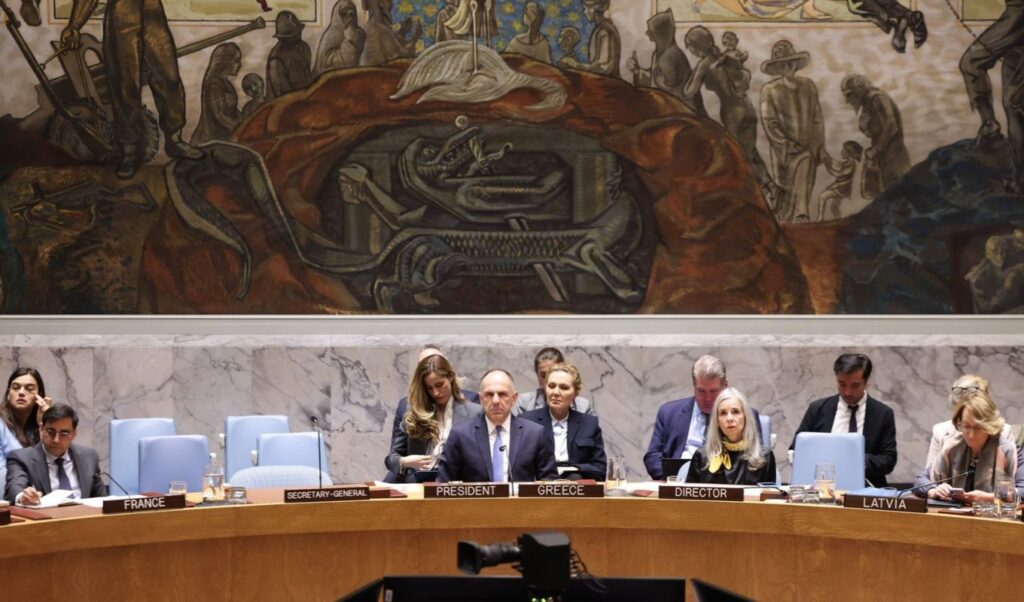
Greek Foreign Minister Georgios Gerapetritis formally rejected the Turkey-Libya maritime memorandum from the floor of the United Nations, where Greece currently holds the presidency of the Security Council. The Greek Foreign Minister issued a statement on behalf of Egypt, Cyprus, Bahrain, the United Arab Emirates, the European Union, and Greece, noting that “the recent decision of the Libyan House of Representatives to ratify the misnamed ‘Memorandum of Understanding between Turkey and Libya on the delimitation of maritime jurisdiction areas in the Mediterranean’ of 2019 raises serious concerns for regional security and stability.”
The statement by Georgios Gerapetritis
Flanked by representatives from Cyprus, the EU, Egypt, and Bahrain, Georgios Gerapetritis stated: “I make this statement on behalf of Egypt, Cyprus, Bahrain, the United Arab Emirates, the European Union, and my own country, Greece. The recent decision of the Libyan House of Representatives to ratify the misnamed ‘Memorandum of Understanding between Turkey and Libya on the delimitation of maritime jurisdiction areas in the Mediterranean’ of 2019 raises serious concerns for regional security and stability.
It also highlights a broader challenge to the international legal order: the need to ensure that arbitrary bilateral agreements do not undermine established rules of international law or infringe upon the rights of third states. International law — and in particular the United Nations Convention on the Law of the Sea (UNCLOS), as well as customary international law — constitutes the legal framework for the delimitation of maritime zones.
These rules are of fundamental importance for ensuring predictability, legal certainty, and peaceful relations between states. Accepting bilateral agreements that disregard the applicable rules and principles of international law would set a dangerous precedent, undermining the international legal order and the principles upon which the peaceful settlement of disputes is founded. The misnamed Turkey-Libya memorandum runs counter to these fundamental principles.
It ignores geographical reality and the rights of all coastal states involved with respect to maritime zones, including the rights of islands under the United Nations Convention on the Law of the Sea. The subsequent decision of the Libyan House of Representatives does not alter this legal reality.
The memorandum in question remains null, void, and without legal effect. It is contrary to international law and cannot serve as a valid basis for the delimitation of maritime zones, nor can it produce legal consequences for third states. We remain committed to the reunification of Libya’s institutions and to the prospect of a united and prosperous Libya. A stable Libya, actively engaged in regional cooperation, is essential for peace and security throughout the Mediterranean.
Libya’s political transition and its relations with neighboring countries must be governed by respect for international law and good-neighborly relations. As member states of the United Nations, we have consistently supported the peaceful settlement of disputes through dialogue and in accordance with international law. In this spirit, Greece has conducted bilateral talks with Libya on maritime delimitation in good faith and in accordance with international law, and reaffirms its readiness to continue these efforts. Respect for international law is an indispensable prerequisite for regional stability and for upholding a rules-based international order.”
“Violations of international law are unacceptable”
Earlier, speaking from Cairo, UN Secretary-General António Guterres responded to a related question by firmly declaring violations of international law unacceptable: “Our position is very clear: violations of international law are unacceptable. And regarding the situation at sea, there is the UN Convention on the Law of the Sea. Anything that is not compatible with the Convention on the Law of the Sea should not be respected or accepted. And regarding any other violations of international law, we have always been very clear: we must ensure that the rule of law prevails over the law of force — and this applies to all the situations you mentioned,” he stated emphatically.