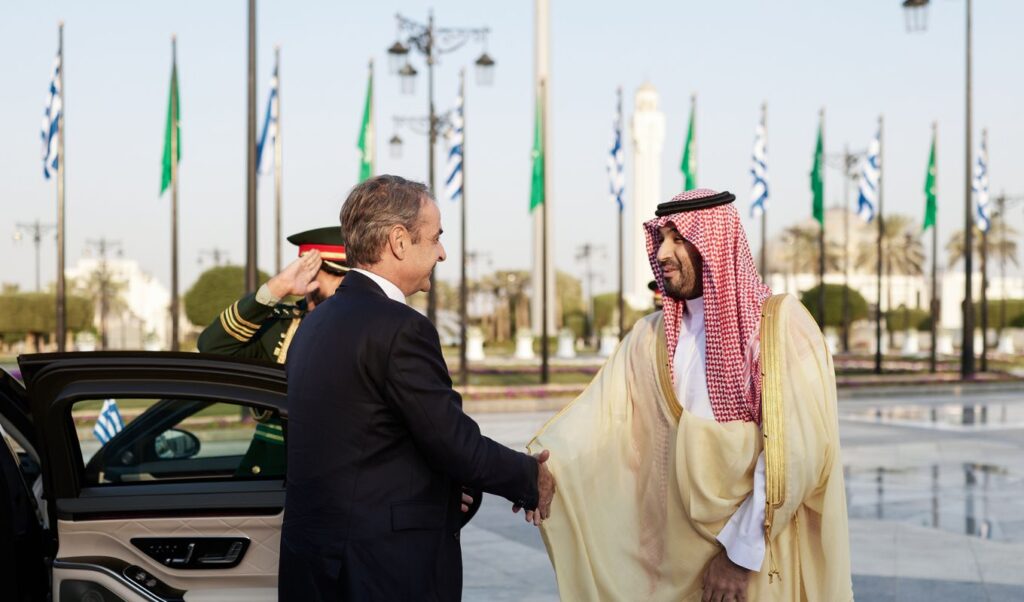
A week ago, Brussels announced the postponement of the EU-Gulf Cooperation Council Summit, which had been scheduled for October 25 in Riyadh, citing security concerns. Nevertheless, Kyriakos Mitsotakis chose that very day to send a clear message of Greek solidarity with its allies, traveling to the Saudi capital to meet Crown Prince Mohammed bin Salman with a very specific agenda: deepening and expanding ties with one of the Arab world’s most powerful states — a relationship that has taken on added significance in the shadow of the illegal Turkey-Libya maritime memorandum and its ratification by the Benghazi parliament, as well as the ongoing war in the Middle East.
Read also: Mitsotakis and Bin Salman hold one-on-one talks in Riyadh — Patriot missile system to remain in Saudi Arabia (Photos)
Yesterday also brought a noteworthy development on the Turkey-Libya memorandum front. “The announcement of the ratification of the Turkey-Libya maritime boundary memorandum has heightened tensions in the region and represents an unconstructive and provocative development,” the U.S. State Department stated (in communication with Kathimerini), adding that “our position on this matter has not changed.”
The U.S. State Department reiterated — as it did in its initial statement — that “we encourage all countries, including our partners in the Eastern Mediterranean, to resolve their differences regarding maritime zones through good-faith negotiations.” However, in this latest statement, it added the phrase “and to avoid any provocative behavior” to the same sentence.
In Riyadh, the Prime Minister brought with him, among other things, confirmation that the Patriot missile battery will remain deployed in the country — a deployment that had clearly transformed the bilateral relationship, and which, as had been repeatedly conveyed to Athens, has been greatly appreciated by Saudi Arabia. Last January, Mitsotakis had also participated, alongside a number of ministers, in the Saudi city of AlUla for the inaugural session of the Saudi-Hellenic Strategic Partnership Council — the first meeting of the body that Mitsotakis and Mohammed bin Salman had agreed to establish during the Crown Prince’s visit to Athens in 2022, as a further step toward deepening bilateral ties and expanding the rapidly growing Greek-Saudi partnership.
The EMC undersea cable and Greece as a “bridge” between the Middle East and Europe
Perhaps the most ambitious projects the two countries are jointly planning are the construction of the East to Med Data Corridor (EMC) undersea cable — which would establish Greece as a data gateway to the EU while simultaneously connecting it with the Middle East and Asia — and an electricity transmission cable running from Saudi Arabia to Europe via Greece, positioning the country as a strategic “bridge” between the Middle East and Europe.
During his meeting with Bin Salman, the Prime Minister expressed Greece’s condemnation of the attacks against Saudi Arabia and underscored Greece’s tangible solidarity at a critical juncture for the Kingdom and the broader region, as Greece has been contributing to Saudi Arabia’s air defense with a Patriot battery since 2021.
The Mitsotakis–Bin Salman talks: what was on the agenda
Mitsotakis emphasized that Greece’s presence contributes not only to the security of the Kingdom, but also to regional security more broadly, as the Patriot system protects critical energy infrastructure in Yanbu, on the Red Sea coast. He informed the Crown Prince that Greece is responding positively to the Kingdom’s request for the Patriot system to remain in Saudi Arabia during this difficult period.
The two leaders also discussed regional developments, particularly concerning Iran and the broader Middle East, with a strong focus on freedom of navigation. The Prime Minister reiterated that Greece, as a major maritime power, attaches the utmost importance to the security of international sea lanes and the unimpeded flow of global trade. He stressed that the international legal framework must be respected and that no restrictions should be imposed on freedom of navigation, as doing so would set a dangerous precedent.
The two leaders held extensive discussions on cooperation in the field of connectivity — particularly in data infrastructure — and on the EMC (East to Med Data Corridor) project, which aims to link Europe and Asia through Greece and Saudi Arabia.
They also discussed the upcoming second session of the two countries’ Supreme Council for Strategic Partnership, and reviewed the progress achieved since the Council’s inaugural session in January 2025, which established a systematic and institutionalized framework for bilateral cooperation across a range of sectors.
“I see my country, Greece, as a ‘bridge’ between Europe and the Gulf — two regions whose security, prosperity, and economic future are increasingly intertwined. In an era of deep geopolitical uncertainty, bringing these two regions closer together is not merely an economic opportunity. I believe it is a strategic necessity,” Mitsotakis said in his address at the Greece–UAE Strategic Forum organized by Enterprise Greece in Athens just days earlier — words that clearly reflect the Greek government’s broader strategic vision for the Gulf region.
On the same day, the Prime Minister met at the Maximos Mansion with the Crown Prince of Abu Dhabi, Sheikh Khaled bin Mohamed bin Zayed Al Nahyan, describing the current moment as “a period of great regional turbulence” and stressing that “it is precisely in moments like these that we must strengthen the strategic partnerships that have delivered tangible results.”