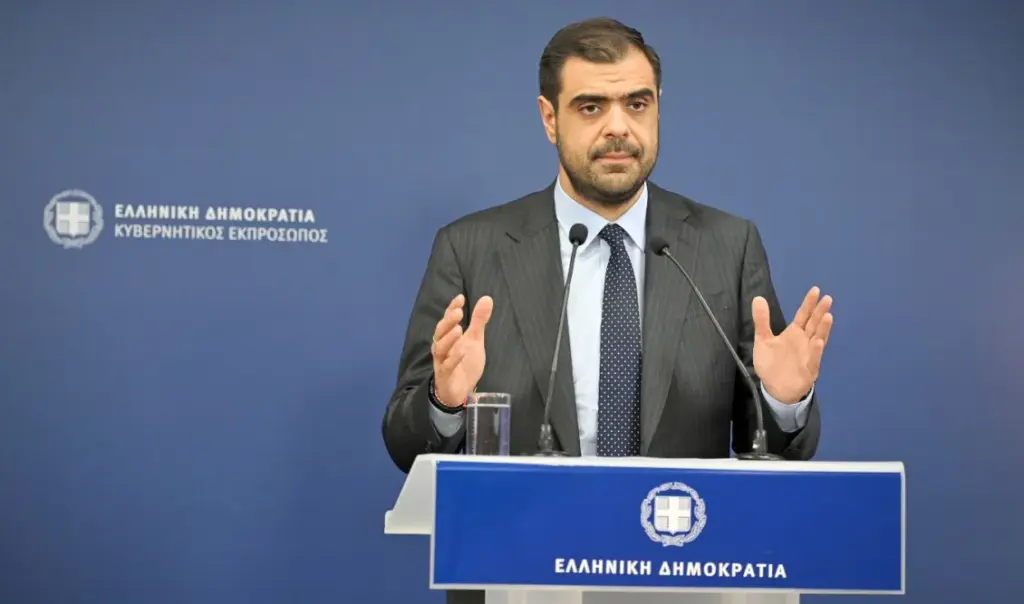
Greece’s Deputy Minister to the Prime Minister and government spokesperson, Pavlos Marinakis, expressed confidence on Sunday (04/10) that the Greece-Cyprus electrical interconnection project will be completed without problems. Speaking on SKAI television, Marinakis stressed that “the project will move forward,” emphasizing that Greece, Cyprus, and France are all “on the same page.”
As he stated, “beyond the fact that Greece, Cyprus, and France are now on the same page, this project lifts the energy isolation of an EU member state — Cyprus.” Marinakis also expressed his hope that the project’s implementation would not be accompanied by political tensions. “I want to believe we won’t have any tensions,” he said, stressing that this is an energy infrastructure project that “should not get caught up in disputes over tensions or permits.”
What Pavlos Marinakis said about the Greece-Cyprus electrical interconnection
“No special permit is required for this project to proceed,” he noted, adding that “Europe has embraced it” and that “one of the largest companies in this sector” is now involved. “It will proceed according to schedule. As we have proven, we speak through actions,” he continued.
The 120-installment tax settlement plan
Responding to opposition criticism that the government “stole the idea” of a 120-installment tax debt repayment scheme from PASOK, Marinakis fired back sharply: “Even a broken clock is right twice a day. The opposition throws out whatever idea might sound good, without costing it out or giving it any coherent structure.” He questioned the credibility of PASOK’s proposals, pointing out conflicting figures coming from within the party itself. “PASOK announced a program that its spokesperson said would cost 4 billion euros over four years, while its leader costed it at significantly more just days later,” he said. He went on to note that “the 13th pension alone, as described — half for the first two years and full for the following years — amounts to 5 billion euros in the last two years and 2.5 billion in the first two, totaling 7.5 billion euros for just one measure.”
Turning specifically to the 120-installment plan, Marinakis clarified: “The 120 installments build on the existing 72-installment scheme, and also include debts from 2024.” On the interest rate, he explained that “it must be the same as for the 24-installment option, which individuals can use for remaining years.”
“We are giving as much breathing room as possible to those who want to meet their obligations,” he said, underlining that people who use debt settlement schemes are not necessarily “deadbeats,” but individuals facing genuine financial hardship. “These people don’t enter installment schemes because they’re deadbeats — they do so because they’ve struggled, because they need to pay,” he said pointedly.
He also raised the issue of fairness between those restructuring their debts and those who consistently meet their obligations. “There must also be a balance with those who are compliant,” he noted, adding that “many times it’s as if they’re speaking to a country where there are no people who — without being financially comfortable — pay their taxes every month, pay their contributions every month, and meet their obligations every month.”
Pavlos Marinakis’ comment on Antonis Samaras’ latest intervention
Commenting finally on former Prime Minister Antonis Samaras’ latest intervention regarding the return to Greece of the relics of Tsar Samuel, Marinakis first addressed the claim about “100 years.” “First of all, Mr. Samaras said that the return of Samuel’s bones has been the desire of Bulgarians for 100 years. Let’s note that the bones were discovered in 1965 — so we cannot talk about 100 years,” he pointed out.
Marinakis also referred to the Holy Synod’s official statement on the matter. “The best response to any criticism regarding yesterday’s historic day is the announcement issued by the Holy Synod,” he said. Addressing the religious artifacts that had been transferred to Bulgaria, he argued that this constitutes a separate and distinct case from the return of Samuel’s relics.
“Beyond that, artifacts and manuscripts were stolen from monasteries. These are two different cases. We are reclaiming all the artifacts,” he stated. “This is, in fact, only the first phase of the negotiation — all the artifacts that were held at the National Museum in Sofia.”
Regarding additional items that may still be sought, Marinakis noted that “the Ministry of Culture already provided a detailed briefing yesterday.” “It is engaged in an ongoing negotiation process, and some items have already been returned,” he concluded.