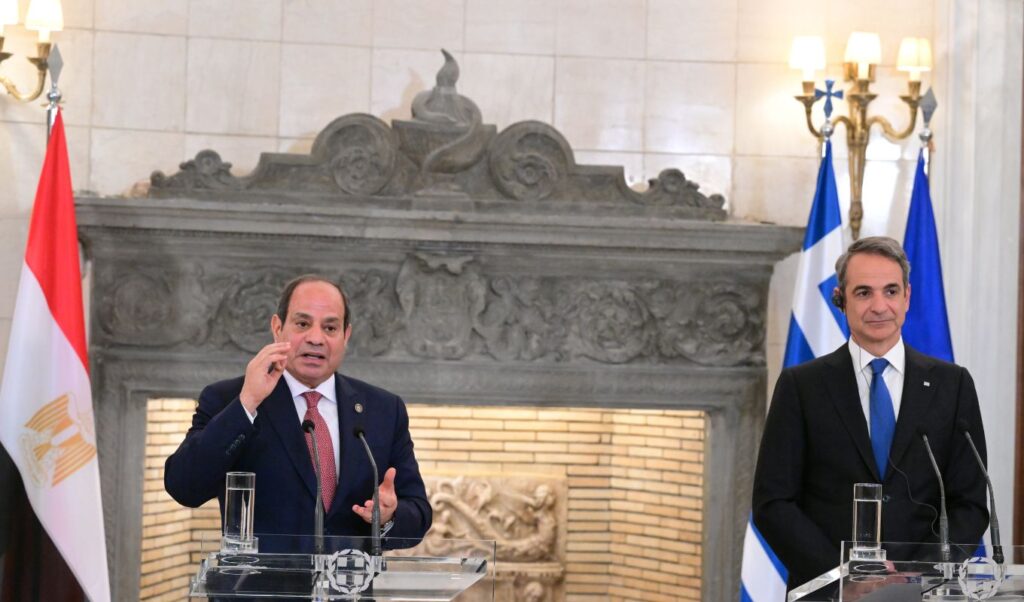
Today’s meeting between Greek Prime Minister Kyriakos Mitsotakis and Egyptian President Abdel Fattah Al-Sisi in El Alamein is taking place at a particularly critical juncture for the geostrategic balance of power in the Eastern Mediterranean.
At the heart of the talks are issues of vital geopolitical importance, with Eastern Mediterranean security topping the agenda. The question of the Sinai Monastery also features prominently, as the agreement on its ownership and legal status has yet to be finalized. Athens and Cairo are working closely together to establish a special regulatory framework that would prevent the Monastery from being treated as a mere archaeological site. Although the final agreement remains pending due to outstanding details, the health issues of Archbishop Symeon, and the heightened religious obligations of the Dormition of the Virgin Mary period, the matter is expected to be discussed extensively during the two leaders’ meeting.
The special protection framework sought for the Sinai Monastery
According to information available so far, the forthcoming agreement aims to secure the Monastery’s status through official Egyptian state documents and to establish its legal personhood. The provisions under consideration are designed to permanently preserve the Monastery’s status quo — meaning its Greek Christian religious character — with ownership and use retained by the Sinaite Community at no financial cost, placing it under a special framework of protection analogous to that afforded to archaeological heritage sites. It should be noted that Egypt’s Supreme Court of Cassation — the equivalent of Greece’s Court of Cassation — before which both sides have filed appeals, has now postponed its ruling on four separate occasions. Based on what has been made public so far, the Egyptian proposal recognizes state ownership of all properties, including the small chapels located at a distance from the main Sinai Monastery complex. As for the estates located near the Monastery that were historically used to supply it, the Egyptian state’s proposal provides for the possibility of long-term leases at a nominal cost.
Parapolitika.gr sources: Why the finalization of the agreement has been delayed
However, well-placed sources tell parapolitika.gr that, while the agreement has been largely accepted, certain individual issues remain to be resolved. The same sources attribute the stalling of negotiations with Egypt to Archbishop Symeon’s health problems, compounded by the dual religious feasts of August observed according to the Old Calendar. It should be noted that what the Archbishop requires is for the agreement to be accepted by the Sinaite Community as a whole. Nevertheless, according to ecclesiastical sources, tensions between former Archbishop Damianus and the brotherhood have intensified in recent months, while a hardline Arabic-speaking faction of monks has been gaining influence within the community — effectively undermining the Monastery’s negotiations with the Egyptian state. It is also worth noting that the issuance of a decree formally recognizing Symeon’s election as Archbishop remains pending; he was elected to the Archiepiscopal Throne — following previous incidents — exactly one year ago. As a result, he does not hold an Egyptian passport, and the monks themselves travel only on standard tourist visas.
Greece, Cyprus, and Egypt facing new geopolitical challenges
All pending issues regarding the Sinai Monastery are expected to be raised during today’s bilateral meeting between Kyriakos Mitsotakis and Al-Sisi. Of particular interest, however, is the trilateral summit between the Greek Prime Minister, the President of the Republic of Cyprus, and the Egyptian President in El Alamein.
Greece and Cyprus have played a significant role in connecting Egypt with the European Union, primarily by facilitating access to European programs that proved especially important in supporting the Egyptian economy — which has been hit hard by global crises and the war in Gaza. The three-way cooperation, particularly in energy grid and pipeline interconnectivity, ranks high on the agenda.
Greece’s strategic bet on expanding the EEZ
At the same time, Athens is seeking to reaffirm its common position with Cairo, building on the partial Exclusive Economic Zone (EEZ) delimitation agreement signed in 2020. That agreement effectively nullified the Turkish-Libyan memorandum signed with Libya’s Government of National Accord. Greece’s objective is to extend the EEZ with Egypt further eastward, in order to prevent Cairo from drawing closer to Ankara — which is attempting to court Egypt by promising larger maritime areas, a development that would seriously undermine Greek geostrategic interests. Egypt, despite considerable pressure, has refused to align with Turkey in the agreement with Pakistan and Saudi Arabia, known as the “Mecca Agreement.”
Why Ankara has its eyes fixed on El Alamein
For this reason, Turkey is watching today’s trilateral summit closely. As Hurriyet reports, “Greece, Cyprus, and Egypt will hold a trilateral summit in the Egyptian city of El Alamein on September 8, with regional developments and the Mecca Agreement expected to be among the items on the agenda,” adding that “Egypt is considering joining the alliance, while Turkey has stated that the agreement remains open to other countries in the region.” Nevertheless, Cairo appears unwilling to be drawn into the orbit of any neighboring country — and especially not Turkey, toward which it maintains considerable wariness despite the recent normalization of their relations.