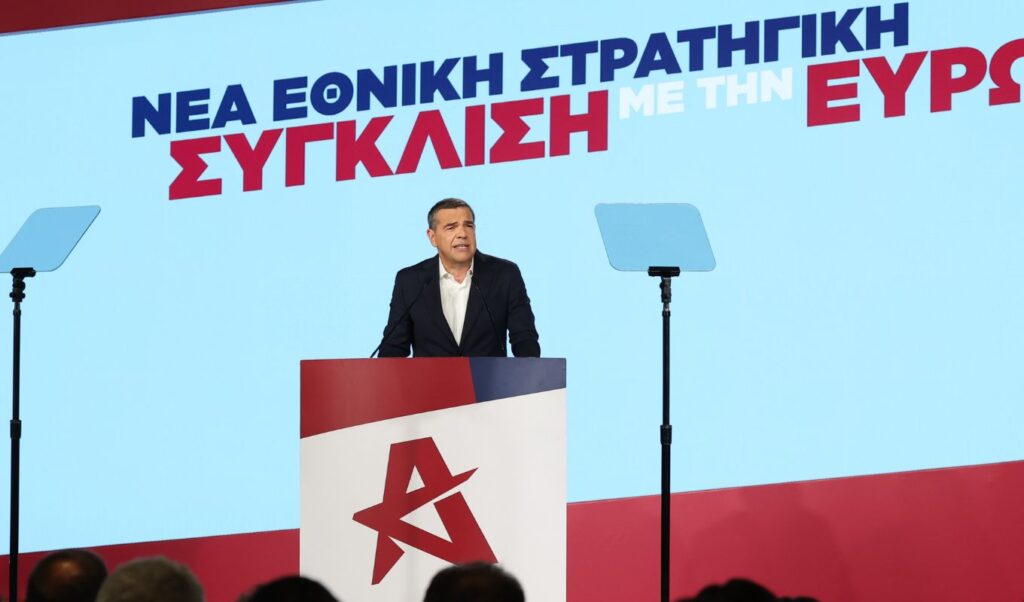
SYRIZA officials consider the government’s criticism of Alexis Tsipras‘s economic program to be expected — but ultimately toothless. They pointedly noted that government officials had already begun publicly criticizing the SYRIZA leader’s announcements before he had even stepped up to the podium.
According to the same party sources, SYRIZA intends to submit all of the former prime minister’s proposals to the Hellenic Fiscal Council in the coming days, requesting a comprehensive cost assessment. They argue that this process will expose what they describe as the government’s reliance on fiscal sleight of hand — the kind of creative accounting, they say, that would make even first-year economics students laugh.
Tsipras’s associates were blunt in their assessment: “The government costed the program Alexis Tsipras presented at the Thessaloniki International Fair before his speech had barely finished. It’s a new record in their back-of-the-envelope arithmetic.” They went further, accusing government officials of engaging in political and economic alchemy, claiming that the Maximos Mansion “fabricated the figure of €13 billion by lumping together permanent expenditures, four-year investments, loans, reallocation of already available resources, and measures to be implemented gradually — then labeled the total an annual cost.”
“The government’s own figures expose the construction for what it is,” they said, presenting the following specific points:
- The government costed 50,000 affordable housing units as if the state were going to build 50,000 brand-new 80-square-meter apartments from scratch and pay for them in cash — completely ignoring the utilization of vacant homes and public properties, renovations, public-private partnerships, and the leveraging of private and European capital.
- It presented resources from the Public Investment Program, the Green Fund, the European Investment Bank, and the resilience levy as if they were all additional consumer expenditures in the state budget — disregarding reallocations, co-financing arrangements, transfers of responsibilities, and the phased execution of projects.
- It assumed that every policy measure would be fully implemented from day one, despite the program having a four-year timeframe.
- It completely ignored the permanent revenue streams and tax justice measures that are designed to fund the program’s ongoing expenditures.
SYRIZA’s shadow finance minister, Fragkiskos Koumentakis, was scathing in his response to the government’s arguments: “In any case, what we saw in the government’s announcement was yet another case of adding apples and oranges — and goodness knows what else — to arrive at a total that comes from nowhere.
“They cost the new housing units, for example, as if the Greek state were about to start building homes from the ground up, laying foundations and pouring concrete. They mix up funding streams from the Public Investment Program, the Green Fund, and the European Investment Bank. They conflate loans with expenditures, and they assume every measure kicks in at full force from the very first day. And of course, they conveniently forget to account for the permanent revenues built into our program. I would describe the announcement, in general terms, as laughable.
“We start from a basic projection — from the available fiscal space based on current data, which is estimated at around €5.6 billion over a four-year period. This figure is derived from the medium-term fiscal plan running to 2028, with the permitted increase in primary expenditure for 2029 and 2030 set at the same level as in the current medium-term framework. That is actually a rather conservative estimate, given that all indications suggest the margin will be larger — in all likelihood larger — in the next medium-term plan.
“Starting from that existing fiscal space, we add approximately €2 billion generated through a series of tax measures targeting high incomes and large assets. This creates a total package — what we call an overall envelope — of around €7.5 billion, which is directed, on one hand, toward strengthening the welfare state, education, and healthcare, and to a significant degree toward the younger generation and children, and on the other hand toward a series of tax burden reductions for both salaried workers and small and medium-sized enterprises.”
SYRIZA’s press spokesperson, Theoni Koufonikola, addressing the government’s criticism, stated: “The body that will judge whether things actually stand as the government claims is the Hellenic Fiscal Council. That is the second point. What is very strange is that the Ministry of Finance keeps resorting to creative accounting. It produced a cost estimate half an hour after the program was announced — yet just a few months ago, the same Mr. Kontogeorgis had costed a portion of this program, and a small portion at that, at €18 billion. And now the entire program is supposed to cost €13 billion?” she asked pointedly.