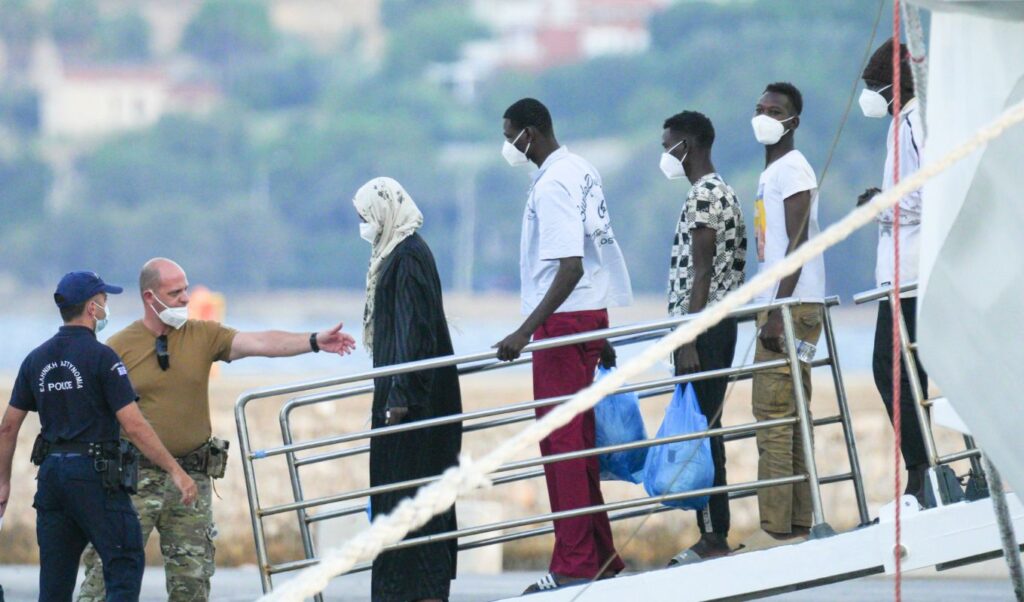
The Greek government is highlighting a significant overall annual reduction in migration flows — approximately 20,000 fewer arrivals over the past year since the implementation of stricter new measures — pushing back against opportunistic political criticism that ignores reality by focusing solely on recent illegal migrant arrivals in Crete.
The data available to the Ministry of Migration and Asylum — which provides concrete evidence that the government’s tough line on migration is delivering results — follows the July 2025 decision to tighten migration policy. This was enacted through asylum suspension legislation that came into force in mid-July, as well as the passage of a bill built around the doctrine of “detention or deportation,” which was tabled in July and passed at the end of August.
Migration flows down — Pleuris measures proving effective
The dual purpose of these two pieces of legislation was to reduce illegal flows and increase deportations, with results now measurable after one year of implementation. Data from the relevant ministry shows that in the 12-month period from 1 August 2024 to 31 July 2025 — before the new measures took effect — illegal arrivals reached 61,123. By contrast, in the 12-month period from 1 August 2025 to 31 July 2026 — during which the “detention or deportation” doctrine has been in force — arrivals fell to 41,998. In other words, within just one year, a reduction of nearly 20,000 illegal arrivals was achieved, representing a 35% drop in illegal entries in a single year.
The figures
At the same time, ministry data shows that deportation figures for the seven-month period reflect a 20% increase overall, with forced deportations up by 35%. There is, of course, no room for complacency, and the problem persists — particularly regarding flows from Libya to Crete. However, it is now clear that the tough policy is bearing fruit, with Migration and Asylum Minister Thanos Pleuris having implemented a series of strict measures and cooperation policies with third countries.
Pleuris meets his Danish counterpart
Far from resting on these results, Minister Pleuris continues to seek ways to improve the situation. He is currently in discussions regarding the establishment of return centres in Africa, with plans for them to become operational in the second half of 2027 — coinciding with the Greek presidency of the EU. Toward this goal, Mr. Pleuris met yesterday in Athens with his Danish counterpart, Morten Bødskov, with talks focusing on strengthening European cooperation to address illegal migration.
The competent ministers from five countries — Greece, Germany, Austria, Denmark, and the Netherlands — currently in negotiations with African nations are set to meet on 4 September in Copenhagen, where announcements regarding the timeline are expected.
The situation in Crete
As for the situation in Crete, where flows remain high despite efforts to improve cooperation with the Libyan coast guard, it is worth noting that a temporary reception facility is already operational in the Agia area of Chania, while another temporary facility in Heraklion is in its final stages of becoming operational. Meanwhile, reception facilities from across mainland Greece are providing support to the island. Speaking to “A,” Minister Pleuris commits that “there will be no additional burden placed on the other islands, and any transfers will be carried out on a small scale with corresponding capacity adjustments.”
This commitment is also reflected in the ministry’s planning for migration flow management and its implementation. Specifically, Greece operates 33 facilities — both open and closed — with newly arrived migrants not required to remain on the island of first arrival. Instead, a sorting and relocation process is followed based on each individual’s profile and the progress of their asylum claim.
As an example, in recent days a total of 417 individuals were transferred to Samos and Lesvos, while since the beginning of the year more than 4,000 people have been relocated from these islands to closed and open facilities on the mainland. This demonstrates that available space had already been created within the island facilities, as other residents had previously been moved elsewhere in the country.
Occupancy rates at historic lows
Ministry data further indicates that occupancy levels are at a historic low — below 1,000 individuals across both facilities, which have a combined capacity of over 6,000. Relevant sources explain that a decision was made in recent days to transfer 205 individuals to Samos, from where 229 people are scheduled to depart this coming Thursday — demonstrating that transfers from Crete are being accompanied by a parallel decongestion process.
Originally published in Apogeumatini