Greece’s new Special Spatial Framework for Renewable Energy Sources, which covers the maritime territory of the Aegean Sea, has drawn sharp criticism from Turkey. Ankara is once again raising the issue of gray zones, with Turkish Foreign Ministry spokesman Öncü Keçeli stating that this framework — along with similar Greek initiatives — carries “no legal consequence” for Turkey regarding Aegean affairs. Turkey, which has itself used international waters for its own announced National Marine Parks, now argues that its position concerns, among other things, “geographical formations whose ownership has not been transferred to Greece through international agreements.”
Read: Papastaurou: “A new model of sustainable development through spatial planning”
Turkey: Now talking about good neighborly relations
According to the Turkish Foreign Ministry spokesman, as reported by SKAI, this action and similar ones do not change Turkey’s legal position on Aegean issues. Commenting on the Greek initiative, he claimed that unilateral actions in enclosed or semi-enclosed seas — such as the Aegean and the Mediterranean — should be avoided, calling instead for cooperation among coastal states in accordance with international maritime law.
Notably, despite Turkey’s “Blue Homeland” doctrine and the dozens of daily airspace violations, the spokesman declared that “Turkey, as one of the two coastal states of the Aegean Sea, is always ready to cooperate with Greece.” He further claimed that Ankara’s position favors a “sincere and comprehensive” approach to bilateral issues, based on international law, equality, and good neighborliness. He also referenced the Athens Declaration on Friendly Relations and Good Neighborliness, signed on December 7, 2023.
What Greece’s new Special Spatial Framework for renewable energy includes
SKAI reports that the new Special Spatial Framework entered into force by ministerial decree of Environment and Energy Minister Stavros Papastaurou, along with Deputy Ministers Nikos Tsafos and Marilena Soukouli.
Its goal is to update the regulations governing the siting of new renewable energy projects and energy storage facilities, taking into account current environmental, social, and economic conditions. At the same time, it introduces stricter terms for the protection of the environment, local communities, and cultural heritage, with a long-term horizon of meeting the country’s energy targets by 2050. The previous special spatial framework had been established in December 2008.
Solar energy provisions
For new solar photovoltaic installations, uniform rules are established across the entire country, while installation is prohibited in a range of environmentally, culturally, and spatially protected areas. Among other restrictions, new solar farms are banned in NATURA 2000 network areas, forests and woodland, Ramsar wetlands and small island wetlands, national parks, natural monuments, aesthetic forests, and Areas of Outstanding Natural Beauty.
Also excluded are areas under cultural heritage protection, terraced landscape protection zones, roadless areas, and swimming beaches. Additionally, a maximum land coverage limit is set for new solar installations. At the regional unit level, coverage may not exceed 1.5% of total land area, with the aim of protecting the landscape, agricultural land, and diverse land uses.
Following public consultation, the exclusion zones were expanded to include historic sites, ancient monuments, designated or automatically protected monuments, as well as post-1830 monuments with protected status. Restrictions were also extended to areas containing water sources used for human consumption. For floating solar installations, prohibitions apply in diving parks, modern shipwrecks, anchorage areas, and artificial underwater attractions.
Furthermore, when siting projects in marine areas and lakes, fishing grounds will be taken into account and required safety distances will be maintained. In areas vulnerable to natural hazards, special measures will be in place to ensure the safe installation and operation of projects.
Wind farm regulations
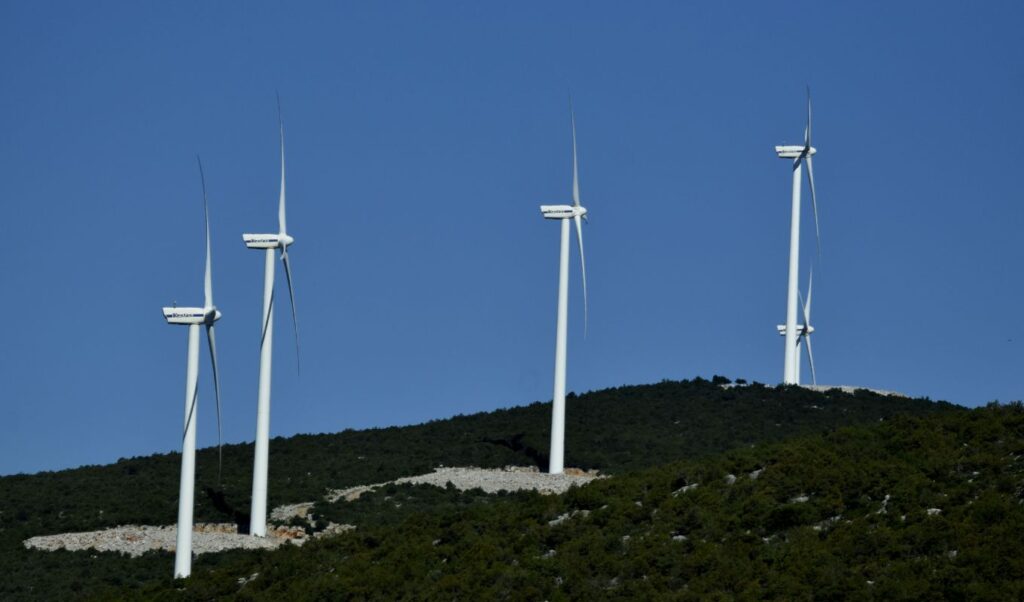
The new framework introduces corresponding restrictions on wind farm development, aiming to ensure that wind energy expansion takes into account the environment, landscape, and local communities. Wind farms are prohibited, among other locations, in Attica and the Metropolitan Area of Thessaloniki, in areas above 1,200 meters in altitude, in Ramsar wetlands and small island wetlands, as well as in Areas of Outstanding Natural Beauty, national park core zones, and specific nature protection zones.
Restrictions also apply to islands smaller than 300 square kilometers, with exceptions for critical or public-interest infrastructure and energy system security. Similar restrictions apply to out-of-plan areas designated for tourism and recreational uses, active quarrying, mining and extraction zones, roadless areas, and swimming beaches.
In Special Protection Areas within the NATURA 2000 network designated for bird protection, wind farms may only be installed on an exceptional basis, provided this is stipulated in an approved Special Environmental Study and wind potential exceeds 7.5 m/s. Following public consultation, a ban was also added on new wind farm installations in Category A and B areas of the new Special Spatial Framework for Tourism. Exclusion zones were further extended to include historic sites, ancient monuments, designated or automatically protected monuments, post-1830 protected monuments, areas with drinking water sources, and pristine beaches.
Special landscape study for islands
For wind farm installations on islands, a special landscape study is required as part of the environmental licensing process. The study will examine, among other aspects, the size of the wind farm, the characteristics of the landscape, and the potential visual impact. In mountainous island areas, assessment will be conducted on a case-by-case basis, taking into account the morphological, ecological, and local characteristics of each area.
The maximum land coverage rate from wind farms in island territory is maintained at 4% per municipal unit.
The new framework also opens up the possibility of utilizing areas with locally high wind potential, even where the average for the broader region is low. Thus, in municipal units where average wind potential is below 4 m/s, a wind farm may exceptionally be approved if wind potential at the specific site is demonstrated to exceed 7.5 m/s.
Updates for other renewable energy sources
The new spatial framework also updates the rules for other forms of renewable energy. Specifically, it includes new siting guidelines and conditions for biogas, biomethane, biomass, geothermal energy, and small hydroelectric projects, with the goal of establishing a more modern and comprehensive framework for their development.