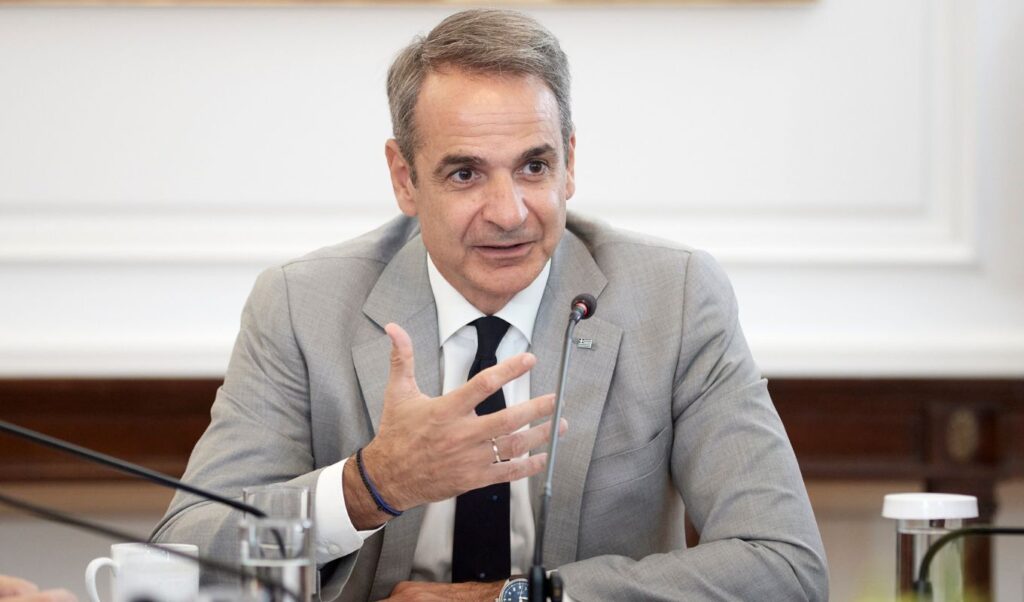
The Maximos Mansion is operating in full Thessaloniki International Fair (TIF) mode, with Kyriakos Mitsotakis and his associates back at the Herodes Atticus residence, holding a series of meetings to put the finishing touches on this year’s policy package. The prime minister is set to unveil the measures in his keynote address on Saturday, September 5. What is certain is that this year’s announcements will remain within the existing fiscal framework, with government officials emphasizing that while the upcoming TIF has a pre-election character, it will not amount to a giveaway. In this spirit, the economic team is designing a package of measures with a strong social dimension, with private sector workers and pensioners at the center of the government’s focus. Given that Mitsotakis’ appearance will be his last as head of the current government at TIF, the political climate creates the conditions for a package more sharply focused on boosting household disposable income and supporting retirees.
Mitsotakis’ TIF “gift” — the “13th national pension”: Raising the €300 bonus to €446.87 and abolishing the personal difference supplement
At the heart of the deliberations is a proposal to convert the €300 bonus paid at the end of November into a “13th national pension,” alongside pension increases, the permanent abolition of the personal difference supplement, a new reduction in social security contributions, a rise in the minimum wage, and corresponding pay increases across both the private and public sectors. For pensioners specifically, sources indicate that a further increase to the €300 bonus is imminent — raising it to either €400 or the full national pension level of €446.87 — so that it can be rebranded as a “13th national pension.” The broad outline of the measures Mitsotakis will announce is already in place, with final consultations with the economic team underway to lock in the details. Speaking to Mega television, Deputy Labour Minister Kostas Karagkounis explained that the government is currently completing its assessment of revenue figures — including tourism receipts, which performed reasonably well despite the challenges — as well as growth rates, as reflected in the number of new jobs being created.
“When we have the full picture of the public finances, Greeks should know they will see a boost in their wallets. All Greeks,” Karagkounis stressed, making particular reference to targeted interventions planned for the self-employed and small and medium-sized enterprises. “They have indeed come under enormous pressure and have been somewhat shortchanged compared to a range of measures we have taken in recent years for civil servants, pensioners, and the self-employed. As the finance minister has indicated, a very significant intervention for SMEs and the self-employed is coming. Beyond that, we’ll see it in a few weeks, when the prime minister makes the announcements,” the deputy minister said. In any case, the finer details of the TIF package will be placed under the microscope this week, while the Cabinet meeting is scheduled for Monday, August 24.
Northern Greece in the spotlight
At the first session of the new political season, Mitsotakis is expected to outline priorities for the immediate period ahead, starting with the upcoming TIF, while attention will also turn to pending plans for Recovery Fund resources. All projects and milestones must be completed by August 31, so that the final payment request can be submitted to the European Commission by September 30. On August 27, Mitsotakis will visit Thessaloniki for meetings with the productive bodies of Northern Greece, where the government will focus on showcasing the infrastructure projects underway — including the Thessaloniki Metro mainline, which has been completed, and its extension toward Kalamaria, set to open to the public shortly; the suburban railway for western Thessaloniki; the Flyover highway; two new hospitals (a Children’s Hospital and an Oncology Centre); school infrastructure upgrades; the redevelopment of the TIF grounds; and the Holocaust Museum. Traditionally, August and the first week of September place Northern Greece at the center of the government’s attention, but the pre-election character of this year’s International Fair demands an intensified government presence in Thessaloniki and, more broadly, across Macedonia. This is because all eyes at Maximos Mansion are fixed on the ruling party’s polling performance in the regions of Macedonia and Thrace, where rightward defections from the party’s electoral base have been recorded.
Given that parties to the right of New Democracy are concentrating their strongest momentum in Macedonia’s electoral constituencies — capitalizing on local ties and the Northern Greek roots of their leaders (Kyriakos Velopoulos, Dimitris Natsios, Afroditi Latinopoulou) — and given that this trend was already reflected in the 2024 European Parliament election results, where New Democracy saw its support decline in Northern Greece while right-wing rivals gained ground, the party’s secretary-general, Konstantinos Kyranakis, is planning a broad campaign blitz from August 31 to September 4 — one day before the prime minister’s address at the Vellidio Conference Centre. Ministers and party officials will fan out across Eastern Macedonia, Thrace, Central Macedonia and Western Macedonia, with teams expected to make targeted visits to areas that can be paired with the projects and initiatives being delivered by their respective ministries. Prime Minister Mitsotakis himself is also expected to visit the regional units of Florina and Kozani in late August. In Western Macedonia, the government has struggled to effectively communicate its track record and policies, partly due to local concerns over the ongoing decarbonization programme. Maximos Mansion is therefore turning its attention to the region, with a particular focus on highlighting infrastructure projects and investments aimed primarily at creating new jobs.