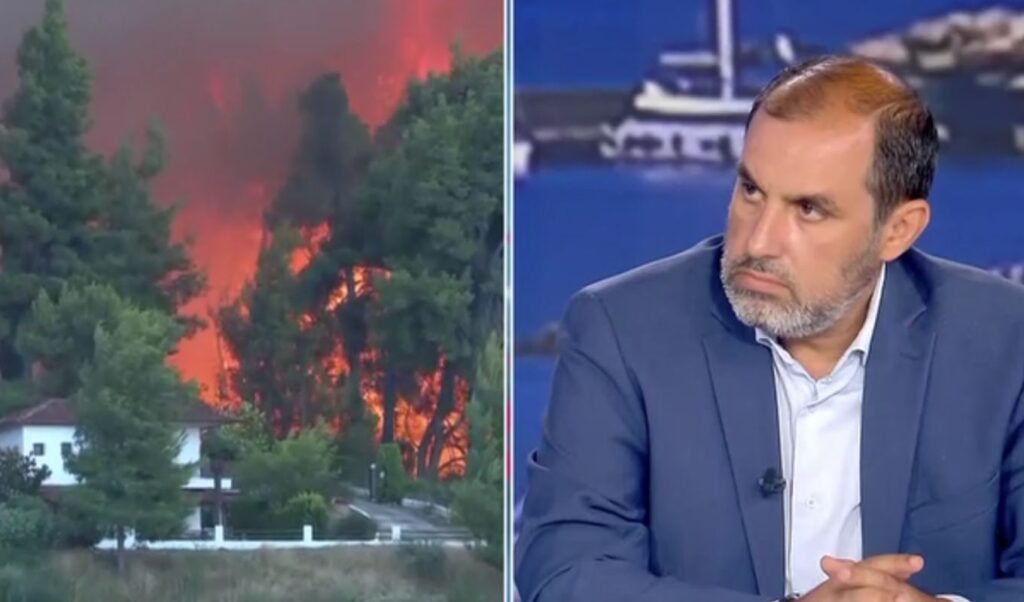
Deputy Minister for Climate Crisis and Civil Protection Kostas Katsafados addressed the devastating fire on the island of Salamina, which claimed two lives, as well as compensation measures for wildfire victims. He outlined the immediate mobilization of government emergency response mechanisms to deal with the aftermath of the wildfires and extreme weather events, as well as the state’s plans to restore and support affected residents.
Speaking on Monday morning (August 17) on SKAI television, Kostas Katsafados began by expressing his condolences over the deaths of two elderly people in Salamina. He stated: “Allow me to begin by expressing my sincere condolences for the loss of two of our fellow citizens yesterday in one of the two fires we faced, in Peristera, Salamina.”
He continued: “The state mechanism responded immediately. Today I want to inform you that teams from the General Secretariat for Natural Disaster Recovery are already on the ground in the Municipality of Kassandra and in Siviri, Halkidiki, where they are conducting the necessary on-site inspections in cooperation with local authorities. On Wednesday, both myself and the Minister of Rural Development Margaritis Schinas will attend a meeting at the Kassandra Town Hall.” He added: “After that, we will head to Salamina — we are beginning operations there today as well.”
First payments to Porto Germeno wildfire beneficiaries expected by end of week
Referring to the major wildfire at Porto Germeno, Katsafados noted that the first request submitted by the Municipality of Mandra on behalf of affected residents has already been processed, with the first payments expected to begin by the end of the week. “The first request related to the major Porto Germeno fire was finalized on Friday. The Municipality of Mandra sent us the initial list with the first 49 eligible recipients, so payments will begin by the end of this week,” he said.
He further noted: “By the end of the week, we will have transferred the funds for household contents — the amounts corresponding to those 49 beneficiaries.” He added: “We are also awaiting additional requests from the Municipality of Mandra for the remaining applicants, so they can also receive their household compensation and basic needs allowance.”
The deputy minister also addressed the process for repairing and rebuilding damaged buildings, noting that the relevant Joint Ministerial Decision is ready. “The Joint Ministerial Decision is finalized, so next week the process will begin. Citizens will be informed from early September through a dedicated call center we have set up. From early September, they will be able to submit their applications to proceed with the repair or reconstruction of their properties,” he stated.
He also reaffirmed the government’s commitment to covering the demolition costs for buildings classified as “red-tagged” — deemed unsafe for habitation. “As we had announced regarding Porto Germeno, the state will undertake the demolition of red-tagged homes, so that residents can obtain the necessary documentation to proceed with reconstruction.” He added: “The same will apply to other affected areas where this is deemed necessary. Wherever there are red-tagged buildings — that is, structures slated for demolition — the state will cover the demolition costs.”
Red-tagged homes in Porto Germeno rise to 101
According to the deputy minister, the number of buildings classified as “red-tagged” in Porto Germeno has increased from 79 to 101, as on-site inspections continued and new applications were submitted. “Inspections are still ongoing. The last time we spoke, I mentioned 79 homes in Porto Germeno. Since then, more residents have submitted applications. We have now reached 101 red-tagged homes in Porto Germeno — all designated for reconstruction,” he said.
He continued: “On-site inspections are beginning today in two areas — the Municipality of Kassandra and the Municipality of Salamina. Our initial assessment is that we are talking about a relatively small number of properties; in both cases, the figure is expected to be fewer than 15 buildings.”
“14 tonnes of water per stremma in Mani — locals have never seen anything like it”
The deputy minister also addressed the extreme flooding that struck the Mani peninsula, emphasizing that while the climate crisis cannot serve as an “alibi,” the rainfall recorded in the area was truly unprecedented. “The climate crisis is not an alibi, nor are its consequences. What happened in Mani was something unique. The local residents I spoke with — older people — said they had never seen anything like it in their entire lives,” he said.
He added: “On the Feast of the Assumption [August 15], 14 tonnes of water fell per stremma in a geographically small area. You can imagine just how enormous the volume of water was.”
Katsafados stressed that the state emergency mechanism was mobilized immediately in Mani as well, and that the situation has since returned to normal. He noted: “Today, teams from the General Secretariat for Natural Disaster Recovery are present in the Municipality of Eastern Mani to assess any damage sustained by buildings and businesses.”
He also highlighted the coordinated response effort: “We carried out a coordinated operation with both the Regional Authority and the Municipality to mobilize as much heavy machinery as possible, so that normal life in the area could be restored the following day. We are, after all, in the middle of the tourist season. Since August 16, the situation has been normalized.”
Regarding businesses that suffered damage from the extreme weather in Mani, the deputy minister noted that the numbers are limited. “Tomorrow, Tuesday, the Government State Aid Committee will convene. The information we have indicates that the number of businesses that have sustained damage is very small — you could count them on one hand,” he said. He added: “However, the standard procedures will be followed for those affected. When the Government Aid Committee meets tomorrow, we will take specific measures targeting citizens and businesses impacted by all these weather events.”
“Everyone has their own personal responsibility”
Closing his remarks, Kostas Katsafados addressed the causes of wildfires and the importance of individual responsibility, stressing that: “The climate crisis does not start fires — but it does create conditions that make fires extremely difficult to extinguish.”
He emphasized that the vast majority of wildfires are caused by human activity, whether deliberate or accidental. “For the most part, it is people who start fires — which is why this year we are approaching 300 arrests of individuals who either intentionally or accidentally started a fire,” he noted. He concluded: “Everyone bears their own personal responsibility.”