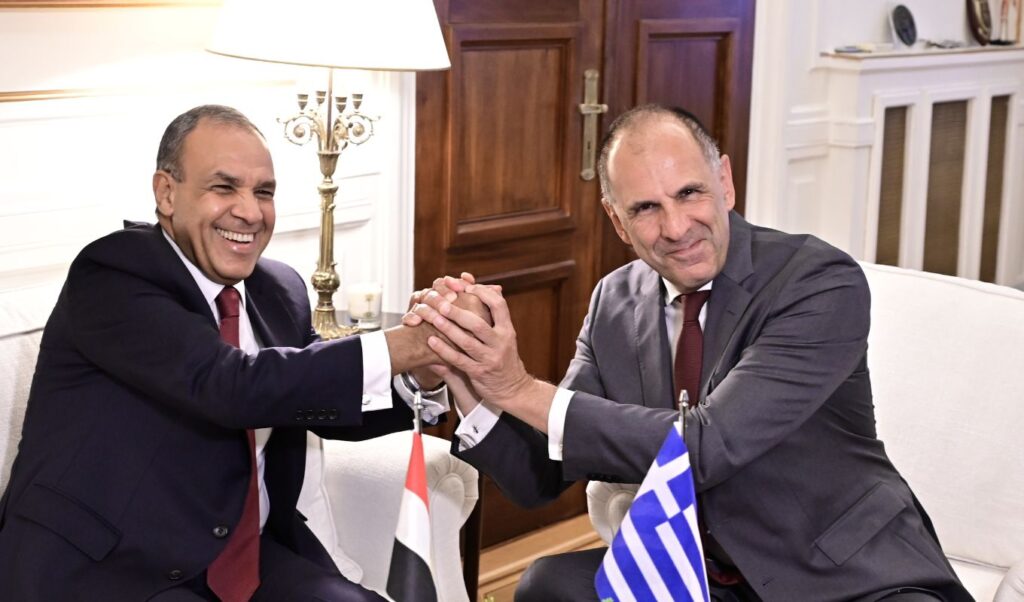
The latest phone call between Foreign Minister Giorgos Gerapetritis and his Egyptian counterpart Badr Abdelatty has drawn significant attention, as it took place just days after the signing of the Mecca Agreement between Turkey, Saudi Arabia, and Pakistan — and following Ankara’s open invitation to Cairo to become the next partner in this new defense arrangement.
The two foreign ministers spoke on Monday, with Athens and Cairo exchanging views on developments across the broader Middle East and Eastern Mediterranean. According to the Egyptian side’s readout, the discussion also touched on regional security arrangements aimed at bolstering both security and stability — a reference that carries added weight in light of the new security architecture that Ankara, Riyadh, and Islamabad are working to build.
Badr Abdelatty briefed Giorgos Gerapetritis on Cairo’s intensive diplomatic contacts aimed at de-escalating regional tensions, reaffirming Egypt’s commitment to diplomacy and dialogue. The two ministers also reaffirmed the strategic partnership between Greece and Egypt and expressed their intent to maintain close coordination between the two countries.
The Mecca Agreement
The timing is significant. On August 7, Recep Tayyip Erdoğan, Saudi Crown Prince Mohammed bin Salman, and Pakistani Prime Minister Shehbaz Sharif signed a new mutual defense agreement in Mecca, stipulating that an armed attack against any one of the three states would be treated as an attack against all.
Ankara has made no secret of its ambition to expand the arrangement. Turkish Foreign Minister Hakan Fidan pointed openly toward Egypt, describing it as a “natural partner” for the three countries and publicly suggesting that Cairo could join the new alliance at a future stage. Egypt, for its part, has so far maintained a noticeably more cautious posture than Ankara would prefer. Cairo did not participate in the signing of the Mecca Agreement and has not publicly responded to Fidan’s invitation.
This restraint reflects Egypt’s long-standing diplomatic tradition of preserving room to maneuver in an exceptionally fluid regional environment.
Egypt’s relationships with Greece and Cyprus also figure prominently in this equation. Athens and Cairo have built a strategic partnership in the Eastern Mediterranean over recent years, anchored in cooperation on energy, security, and maritime zones, while the trilateral framework involving Greece, Cyprus, and Egypt has become a well-established regional arrangement. Egyptian media outlets have even cited ties with Athens and Nicosia among the factors Cairo weighs when considering participation in new regional alliances.
This does not mean Egypt has definitively closed the door on the Mecca Agreement. Ankara and Cairo have invested considerably in rebuilding their relationship in recent years, and Egypt’s leadership has every reason to keep its channels with Turkey open. At the same time, the normalization of Turkish-Egyptian relations does not automatically translate into Egypt joining a defense architecture in which Turkey aspires to play a central role.
Viewed through this lens, the Gerapetritis–Abdelatty call carries far greater political weight than a routine exchange of views on regional developments. It takes place at the very moment Ankara is pushing to draw Cairo into its new alliance, while Egypt is choosing — at least for now — to keep its distance from any formal commitment. For Athens, this stance is being watched with keen interest: maintaining the strategic relationship with Egypt is a cornerstone of Greece’s balancing act in the Eastern Mediterranean, at a time when the region’s security map is once again in flux and shifting rapidly.
Originally published in “Apogevmatini.”