The electrical interconnection between Greece, Cyprus, and Israel — the Great Sea Interconnector (GSI) — is entering a new phase, unlocked by a pivotal French partnership. French fund Meridiam has acquired a 66% stake in the special purpose vehicle implementing the project, which was previously a 100% subsidiary of Greece’s Hellenic Electricity Transmission System Operator (ADMIE). The agreement, signed last Wednesday at the Maximos Mansion in the presence of Prime Minister Kyriakos Mitsotakis — underscoring its significance at the highest political level — opens a new chapter for a landmark project that had been caught between financing uncertainties, reservations from Nicosia, and the long shadow of Turkey.
The significance of the deal was articulated by Environment and Energy Minister Stavros Papastaurou, who played a key role in moving the project forward. In televised statements, he described the agreement as one that creates powerful new momentum for accelerating and delivering the project, while addressing its technical, geopolitical, and financial challenges — though those challenges, he acknowledged, won’t disappear overnight. At the same time, the deal reinforces the project’s European identity — it is among the eight cross-border “European corridors” and has received €658 million in EU funding — and signals France’s more active engagement in the Eastern Mediterranean through the cable, with potentially significant implications for Ankara’s posture.
GSI: A new era for the Greece-Cyprus-Israel electrical interconnection
ADMIE retains a 34% stake, along with statutory minority rights and technical leadership of the interconnection, as well as responsibility for the cable’s operation and maintenance once construction is complete. Meridiam, a globally recognized fund managing €22 billion in assets and specializing in complex infrastructure projects — most notably the NeuConnect electrical interconnection between the United Kingdom and Germany — enters as the majority shareholder and primary financing partner in a project valued at over €1.9 billion. Its involvement serves a dual purpose: it signals that the GSI can attract long-term private capital and bank financing — including from the European Investment Bank — and it acts as a financial pressure valve for ADMIE, reducing the operator’s exposure to a massive investment it had been financing entirely on its own.
Meridiam and Nexans give the GSI a distinctly French imprint
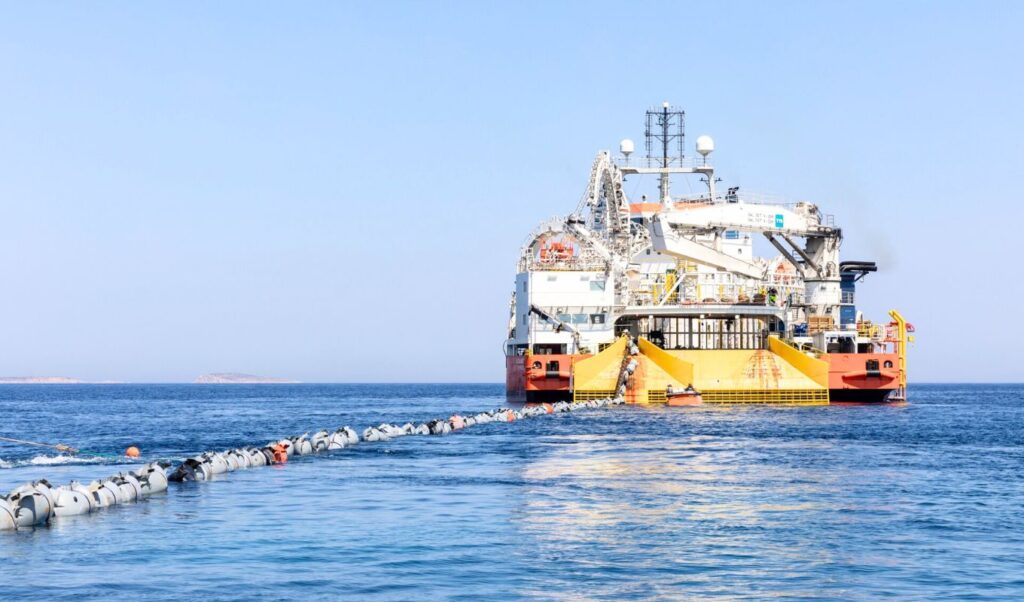
The agreement gives the GSI a strong French identity. Beyond Meridiam, French credentials are also carried by Nexans, which has been contracted to build the cable between Greece and Cyprus under a €1.2 billion contract. The simultaneous presence of both a majority shareholder and a construction contractor from France fundamentally changes the project’s dynamics. It is no coincidence that the agreement matured through high-level contacts between Athens and Paris, with French President Emmanuel Macron offering personal support. Meridiam CEO Thierry Déau noted that the French president is closely monitoring the project’s progress — a detail that makes clear Paris does not view the GSI as a mere business transaction. It is also significant that ADMIE, the GSI under its new shareholder structure, and Nexans have agreed to collaborate on accelerating work, with priority given to completing the seabed surveys.
GSI: The major obstacle of Turkey and the seabed surveys
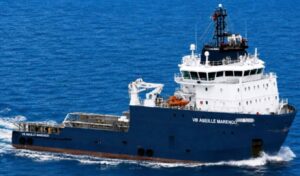
One of the biggest hurdles facing the project’s implementation is the geopolitical challenges surrounding it. It is worth recalling that in the summer of 2024, seabed surveys were halted following Turkish intervention, when Ankara disputed the right of the Italian vessel “Ievoli Relume” to operate in international waters off the island of Kasos without prior coordination with Turkey. With Meridiam and Nexans now part of the project, any future obstruction will no longer concern only Greece and Cyprus — it will directly affect French business interests and a project formally designated by the European Union as infrastructure of common interest. This does not make the elephant in the room — Turkey — disappear, but it significantly raises the political cost of any fresh escalation, as the GSI now carries a stronger European identity and the dispute over the surveys can no longer be framed as purely a Greek-Turkish affair. Turkey’s Hurriyet newspaper noted as much in its English-language edition, reporting that “a French group is entering a contested cable project in the Eastern Mediterranean,” pointedly recalling Ankara’s standing position that part of the cable’s route passes through its continental shelf and that activities such as seabed surveys and cable laying in those areas require its prior consent.
The new balance in the Eastern Mediterranean and Cyprus’s stance
Meridiam’s entry is also reshaping the conversation in Nicosia — a shift that was evident in the first remarks from Cyprus’s Minister of Energy, Commerce and Industry, Michalis Damianos, who expressed satisfaction with the development, describing it as bringing “tremendous new momentum” to efforts to deliver the project and confirming the shared political will of Cyprus and Greece to secure a strong investor. When asked about the Republic of Cyprus’s direct involvement in the GSI, Minister Damianos said the government is awaiting the results of a due diligence study currently being conducted by the European Investment Bank — expected before the end of the year — which will clarify the project’s final cost, before making its decisions.
Published in Apogevmatini tis Kyriakis