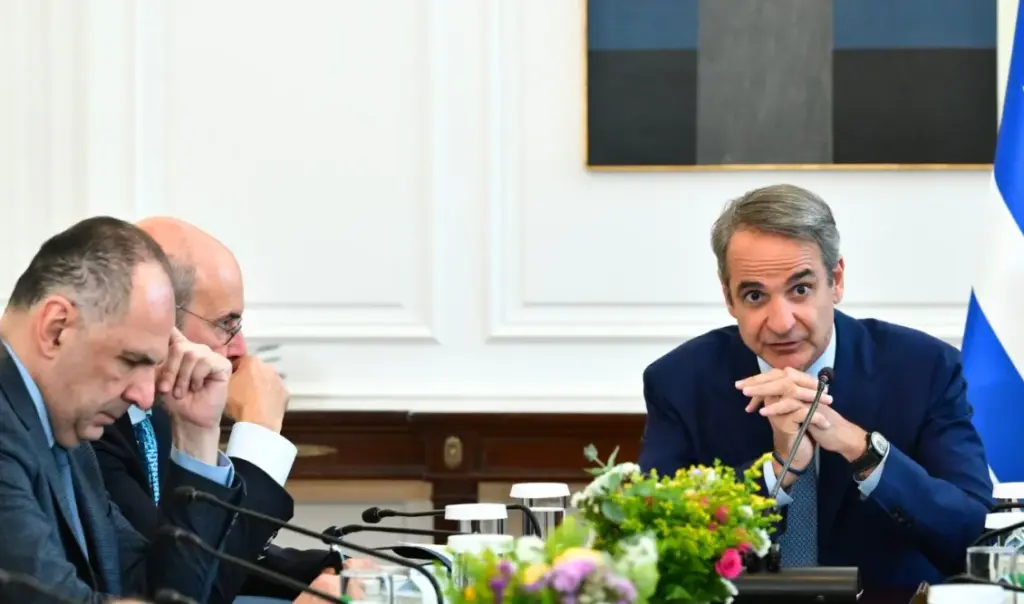
Kyriakos Mitsotakis has called all his advisors and staff to return to their posts on Monday, August 17, following brief summer holidays. However, the government’s legislative work will officially resume on Monday, August 24, with the occupational insurance bill set to be the first piece of legislation put to a plenary vote in parliament, followed immediately by a series of additional bills and initiatives.
Mitsotakis’s message to ministers and MPs: time to accelerate
“You are aware that elections will take place in the spring of 2027. We have sufficient time until then to continue delivering results across all ministries. We will need a longer period so that, first and foremost, all members of the Cabinet — as well as the Parliamentary Group — can be briefed on the full scope of our work, and so that this can be communicated to the public, with strong emphasis on local and regional projects that are now being completed or have already been completed,” the Prime Minister told government members at the close of last Thursday’s Cabinet meeting, signaling both an acceleration of the legislative agenda and a stronger push to showcase the government’s achievements to citizens.
Occupational insurance reform bill heads to parliament first
The Ministry of Labour bill aims to improve the existing occupational insurance framework, making it simpler, more functional, more protective, and more attractive for both workers and businesses. The primary goal of the draft law, proposed by the responsible minister Niki Kerameus, is to strengthen the second pillar of the insurance system — occupational insurance — by establishing a modern and competitive framework for supplementary pension savings.
Public administration overhaul through modernization of the EKDDA
Next in line is the bill for the reorganization and modernization of the National Centre for Public Administration and Local Government (EKDDA), recently introduced by Interior Minister Theodoros Livanos and Deputy Minister Vivi Charalampogiannis. The aim is to create a modern mechanism for systematic and targeted training, tailored to the needs of each civil servant, public service, and ministry. Early in the autumn, Health Minister Adonis Georgiadis will bring to parliament a bill establishing a national governance framework for the safe and controlled secondary use of electronic health data. The bill provides for the creation of an advisory scientific committee and an ethics committee, defines the responsibilities of the Ministry of Health and HYDIKA, and regulates the procedures for licensing, access, processing, and further use of data for public health, research, innovation, and health policy-making purposes.
Based on the revised Unified Government Policy Plan 2026, presented to the Cabinet by Minister of State Akis Skertsos, 73 new actions are being added by the end of the year.
Changes to the electricity market and consumer protection
At the most recent Cabinet meeting, Environment and Energy Minister Stavros Papastauros and Deputy Minister Nikos Tsafos introduced the bill transposing EU Directive 2024/1711 on improving the design of the electricity market, which is also expected to be among the first draft laws brought before parliament for discussion and vote this autumn. The bill addresses two thematic pillars: on one hand, the retail electricity market (consumer rights, fixed-price contracts, energy sharing, protection of vulnerable consumers, supplier of last resort, and supplier risk management), and on the other, the framework for flexible grid connections in congested areas. Two European directives will also be incorporated into Greek law through a bill by Justice Minister Giorgos Floridis: one on the prevention and combating of human trafficking, and another on the protection of the environment through criminal law.
The government opens the debate on nuclear energy
Also of significant interest is the establishment, formation, and operation of a government committee on nuclear energy, which marks a long-term shift in the country’s energy planning. Kyriakos Mitsotakis had previewed the creation of this governmental body several months ago, simultaneously revealing his intention to gradually steer Greece toward a partial use of nuclear energy in the future. “Greece must seriously examine whether small modular reactors (SMRs) can play a role in its energy mix. Some refer to an earlier statement of mine rejecting conventional nuclear reactors — a position I maintain. Small modular reactors represent a different technology, both in terms of safety requirements and investment scale, and I believe this option must be examined. We will form a high-level ministerial committee that will submit specific proposals to the government on this matter,” the Prime Minister wrote in a post.
73 new government actions by the end of 2026
It is worth noting that, based on the revised Unified Government Policy Plan 2026, presented to the Cabinet by Minister of State Akis Skertsos, 73 new actions are being added by the end of the year. These include, among others: the activation of the Property Ownership and Management Registry (MIDA) and the simplification of property transfers, the reorganization of academic education within the Armed Forces, the development and implementation of a national animal protection mechanism for natural disasters, the strengthening of initiatives to improve student performance in the PISA program, and the concession services agreement for Attica Road.
Published in Parapolitika