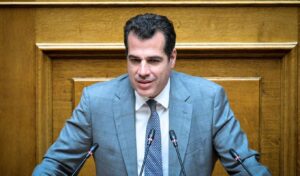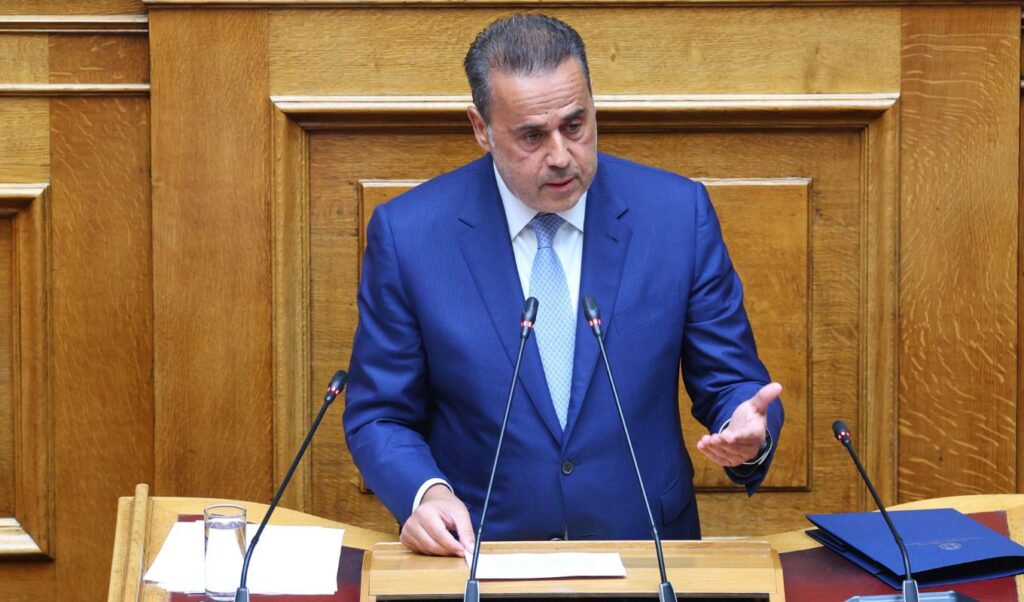
Greece’s Minister of Environment and Energy, Stavros Papastaurou, launched a fierce defense of the government’s landmark water management reform from the floor of Parliament, firing back at critics who oppose the proposed legislation. “Anyone who says no to the reform we are advancing is saying yes to maintaining the old regime, yes to fragmentation, yes to the continuation of poor water resource management,” he declared, addressing the opposition benches directly. The minister acknowledged that while committee sessions and plenary debates revealed one fundamental area of agreement, two significant points of contention remain. According to Papastaurou, all political forces recognize water’s public character and its importance as a strategic national resource — a source of life and an essential prerequisite for citizens’ daily lives, economic development, tourism, and agricultural production. However, he said disagreements center on the scale of the problem and, consequently, the scope of the reform required to address it.
Two opposing approaches
“There are two diametrically opposed approaches. The first holds that the current water management system, despite some dysfunctions and shortcomings, can handle the water scarcity challenge. The second is that this system has already reached its limits,” he said pointedly. Citing data showing that Greece ranks 19th globally in water scarcity risk, and second among the 27 EU member states — behind only Cyprus — in the likelihood of facing water stress, Papastaurou painted a sobering picture of the country’s vulnerability.
Inaction is not an option
“Inaction is not a solution. We cannot continue with understaffed agencies, extreme fragmentation, no technical or financial capacity, no ability to implement large-scale projects, and no access to available European funding,” the minister stressed. Describing the current system as “an architecture of the past,” he argued that Greece urgently needs expertise, digital tools, investment, management capacity, and above all, consolidation of resources. He pointed to concrete examples of failures in municipalities across Halkidiki and Thessaloniki, where prosecutors were forced to intervene after bacteria levels were detected above permissible limits in the water supply. “The harsh reality has come knocking at our door,” he remarked pointedly, linking these incidents directly to deficiencies in water supply and sewage networks.
The minister also highlighted allegations of illegal water extraction in Ilia, and the activities of criminal networks in Messinia that, according to his account, controlled the distribution of irrigation water and extorted farmers — burning their fields when they refused to comply with distributions imposed by local mafias. “Is this the model we are defending? A model with losses of 50% and 60%?” he asked rhetorically. While clarifying that he was not suggesting all 735 water management bodies are performing poorly, he made clear that the overall model can no longer meet the country’s needs.
It is unacceptable for Greece to lose 50% of its water
“We cannot go on losing five or six drops out of every ten. It is unacceptable for a country like ours to lose 50% of its water,” he concluded, framing the debate as a clear choice between meaningful reform and preserving a system that, by his assessment, has already exhausted its capacity to deliver.