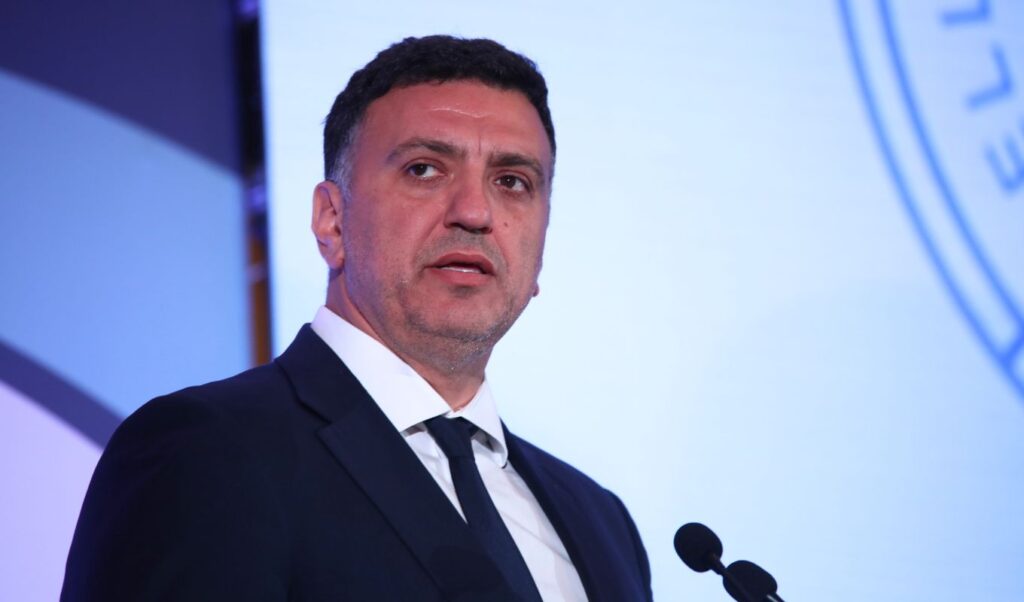
Greek Shipping Minister Vassilis Kikilias has ordered a formal Administrative Inquiry (EDE) into the collision between two vessels that occurred on Tuesday morning (21/07) at Chania’s Souda Bay port. “When it comes to safety, there is absolutely zero tolerance,” the Minister of Shipping and Island Policy declared in a social media post, in which he outlined the steps being taken following the maritime accident.
Vassilis Kikilias’s statement on the Souda Bay maritime accident
In his post, the minister stated: “Regarding the collision between the two vessels at Souda Bay port, I have ordered the Coast Guard Commander to conduct a formal Administrative Inquiry, with the aim of fully investigating the causes of the incident.
At the same time, the Deputy Coast Guard Commander is heading to Chania, a criminal case file is being compiled, and the applicable administrative sanctions will be imposed. When it comes to safety, there is absolutely zero tolerance.”
Για τη σύγκρουση των δύο πλοίων στο λιμάνι της Σούδας, έδωσα εντολή στον Αρχηγό του Λιμενικού Σώματος για τη διενέργεια ΕΔΕ, με στόχο την πλήρη διερεύνηση των αιτιών του συμβάντος.
Παράλληλα, στα Χανιά μεταβαίνει ο Υπαρχηγός του Λ.Σ., σχηματίζεται δικογραφία και θα επιβληθούν…
— Vassilis Kikilias (@Vkikilias) July 21, 2026
How the Souda Bay port ship collision happened
The collision, which is still under investigation, involved the passenger-vehicle ferry ELYROS and the Ro-Ro cargo vessel IOSIF K. Port authorities are investigating the exact circumstances of the maritime accident. It has been confirmed that the impact ruptured water ballast tanks used to regulate the vessel’s weight, while — fortunately — the liquefied gas, fuel, and oxygen tanks remained intact.
The ELYROS, which was carrying 100 passengers, 118 crew members, 32 private vehicles, 74 trucks, and 7 motorcycles, underwent the required damage certification and inspection process by the classification society surveyor. Having received confirmation that it retains its class and is cleared to continue operations, the vessel subsequently departed for the port of Piraeus. As for the IOSIF K., a departure ban was imposed on it, and following a relevant inspection, it was expected to receive clearance to sail on Tuesday evening.
Probable causes of the collision and right-of-way scenarios
The probable causes that led to the collision of the two vessels at Souda Bay port were analyzed by Giorgos Vallis, President of the Panhellenic Union of Private and Professional Yacht Crews. As a reminder, the vessels involved were the ELYROS passenger/vehicle ferry operating on the Souda–Piraeus route, and the Ro-Ro cargo ship IOSIF K. Speaking on Tuesday afternoon, July 21, on MEGA TV, Vallis explained what maneuvers could have been handled differently to prevent the accident, highlighting the critical importance of proper coordination during vessel entry and exit at the port.
“For a ship to be able to leave the port or for a ship to be able to enter the port, there is a person from the port authority on the pier who manages traffic flow correctly — meaning who gets the signal to enter, who gets the signal to leave, who waits, who lowers the ramp, who will cast off, who will moor. In this particular case, I cannot conceive that this person gave the order for one ship to leave and the other to enter simultaneously. We shouldn’t immediately jump to saying ‘it’s the ships’ fault, it’s the captains’ fault.’ Port management is handled via radio by the officer in charge. From the moment you realize a ship is moving backwards — in reverse — it takes a few seconds, especially with vessels this large. In the video we can see they were very close together, so neither one had time to react, nor did the other. But let’s look at where it all started: for the passenger ferry to cast off and leave — to lower the ramp, to untie the mooring lines — it had already received departure clearance from the officer on site. On the other hand, for the Ro-Ro to enter the port, it had also received approval from someone,” he explained.
“Given that one is a passenger ferry and the other is a Ro-Ro, the Ro-Ro should have waited for the passenger ferry to depart, and only once the entrance was clear should it have proceeded. But here we see multiple errors. Normally there are two or three people responsible for supervision, but one is the senior officer — the safety officer with the highest rank — who gives the orders and regulates traffic. (…) It is one person who decides who enters and who exits.” Finally, when asked whether the captains could have done anything to avoid the collision, Giorgos Vallis noted: “They could only have done something at the last moment if they had noticed what we can see in the video. What we see, however, is the Ro-Ro and the passenger ferry approaching at speed without either reducing speed — they were confident nothing was happening, they had received their instructions, so everything seemed fine.”