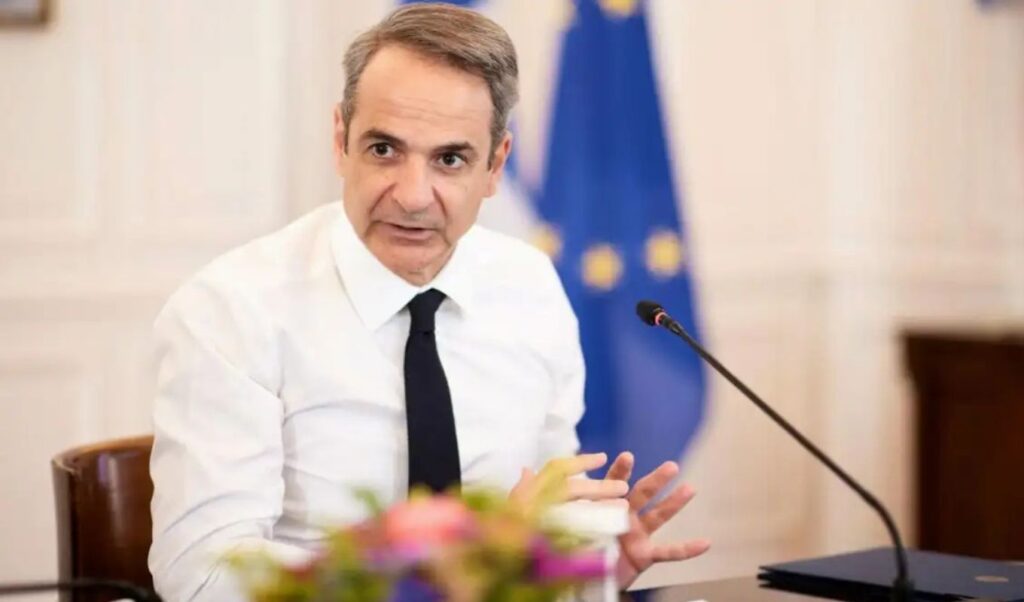
In his regular Sunday review, Prime Minister Kyriakos Mitsotakis addresses cultural heritage monument restoration projects, the new price comparison platform PosoKanei, housing initiatives, public service evaluation, wildfire prevention, and international developments in the Middle East.
The Prime Minister makes special mention of the new PosoKanei platform, emphasizing that it “is here to stay,” while arguing that greater market transparency and better consumer information can help tackle the high cost of living. He also presents the new “Home Renovation” initiative, which provides subsidies of up to €36,000 for renovating vacant or aging properties, aimed at boosting housing supply and addressing the housing crisis. He additionally highlights the urgent need to clear private plots ahead of the peak wildfire season, as well as international developments in the Middle East following the framework agreement between the US and Iran, which he describes as a significant step toward de-escalating regional tensions.
Kyriakos Mitsotakis’ weekly review in full
If I had to single out one image from the past week — one that filled me with deep pride — it is undoubtedly the image from the Acropolis. After approximately 220 years, the western façade of the Parthenon has once again taken on its most complete possible form. The scaffolding has been removed, and we can now admire this architectural wonder unobstructed, with the restoration of the western pediment complete. This is an achievement of historic significance for the monument and for world civilization. An extraordinarily challenging project brought to life by the scientists, engineers, and craftspeople of the Acropolis Monument Conservation Service. They worked with exemplary precision and dedication, and they deserve a heartfelt round of applause from all of us.
For our government, the protection and promotion of cultural heritage is not a secondary policy — it is a continuous national obligation. That is why the image from the Acropolis is perhaps the most iconic, but it is not the only one. On Symi, the restored bell tower of Saint John the Baptist was handed over; on Rhodes, major interventions were completed at three monuments in the Medieval City; and on Halki, a new Archaeological Museum was established alongside the restoration of the Panagia Choriani church. Large or small, all of these projects — funded by the Recovery Fund — reflect a consistent choice we have made: to invest in culture not only as part of our identity, but as a precious legacy for future generations.
From culture, I move on to a completely different topic. This week we unveiled the new platform posokanei.gov.gr. One observation from the outset: a platform is not going to solve the problem of high prices. If it were that simple, we would have solved it long ago. I do believe, however, that greater market transparency, better consumer information, and more effective controls across the entire supply chain — from farm to shelf — can serve as useful tools in our battle for better prices. PosoKanei does not attempt to shift the responsibility for oversight onto consumers. On the contrary, it helps both the government and the public to exercise more effective control over the market. Download the app, try out its features, and you will see that it can make us more demanding and informed consumers, while making businesses more competitive. As for those who question it as a tool for transparency and competition — whether from the opposition or from within the market — they had better get used to it, because PosoKanei is here to stay and will improve week by week. It represents the evolution of e-katanalotis, featuring more than 8,000 products available for comparison, richer data, and the ability to track price trends over time and compare them with equivalent products in other European countries. The high cost of living remains one of the greatest challenges for households, and there are no easy or magic solutions. There is only continuous effort, on many fronts simultaneously.
From the cost of living, I now turn to another major challenge: housing. The new “Home Renovation” initiative is now being added to the programs already underway to address the problem. Very briefly, this program provides strong incentives for renovating vacant or aging properties so that they can either be used as the owner’s primary residence or made available for long-term rental. At the same time, the option to renovate properties already in use as primary residences is also available. Why is this new initiative important? Because it addresses the problem of thousands of closed, dormant properties — in other words, the limited supply of housing. And because it represents a pilot program across Europe, one that Greece was the first to propose and implement with EU funding. The subsidy can reach up to €36,000 or 95% of the cost of the works for low- and middle-income households. It is estimated that through this initiative, up to 20,000 currently dormant properties could return to the market. Interest is already particularly high, with more than 6,700 eligibility certificates issued through anakainisi.apps.gov.gr.
I promise this is the last platform I will mention today. But it matters, as it concerns the evaluation of public services and how we can improve them. The second round of evaluation has begun through axiologisi.ypes.gov.gr. I should note that the first evaluation process, in which approximately 65,000 citizens participated, produced useful findings about services that needed reform. A prime example is urban planning offices, which were rated negatively by citizens and are now at the center of a major reform through their integration into the new digital Land Registry. I would therefore like to encourage as many citizens as possible to take part. Your opinion counts and, most importantly, it makes a difference.
On the labor front, yet another collective labor agreement was signed this week — this time for food technologists and food scientists. It is the first agreement in the sector in 15 years, with increases in wages and additional benefits for workers. I want to dwell on this point, as Greece’s efforts to strengthen collective agreements are now being discussed at the European level. A few days ago, I had the opportunity to present in Brussels the National Social Agreement we signed with social partners, which is attracting considerable interest: an agreement signed at the initiative of a center-right government has already led to the expansion of collective agreements, covering more than 15% of the country’s workforce with wage increases and additional protections within just a few months.
Let me now turn to the very important issue of wildfire prevention, which demands the constant attention of all of us. We are now entering the most demanding phase of the fire season, and conditions are favorable for both the outbreak and the rapid spread of wildfires. Since May 1st, 803 wildfires have been recorded across the country, and thankfully all were dealt with immediately without causing major damage. I want to place particular emphasis on the clearing of private plots. It has been proven in practice, time and again, that this can prevent a fire from breaking out or significantly limit its spread. From Tuesday, municipalities will begin inspections and enforcement of the relevant penalties. I therefore urge those who have not yet done so to act now. It has been shown that properties which faced fire risks in previous years were ultimately saved because their owners had carried out exactly these clearing measures. Prevention is always preferable to dealing with a disaster, and clearing private plots is perhaps the simplest yet most effective prevention measure at our disposal.
Preparation for natural disasters has yet another important dimension: the care of animals at risk from wildfires and other extreme weather events. This is why the National Animal Protection Mechanism we established is particularly significant. What began a few years ago through the collaboration of the state, volunteers, and animal welfare organizations has now taken on an organized and permanent form, coordinating rescue and care operations for animals in natural disaster situations. I had the opportunity to visit the new animal shelter and care facility in the Municipality of Galatsi, where excellent work is being done. I hope these facilities will never need to be used to the extent they have been designed for — but it is important that they now exist.
I have saved international matters for last.
I will naturally begin with the framework agreement signed by the United States and Iran on Friday in Switzerland, which encourages the continuation of dialogue and diplomatic efforts toward a definitive agreement to end the conflict in the Persian Gulf. Greece welcomes this agreement and, as a member of the EU, can contribute to the promotion of a comprehensive strategy for lasting peace across the entire Middle East. Of immediate urgency is the restoration — without restrictions — of freedom of navigation through the Strait of Hormuz, as the smooth flow of the region’s energy supplies is of paramount importance for both regional stability and the global economy. Already, simply with the announcement of the framework agreement, international oil prices fell by 20%, which means that achieving a final and enforceable agreement will serve as a catalyst for reducing energy costs and easing the inflationary pressures that have taken a heavy toll on European economies and households.
This significant development comes at a time when Greece’s position as a reliable energy partner in the Eastern Mediterranean is being elevated. Our country is participating, alongside the US, Cyprus, and Israel, in the creation of the Eastern Mediterranean Energy Center — an initiative aimed at strengthening energy security, developing new infrastructure, and attracting investment to the region. At the same time, procedures for Chevron’s entry into a new exploration project off the Kyparissiakos Gulf have been completed. As I have said before, the presence of one of the world’s largest energy companies represents yet another vote of confidence in our country’s prospects and in the strategy we are pursuing to harness our energy potential.
One more significant development — and with this I close — is Greece’s official accession to the European defence funding instrument SAFE, securing €700 million for investments in critical defence capabilities, such as strategic surveillance, secure communications, and counter-drone technologies. I consider this development particularly important, because for the first time Europe is taking such a substantial step toward joint defence funding, and our country is at the forefront of this effort. In an era of geopolitical turbulence, security is neither a theoretical concept nor a given. It is a prerequisite for stability, growth, and national confidence. And for this reason, we must make use of every opportunity that strengthens our country’s position.
I will close with a more personal reflection on today’s World Father’s Day. Of all the roles I hold in life, that of father is one of the most important and most defining. And as a father — and as a son — I know well how profound that impression is. It is a role full of responsibility, but also the greatest joy: to be there, a source of support in both good times and hard times, and to watch your children grow and forge their own path. Happy Father’s Day to all the dads out there.
Have a wonderful day!