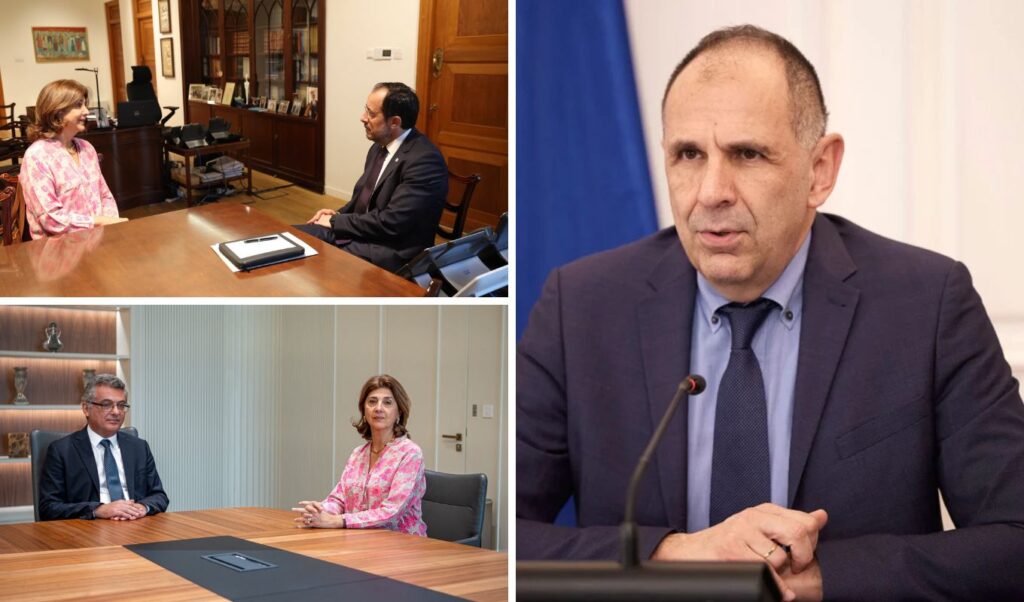
The personal envoy of UN Secretary-General António Guterres for the Cyprus issue, María Ángela Holguín, is in Athens for meetings with Foreign Minister Giorgos Gerapetritis, as reunification efforts resume following the end of the Cypriot Republic’s EU Presidency.
Holguín arrives in Athens directly from Turkey, where she met with Foreign Minister Hakan Fidan. One day after that meeting, Turkish President Recep Tayyip Erdoğan held a phone call with the UN Secretary-General to discuss the latest developments regarding Cyprus, though no further details were made public. Fidan once again reiterated Ankara’s position in favor of a two-state solution on the island, stating that “the most realistic solution to the issue is the coexistence of two states on the island. Approaches that do not recognize the sovereign equality and equal international status of the Turkish Cypriot people will not yield results.”
This stance drew a sharp response from Cypriot President Nikos Christodoulides, who reaffirmed the longstanding Greek Cypriot position: a resolution based on a Bizonal Bicommunal Federation with political equality, in accordance with the UN Charter and relevant resolutions — firmly rejecting any approaches that fall outside the agreed UN framework.
The Cyprus issue also dominated a meeting held six days ago in Sofia between the Greek and Turkish foreign ministers, as a new round of consultations with UN envoy Holguín got underway, exploring conditions for the next informal expanded conference. António Guterres is actively working toward convening a 5+1 expanded meeting before the end of his term, hoping it could produce meaningful progress toward a Cyprus settlement.
However, Turkey’s increasingly aggressive rhetoric toward the Republic of Cyprus — and toward the strategic alliances Cyprus has forged with both Israel and France — is directly impacting the reunification process.
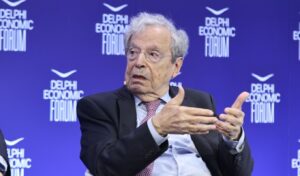
Ioakeimidis speaks to parapolitika.gr: “Any creative effort to resolve the Cyprus issue is almost impossible right now”
Professor Emeritus of European Studies Panagiotis Ioakeimidis, speaking exclusively to parapolitika.gr, views the prospect of any meaningful progress on Cyprus as extremely difficult under current circumstances. “Although the Cyprus issue is a distinct parameter and Cyprus is a separate state, the climate that has been created — both regarding Cyprus and between Greece and Turkey — makes any creative effort toward resolving the Cyprus issue almost impossible,” he said.
According to Ioakeimidis, the European Union could potentially play a role in the Cyprus issue, given that it has linked a resolution to progress in EU-Turkey relations. Indeed, there has been close cooperation recently between António Guterres and European Council President António Costa, a direction also pursued by President Christodoulides, who is currently in Brussels holding meetings aimed at restarting the talks.
Meanwhile, just yesterday, Turkish Cypriot leader Tufan Erhürman — marking 200 days in office — voiced his full support for President Erdoğan’s recent statements on the Eastern Mediterranean and Cyprus, declaring that “no initiative aimed at excluding the Turkish Cypriot people and the Republic of Turkey from issues such as security, energy, and maritime jurisdiction zones can succeed.” He stressed that coordination with Ankara on the Cyprus issue remains firm, while reiterating the Turkish Cypriot side’s commitment to a negotiated settlement.
Talks are nonetheless set to continue, as UN envoy María Ángela Holguín is expected to travel to Cyprus after Athens for a new round of contacts. It is worth recalling that the most recent significant round of negotiations took place in Switzerland in 2017, under the auspices of the guarantor powers — Turkey, Greece, and the United Kingdom — and ended without an agreement.